Showing posts with label STEAM. Show all posts

Wednesday, August 27, 2025

Kitchen Science ~ Spin Art!

 Our library's Summer Reading theme was "color your world" and one of the activities that kids could do was create spin art. It's fun and all you need are a few things: some cardstock, washable tempera paint, and a salad spinner (NOT the one you use to spin your lettuce!)
 
 Put your cardstock in the basket inside the spinner and squirt some tempera paint on it. You might have to experiment to get it thin enough to move when the spinner spins. 
 
 
Then start the spinner. I discovered that I had to keep pumping the thing to get the paint to push out to the sides (the effect of centrifugal force)
 
You may want to add more drips and drabs of paint to fill in a few blank spaces...


... and then finish off with a white or silver gel pen! Have fun! Oh, and if your salad spinner has holes on the bottom of the outer plastic bowl, make sure to cover your table with a piece of plastic so you don't get paint all over it. Or just do it outside on an old stump.
 

Friday, March 21, 2025

Oh my Crikeys! It’s tadpole season

 
We Are the Wibbly! 
by Sarah Tagholm; illus. by Jane McGuinness
32 pages; ages 2-6
‎Bloomsbury Children’s Books, 2025 

theme:  frogs, life cycles, nature

We are eggs. We are egg friends. We are the Wibbly.

I love frogs. Maybe not quite as much as I love bugs (which frogs eat – but that’s another matter altogether), but still, when I saw the title of this book I absolutely knew I had to read it! 

Fortunately, you can read it too, as it released earlier this week. 

Subtitled “A Tadpole’s Tail” this book is all about the frog lifecycle. It’s basic biology at its most humorous, as we follow along with our narrator who begins their story as one of the many eggs in a mass of frog eggs. Or, as they call it, “the Wibbly.” And it’s a nice life until things start happening: they get tails. They learn to swim – faster when there’s a “hunger-muncher” following them. They sprout hind legs. Front legs. Finally – in the nick of time – they achieve frogdom! 

This book is also about more than biology. What happens when you’re the last one to develop a tail? What happens when you are perfectly fine being just who you are and a leg unexpectedly sprouts from your torso?


What I like love about this book: I love the way Sarah Tagholm invites readers into the world of the Wibbly. She helps us see tadpole development from the tadpole’s point of view – their egg friends have gone “longish.” Then they … “Oh My Crikeys!” … burst out of the wibbly and begin “water-flying.”

I love the language. I have now incorporated “oh my crikeys!” into my basket of useful phrases for when unexpected – er, Stuff – hits the fan. I love the back matter, where the “true” story of the frog life cycle is presented. And I love Jane McGuinness’s illustrations created with a combo of mixed media, inks, and photoshop. She gets the perfect expressions on the frog faces when they discover their hands! Sorta reminds me of my granddaughter when she discovered her hands…

If I rated books, I'd give this one 5 lily pads!

Beyond the Books:

Listen for frogs and toads calling. Go outside in the afternoon on warmer days to a pond or wetland area. Find a comfy place to sit or stand and just listen. How many kinds of frogs can you hear? These recordings can help you learn a few of the calls.

Create your own wibbly. Gather some friends and find a space big enough for some jumping. Then start by crouching down like eggs in a mass, all snug together. When you’re ready to be a tadpole, lay on your tummy and wiggle. To begin turning into a frog, your hind legs grow out – so “fast swim” (or run) a few paces. When your front legs grow, you’re a real frog. Hop, frog, hop!

Brainstorm your own words or phrases to say when something surprising and unexpected happens. Here are a few words to get you started: yikes! Gee whiz! Holy smokes! Please share yours in the comments.

Today we’re joining Perfect Picture Book Friday. It’s a wonderful gathering where bloggers share great picture books at Susanna Leonard Hill's website. Review copy provided by publisher. 

Friday, March 14, 2025

More than Mushrooms: an author interview!

 Just a quick reminder that it's Pi Day (3.14) - and that Pie are round; cake are square. Now on to the wonderful book for today!

Fungi Are... More Than Mushrooms
by Alisha Gabriel; illus. by Vivien Sárkány 
36 pages; ages 4-8
Tielmour Press, 2025 

theme: nature, observation, fungi

Fungi are travelers.

Most people, when they think about fungi, think about the mushrooms on their pizza, or popping up in their lawn after a week of rain. But fungi are so much more. They recycle nutrients. They come in an amazing assortment of colors and shapes and sizes. And they don’t stay in one place! Sure, you’re not going to see a mushroom uproot itself and saunter over to the woodpile – but they do send their spores out into the world. And their hyphae are always spreading, spreading, spreading under our feet. In fact, its those hyphae that help hold the world together, author Alisha Gabriel points out.

What I like about this book: I like the structure: a main point followed by three specific examples. I like the layered text: simple concepts in large font with explanatory text below the illustrations. I like the soft feel to the illustrations. And I really like that there are a bunch of non-fungi things included in the illustrations – and a scavenger hunt-type list at the back challenging readers to find those items.

Full disclosure: Alisha and I co-authored a book for middle-grade readers called Funky Fungi: 30 Activities for Exploring Molds, Mushrooms, Lichens, and More (Chicago Review Press, 2022), and we are critique partners, so I’ve watched her new book grow from spore to fruiting body. 

Still, I had a few questions

Me: What inspired this book?

Alisha: Do you remember the first walk we took when we met at Highlights? I must have stopped a dozen times to take photos of mushrooms. Even way back then, I knew I wanted to write a picture book about fungi. 

Me: Yeah – that was back in 2013 maybe? I remember some very cool fungi.

Alisha: Then almost a dozen years passed before you and I co-authored the award-winning Funky Fungi: 30 Activities for Exploring Molds, Mushrooms, Lichens, and More. When that book came out, I started giving presentations at schools, libraries, museums, and festivals. The age of my audience varied from 2 to 92, but Funky Fungi is aimed at middle grade readers. As I adjusted my presentation on the fly, I explored ways to share the information with a younger audience. I realized that I still wanted to write a picture book about fungi. Since there were already several beautiful picture books about fungi available, I knew that it would require a unique approach to capture an agent or editor’s attention. 

Me: How did you come to the structure and categories? (fungi are travelers, fungi are homes…)

Alisha: In late May and early June 2023, I jotted some notes in my journal about writing an expository picture book about fungi. I also read many, many books on a variety of topics, keeping a close eye on structure. Some of my journal entries from this time frame included whole sentences, but there were lists and lists of words. Nouns. Adjectives. Synonyms. There were late night scrawls that meandered diagonally across the page. One that stood out was, “Fungi become homes to animals and insects. They soften, cradle, and protect.” 

After exploring and contemplating different directions the text might take, I came back to that snippet. With a bit of tweaking, it became Fungi are homes. They soften, cradle, and protect. I had landed on my first layer text structure; a statement and three specific examples. The second layer would become a short explanation with a specific type of fungi. The writing went incredibly fast, from idea to final draft in one month. That was unusual for me, but I had been immersed in fungi research since 2020, so perhaps these ideas had been marinating and were ready to come together.

Me: I think letting ideas marinate helps them become more robust. Now that your book is out (well, as of tomorrow) what do you hope kids (and maybe adults) take away from reading it?

Alisha: I hope they understand that fungi are an incredibly important part of our world. Mushrooms have been popping up on everything from clothing, art, and interior design for a few years now, and it’s exciting that they’re having a renaissance in our culture. However, there’s more to fungi than the mushrooms we see, and I hope people will also continue learning about the less noticeable fungal relatives. 

Me: You’re published with Tielmour Press, in Canada. Can you share a bit about working with them? 

Alisha: It has been a wonderful experience working with Tielmour Press! They’re still a fairly new publisher, but have several books in the pipeline. Although some people might hold out for an offer from a BIG 5 publisher, there are certainly advantages to working with smaller companies. Everyone at Tielmour Press replies to emails quickly, each book receives individualized attention, and the company has a strong environmental vision. 

Me: The illustrations are so soft and inviting. Did you get to meet Vivien Sárkány ?

Alisha: Yes, her work is amazing! We’ve never spoken, but she did a remarkable job bringing the book to life. It was important to me that the fungi in the book resemble the real thing, and if the text mentioned a type of fungi, that it should be used on the page. She did this, and much, much more! I’d love to work with her again. Her signature style is gorgeous.

Me: I know you have another book under contract, and I can’t wait to see it. 

Alisha: I do have another nonfiction picture book under contract, but it hasn’t been announced yet. I can’t give specifics, but I can say that it’s nature-themed, on a completely different topic, and also uses a layered, expository style. Thank you so much for inviting me over to your blog to talk about Fungi are… More Than Mushrooms! 

You can find out more about Alisha and her books at her website alishagabriel.com

Beyond the Books:

Use mushrooms to make stamp art. Here’s how.

Yeast makes bread rise, but can it blow up a balloon? Try this easy experiment – you could experiment with recycling empty water bottles instead of the squeeze bottles. I remember doing this one waaay back in elementary school. Here's how.

Another fun yeast experiment is to make elephant toothpaste. You’ll need 1/2 cup hydrogen peroxide, yeast, a recycled water bottle, and a drop of dish soap. Here’s how.

Today we’re joining Perfect Picture Book Friday. It’s a wonderful gathering where bloggers share great picture books at Susanna Leonard Hill's website. Review copy provided by the author.

Friday, October 25, 2024

Look Up - Stars Are Falling!

 The annual Orionids meteor shower has been happening this week, and is predicted to peak this weekend. Just how many meteors are we talking about? According to the Washington Post, meteorologists are expecting about 23 meteors to shoot across the sky every hour. I can't think of a better time to check out this book!

The Meteor Shower: Kaleidoscope Club  
by Marie Mazas; illus by Joëlle Passeron 
128 pages; ages 7-10
‎Blue Dot Kids Press, 2024

This is book two in this fun, STEAM adventure series and Nour and August, best friends and tree-house engineers, are at it again. This time they are drawing up plans to build something cool for watching the meteor shower. But first, they need to convince the Mayor to turn off the lights so they can have a dark-sky night. There’s already a law on the books that requires public lighting – street lights, public buildings, monuments – to be off between 1 and 7 am in an effort to reduce energy consumption. But nobody is enforcing the law, and the Mayor isn’t interested in pushing the issue.

So Nour and August engage in a flyer campaign: Keep the Stars Bright! Turn off Your Lights! This is a bold initiative for August, who is afraid of the dark. 

Just as the community seems to rally around the Dark Night idea, a fair moves into town. People have been waiting for the carnival rides and the games for a whole year – but the carnival lights threaten Nour and August’s efforts for stargazing. And an unlikely friendship threatens the Kaleidoscope Club.


What I like about the book is that it focuses on problem-solving and includes lots of STEM stuff: 
  • designing and building a model space capsule using recycled materials (engineering, art);
  • migration and light pollution (biology, conservation science);
  • meteors and constellations (astronomy); and
  • kitchen chemistry
I also like the back matter, which discusses in more depth how light pollution disrupts animal ecosystems, wastes energy, and even affects human health. And there’s a list of “what you can do” about it.

Thanks for dropping by today – and remember to watch for the meteor shower this weekend!. On Monday we'll be hanging out at Marvelous Middle Grade Monday with other  bloggers. It's over at Greg Pattridge's blog, Always in the Middle, so hop over to see what other people are reading. Review copy provided by the publisher.


Friday, June 21, 2024

Celebrating Pollinators of the Gitxan Nation

When I talk about the bees and wasps and butterflies and beetles that pollinate the flowers in my garden and the surrounding meadows, I do so through a lens of western science. But that is only one way of observing the world we live in. So I was very happy to get this book in the mail a few weeks ago, as it reminded me that there are many ways to view the world around us.

The Bee Mother (series: Mothers of Xsan)
By Hetxw’ms Gyetxw (Brett D. Huson); illus. by Natasha Donovan
32 pages; ages 9-12
HighWater Press, 2024

It’s spring and bumble bee, yellowjacket, and honey bee are finding new homes. Bumble bee (Nox Ap) and yellow jacket because the newly emerged queens must start a new colony. Honey bee because her swarm has left an overcrowded hive.

So begins Hetxw’ms Gyetxw/Brett's picture book about these three different pollinators. Through the lens of Indigenous knowledge carrier, he shows the life cycles of these pollinators through the seasons. He also shows their role in the ecosystem and their connection with humans – sometimes as helper and sometimes (as when the wasps want bits of smoked salmon) as uninvited guests and downright annoying at times.

What I like about this book: I like the way the author integrates his language into the text, from the name of bumble bee to the names of the moons over the changing seasons. These names are explained within the main text. He uses text boxes to highlight facts and define words, such as “worker bees” or “pollinators.” A layer through the book shows how the Gitxan people live through the seasons in harmony with the bees.

There is also back matter: a brief introduction to the Gitxan Nation in the Northwest interior of British Columbia, Canada – and a map of the rivers. Brett also includes a list of the moons through the year, from Stories and Feasting Moon to Getting-used-to-cold moon.

The Bee Mother is the seventh book of the Mothers of Xsan series. Other books include The Raven Mother, The Frog Mother, and The Wolf Mother.  You can find out more about the author and his books at his website, https://thegitxsan.ca/

Thanks for dropping by today. On Monday we'll be hanging out at Marvelous Middle Grade Monday with other  bloggers. It's over at Greg Pattridge's blog, Always in the Middle, so hop over to see what other people are reading. Review copy provided by Deborah Sloan and Company.


Friday, July 14, 2023

Books for the Beach, Backyard or ....

 When folks ask, “hey, would you like to review this book?” very often I answer Yes without taking into account the books Already Piling Up in my book basket. So this week I’m sharing three books I think would be fun to take on a road trip, or just to the park to read with kids – or to enjoy for yourself while drinking something cool and refreshing as you rock in a hammock slung between two shady oak trees. Because, really, who doesn’t love reading a fun picture book now and then?

It just so happens that all three were published by Charlesbridge this year.
Theme: Fossils, Math, STEAM

Here We Go Digging for Dinosaur Bones 
by Susan Lendroth; illus. by Bob Kolar
(Board book)

Here we go digging for dinosaur bones, dinosaur bones, dinosaur bones….

In this book, young paleontologists will join scientists as they head out on a fossil dig – and you might find yourself singing along to the tune of “Here We Go ‘Round the Mulberry Bush.” Short sidebars on each spread tell more about fossils and the scientists who find them. And at the back there’s suggestions for acting out the song – great for getting kids moving after reading the book. 

Susan Lendroth and Bob Kolar teamed up on an earlier book, Hey-Ho, to Mars We'll Go! which I discuss over at the GROG. I love their light-hearted way of making science fun and accessible. 

Lia & Luis: Puzzled! (Storytelling Math) 
by Ana Crespo; illus. by Giovana Medeiros
32 pages; ages 3-6 

Lia and Luis receive a package from their grandma. Inside there’s a puzzle … with a secret message.

I am a sucker for secret messages – I mean, who among us has never sent a note in code? But this secret message is the sort of puzzle that must be solved by putting the pieces together. As with any spy novel – or mystery show – there is a time crunch. The twins are trying to put puzzle pieces together while their mom is trying to get them dressed and ready to leave. 

What clues are in the puzzle? Why is mom in such a hurry? And what’s the best way to do a puzzle anyway: corners or edges? Colors or design? What I love about this book (and others in the series) is that there are activities at the back to explore the math concepts – in this case, geometry and sorting. And what I like about this book in particular is the inclusion of Brazilian Portuguese words. Want more Storytelling Math? Check out this post over at the GROG.

Wombat 
by Philip Bunting 
40 pages; ages 2-5 

Wombat. Twobats. Threebats. Morebats.

From youngbats to oldbats, no bat is left out of this silly love story. It is a fun way to play with words, with rhymes (stinkbats and winkbats) and opposites (roundbats and squarebats) and even some compare and contrast (fruitbat and cricketbat). 

This book would be great to pair with Wombat, by Christopher Cheng or Abi Cushman’s not-so-serious guide: Wombats Are Pretty Weird.


Beyond the Books:

Dig for Dinosaurs. Bury some plastic dinosaurs in a sandbox or part of the beach and let kids dig them up while singing “this is the way we excavate, excavate, excavate ….”

Make your own message puzzle. Glue a drawing or photo onto a sheet of cardstock. Once it’s dry, write a message on the back side. Then cut it into puzzle pieces and put it into an envelope, and give it to a friend. You can also do this with extra-large postcards.

Play with animal words and see where they take you. For example, bluebird might lead to truebird or redbird or …. And what about bigfoot (which may or may not be a real animal?) or meercat? 

We’ll join Perfect Picture Book Friday once they resume. It’s a wonderful gathering where bloggers share great picture books at Susanna Leonard Hill's website. Review copies provided by the publisher.

Friday, November 18, 2022

Info-Graph Your Thanksgiving Meal!

If you want to keep track of how the seasons change, your favorite lunches, or keep track of all the food you eat at Thanksgiving (and even the time it takes to make it), all you need is a pencil and a scrap of paper. 

But if you want to impress your neighbor with the numbers, you might need a bit more – a way to share your information so people can understand it in a glance. And that way is through infographics ~ a combination of math, art, and communication. To explain your Thanksgiving meal you might want to use a time line to show how long it took to prepare the food. And you’ll definitely need a pie graph to compare the kinds of pies you ate!

Here are two books that show and tell how to make infographics. They might even inspire kids to keep track of the interesting (and even mundane) things in their lives.


Life Log: Track Your Life with Infographic Activities Diary 
by Lea Redmond; illus. by Andrea Tsurumi
96 pages; ages 8-12
Chronicle Books, 2022 

Life Log is a guided workbook for infographic exploration. It opens with an introduction to the basics: what infographics is, how a key works, and the lowdown on facts and data. There are pie charts, rainbow charts, timelines, and lots of great questions. All the book asks is for curious kids to bring a bunch of colored pencils and a willingness to visualize information in a new way. 


My favorites: tracking a tree, how long a pencil lasts, and a month of insect encounters. This book is a great way to jump into creating graphs and charts.

Or you could keep track of how regularly you "ate the rainbow" of vegetables and fruits suggested in daily servings.


Show and Tell! Great Graphs and Smart Charts: An Introduction to Infographics 
by Stuart J. Murphy; illus. by Teresa Bellón    
48 pages; ages 7-10
‎Charlesbridge, 2022  

Bar graphs, line graphs, pictographs, and pie charts can show a lot of information in a single glance. But which do you use, and when? Let’s say you want to find out more about lunchroom food. If you want to know what meals kids like the most, you could conduct a survey and display the results in a bar graph. If you wanted to compare the number of entrees served during a lunch period, you might draw a pie graph. (yes, you can create pie alamode graphs if you really want to) This book serves well as an introduction to charts and graphs, and ends with a list of things kids can use infographic techniques to explore.


Thanks for dropping by today. On Monday we'll be hanging out at Marvelous Middle Grade Monday with other  bloggers. It's over at Greg Pattridge's blog, Always in the Middle, so hop over to see what other people are reading. Review copies provided by the publishers.


Monday, November 14, 2022

Doing Our Illustrator Homework ~ by Jacob Souva

I’ve learned a lot over the past five years while focusing solely on illustrating picture books. I still feel like a “newbie” when I open a manuscript, tasked with adding my art to someone’s hard earned text: Where do I start? How do I get ideas? What does that thing or character look like? Am I really getting paid to illustrate poop?


Every book is different, but there are some common threads. No matter the style in which an illustrator works or freedom afforded by the art director, the story is set someplace with rules that apply to that world. The closer the world sits to reality, the more research an illustrator must do into that world. We owe that to our young audience. It’s important that we do our illustrator homework.

In the past two years I’ve had the opportunity to illustrate two books in a series that straddle the fiction/non-fiction line. The books are about real things in nature (the stuff of non-fiction) presented by a talking bug narrator (the stuff of fiction). In the books Butterflies Are Pretty… Gross! and it’s sibling Flowers Are Pretty… Weird! (written by Rosemary Mosco, published by Tundra Books), I knew that the easy part would be the narrator. I’m good at characters and have exercised the creative fiction side of my career my whole life. A spunky bumble bee waxing on about flowers tumbled out of my imagination rather easily.

What I didn’t know was what an Alcon Blue Butterfly caterpillar looked like or why a particular orchid was named “Monkey Orchid.”

It might seem obvious (and it is!) but a folder full of research and visual material is an absolute must for getting these details right. I’ve collected reference material several different ways, but always begin by using search engines to find images. I store them either in a hidden Pinterest collection or a folder on my hard drive, labeled carefully (important for recall). There are times when I’ll need to reach back out to the art director or editor about a specific detail. I also find myself reading papers or articles when the photo reference doesn’t give me enough to work with.

Details matter! I’ve been asked about the colorings of certain butterflies by feisty second graders. Parents reading these books to their kids might be experts in the field and will be great ambassadors for a book that gets the details right.   

I’ve just wrapped up the art for a book called Max And Ed Bike To Nome (by Matthew Lasley, releasing April 4, 2023 by West Margin Press). It’s based on the real-life bike ride of Ed Jesson during the Klondike Gold Rush in Alaska. I was super thankful to find photographic reference material from the 1890s! The State of Alaska has an amazing collection of old photos to dig through. The final art is built upon the visual information I was able to comb.

Lastly, reference is the greatest starting point for creativity. I’ve found that this is where the fun and magic of illustrating resides. A good base level of visual information is a great foundation to jump off and get creative with. As famous jazz improviser Charles Mingus said “You can’t improvise on nothing, man; you’ve gotta improvise on something.”  

 Jacob Souva is an illustrator/author of picture books. You can find out more about him and his books at his website, www.twofishillustration.com. I met him a few years ago, and reviewed his fun book about panning for gold, Pedro's Pan.

Monday, September 12, 2022

Haiku to the Rescue ~ by Kathy Halsey


Cosmic cliffs. Star birth.
Our past mysteries come alive.
Stellar nurseries.

I am thrilled to be guest blogger on author-friend Sue Heavenrich’s Archimedes Notebook today. Sue and I met at the WOW Nonfiction Retreat in the Georgia mountains 7+ years ago and blog together with other children’s writers on the GROG blog

I love writing nonfiction and informational fiction. The natural world is a muse that relaxes me and feeds my curiosity. A writing format that makes nature observation even more detailed and distilled is the seemingly simple haiku. I discovered haiku early in high school; Bashō and Issa were my favorites. 

Last August, after I received a professional critique that made me feel like I couldn’t write my way out of a paper bag, I stopped writing. Haiku came to my rescue. I sat on the back deck with my journal, sketched, and wrote. This simple joy soothed me. 


It's Just Stones!

Making something new
from ordinary unseen
elements is ART.

This year I began to take my haiku, photos, and photos of friends to Twitter weekly. I enjoy participating in #HaikuSaturday, created by Susan (Morhar) Andrews (@AndrewsSusanM).  As Susan says, “There aren't any rules-- just friends sharing haiku and having fun. Everyone is welcome.”  

Connecting to the natural world in an artistic form via haiku comes easily to me now. Through wonder, play and being outside, I meet science through nature’s magic. I observe, make comparisons, investigate, ask questions, take notes, and talk to experts—teachers, scientists, and, of course, I do research. I’ve even used haiku as a revision technique for a STEAM picture book. I’m sharing a few of my favorites to help you jumpstart your brain and see the world with fresh eyes.


Betta Dance

Bettas swim and swish.
Water ballet is their forte.
The tank? Their own stage.


Splendor Alights

Stillness. Perfection
lights upon sweet nourishment.
A moment in time.

For nature to shine.
For me to reflect beauty.
For splendor captured.


Whispering Pines

Fall calls. Reflections
gleam and mirror in the lake. . .
Time to reset. Pause.


Zebras as op art.
Nature's canvas paints a feast
For discerning eyes.


Kathy Halsey received a 2019 PBChat Mentorship and is Ohio SCBWI Central/South region’s newest ARA. Her first board book releases winter of 2023. She is a former K-12 school librarian, seventh grade English teacher, and Past President for The Ohio Educational Library Media Association. Kathy volunteers for the Choose to Read Ohio Advisory Council for the State Library of Ohio and learns about nature, flowers, plants, and vegetables by volunteering in a community garden. Kathy and Bob, her husband, live in Columbus OH with their rescue Corgi Scrappy Doo. Find Kathy online at 
her website ~ http://www.kathyhalsey.com
the GROG ~ http://groggorg.blogspot.com
twitter ~ https://twitter.com/infowoman1
facebook ~ https://www.facebook.com/kathy.halsey.5

Friday, August 12, 2022

Mole and Vole are Friends

Expedition Backyard: Exploring Nature from Country to City (A Graphic Novel) 
by Rosemary Mosco; illustrated by Binglin Hu
128 pages; ages 5-9
‎Random House Graphic, 2022

Mole and Vole are friends, much in the way the Skunk and Badger are friends. Or Frog and Toad. They each have their cozy home and they go off on adventures together.
Vole’s attitude toward adventuring is … well, let’s hear Vole explain: “We could swim across a stream full of hungry fish…. We could climb the tallest tree in the forest and sway with the wind!”

Mole is the sort who carries along a sketchbook and prefers an adventure on the tamer side. “What if we went looking for a Swamp Milkweed flower?” Mole would love to draw one!

So Mole grabs their leaf-bound sketchbook, and the two friends set off. In five chapters, Mole and Vole share adventures in the forest near their homes, inside a house, and in the city… a place they didn’t intend to explore, but ended up there by accident. 

What I love about this book: Each page is divided into a few large panels, making it easy to follow the story. Some pages present a single illustration, such as a page from Mole’s sketchbook, and each chapter includes a spread that shows a birds-eye view of their adventure for the day. In the city park, we can follow their route around the trees, see the birds they meet, and even “hear” their calls – via the magic of speech bubbles.

I like that no matter where they are, they find nature to explore. They even go on a night adventure, and meet a whole new cast of friends. 

And of course, I love that there is back matter! In this case, it’s hands-on activities, including how to draw Mole and Vole, keeping a nature journal, getting involved in a community garden, and more.

Beyond the Books:

Make a simple nature sketchbook. All you need is paper, cardstock for the cover, a twig (in a pinch a pencil will do), a thick rubber band, and a hole punch. Here's how to do it.

Try your hand at creating your own graphic nature story. Learn how to make a 4-panel comic here. And you can find printable comic sheets here and here

Rosemary Mosco writes and illustrates the bird and moon science and nature cartoons. Her recent picture books are Flowers Are Pretty Weird! (reviewed here) and Butterflies are Pretty Gross! (reviewed here)

Thanks for dropping by today. On Monday we'll be hanging out at Marvelous Middle Grade Monday with other  bloggers. It's over at Greg Pattridge's blog, Always in the Middle, so hop over to see what other people are reading. Review copy provided by the publisher.

Monday, August 8, 2022

For the Love of Snails ~ by Marla Coppolino

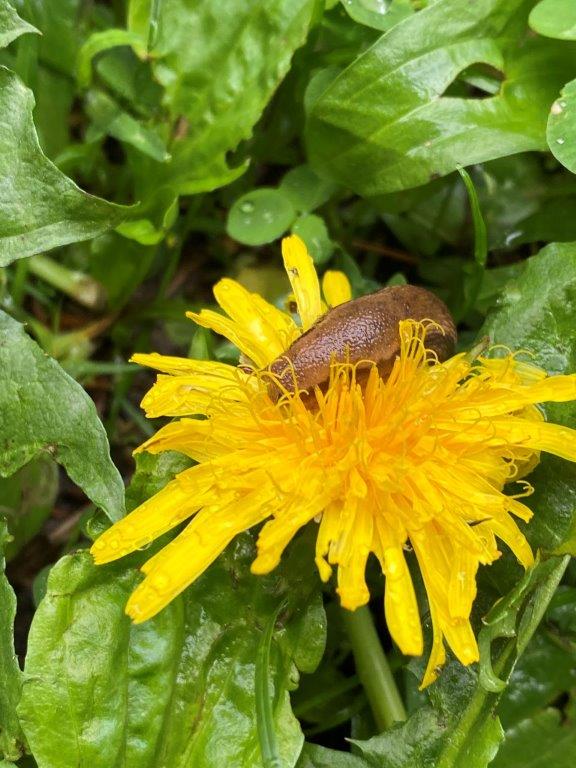
I've had more slugs in my garden this year than ever. So when I found a slug hanging out atop a dandelion after a rain, I asked Marla (a snail expert) whether it was nibbling the flowers or trying to keep its foot dry. One question led to another and finally I asked if she'd maybe just write a little bit about snails for this blog. I'm so happy she did.
 
Peer down into a patch of weeds, under a decaying log, or sift through some topsoil, and you might have the chance to meet the often-misunderstood underdogs of the animal kingdom: the land snails.

Why snails, and what exactly are these squishy, slimy creatures, you ask? As a malacologist specializing in land snails and an artist who likes to draw them, I’m happy to tell you. 

I first discovered snails as a young child. I remember turning over the stones in my backyard, where I discovered the universe of tiny snails that lived beneath them. I was intrigued that they led a seemingly mysterious life and had a beautifully coiled shell. I had to learn more, and so began my lifelong quest.

Slugs are snails too, except that they evolved to not need a shell, or some have a drastically reduced bit of shell under the skin behind the head. So when I refer to snails, I really mean snails and slugs.

by Marla Coppolino
In their hidden lives, native snails do lots of unseen good for the ecosystem. First, they act as clean-up crews, making meals out of leftovers like old, rotted mushrooms, dead plants, and even dead animals. You’re more likely to find them if you do a careful search in their natural habitats, like meadows, undisturbed woodlands, and limestone outcrops, where they glean vital nutrients from these materials, like calcium and magnesium. 

In turn, snails and slugs become food for many other animals of the food web. Firefly larvae feast upon them, salamanders snack on them, even some mammals – like chipmunks and squirrels – munch them. For many birds, snails are an essential source of nutrients important for laying viable eggs.

Some snails and slugs can be real garden pests, but you’re unlikely to find the native snails in your vegetable garden. Snails that have been introduced from other lands are the ones with large appetites, doing much damage to your Swiss chard, cucumbers, strawberries, and other veggies and fruits under the dark cover of night. As much as I like to help others learn about the benefits of native snails in the ecosystem, so many questions come my way about how to get rid of garden pest snails. I’m not the expert here, but I can share one trick: I pick the little buggers off my veggies by hand every morning and drop them off at least 100 feet from the garden. Labor intensive, yes, but there’s minimal damage to my garden.


Why do I like to look for, talk about, write about and draw snails so much? Maybe it’s because they need someone to be their megaphone. Spending time with snails reminds me to slow down in life, in a good way, to stop, ask questions, and stay curious. I hope these amazing animals can do the same for both my children and adult audiences. 

Marla develops online courses at the Cornell Lab of Ornithology, mostly to help people learn about birds, how to be stewards of nature, as well as fun things like drawing and painting birds. She enjoys researching and pulling together scientific information in a way that's broadly understandable and fun to learn. Marla also drew the illustrations for The Sound of the Sea, by Cynthia Barnett (W.W. Norton & Co. 2021). You can find out more about her art at her website, www.marlacoppolino.com


Friday, August 5, 2022

It's Raining Mushrooms!


Mushroom Rain 
by Laura K. Zimmermann; illus. by Jamie Green
32 pages; ages 4-8
‎Sleeping Bear Press, 2022

theme: mushrooms, nature, 

Without warning, they appear. Mushrooms!

Ever since I’d heard the title, Mushroom Rain, I’ve wanted to read this book. And I’m so glad I did! Page by page, Laura Zimmermann introduces readers to the wild and sometimes crazy-looking mushrooms that live around us. She highlights the insects and animals that chomp, scrape, and otherwise feast on fungi. And she takes readers underground, to where the mycelium spreads and reaches from tree to tree. 

What I like about this book:
I love the spare, lyrical language Laura uses to show the diversity of mushrooms, and how animals interact with them. There are delicate umbrellas, cupped nests, spooky mushrooms that glow in the dark. They have smells that range from bubblegum sweet to rotten. I love how Jamie Green’s illustration capture the essence of fungi of all types.

And (of course) I like the back matter. Laura does, too, and she shares yummy tidbits of information about where mushrooms live, who eats them, and how their spores help create rain. She encourages readers to notice and wonder about the mushrooms they come across, and lists more resources for curious naturalists. And of course she includes a hands-on activity.

Beyond the Books:

Check out this trailer of Mushroom Rain on youtube.

On Monday, Laura took over this blog to talk about how curiosity drove her to write this book. You can read her post here. And check out her interview over on the GROG Blog.

Grab a coloring page or word puzzle here. There’s also a teacher’s guide filled to the brim with activities.

Make a spore print. First, go find a cool mushroom growing in your yard (or some place where you have permission to pick a mushroom). You can follow these instructions for making a spore print from the North American Mycological Association, or you can watch this video from the Santa Cruz Museum of Natural History. Remember to wash your hands when you are finished.

We’ll join Perfect Picture Book Friday when it resumes. PPBF is an event where bloggers share great picture books at Susanna Leonard Hill's website. Review copy provided by the publisher.

Monday, August 1, 2022

Curiouser and Curiouser ~ by Laura Zimmermann

Laura and Tivy
When I think of STEAM, I think of Alice’s Adventures in Wonderland. Without curiosity science wouldn’t exist. And wonders? You don’t need a white rabbit to tumble into those. The natural world is filled with them. Take fungi. They are bizarre and mysterious life forms with new mysteries uncovered with each new finding.

As a scientist and professor, I gravitate to STEAM topics. I’m always down one research rabbit hole or another. The e-books my university students and I created for children in Uganda, Ghana, and Sierra Leone led me to nonfiction writing for children—a path that created new rabbit holes that have led to the most unexpected places. 

For example, Mushroom Rain. Reading Beatrix Potter’s journal led me to mushrooms, which primed me to read articles about them and drew me to one, in particular, on how mushrooms help create rain. I had fallen into a world every bit as weird and wonderous as Wonderland.

In writing nonfiction picture books, I share things about the natural world that excite me and I hope will encourage my readers to follow their curiosity. For me that often begins with spare, lyrical language to draw readers in. For Mushroom Rain, Jamie Green’s wonderful illustrations captured that vision and took it in a direction more magical than I could have imagined. 

The back matter builds on this by adding more details and ways to engage with the material. Back matter is where my research side shines through. I love it. With a sparse story, I use backmatter to further explain things and fill in the blanks. I want to provide support to build young readers’ understanding. Then I consider what else my readers may want to know and what will spark them to discover more. I include fun facts and STEAM activities to help make that happen.

Reviewing Mushroom Rain, Jen Forbus wrote, “Together Zimmermann and Green prove how fascinating—and beautiful—science and nonfiction can be.” And there is nothing more wonderous than that.

You can read a wonderful interview with Laura over at the GROG blog. And I'll be reviewing her book here at Archimedes this Friday.

Laura K. Zimmermann is a college professor by day and children’s writer by night. She has a PhD in developmental psychology and has published numerous academic articles as well as nonfiction stories in children’s magazines. Mushroom Rain is her first picture book. When she’s not writing, Laura can be found teaching and conducting research at Shenandoah University or wandering through nature with her Goldendoodle, Tivy. You can find Laura online at laurakzimmermann.com and on Twitter, Instagram, and Pinterest at @LauraK_PBwriter.

Friday, June 10, 2022

It's Strawberry Season!


 I LOVE Strawberries 
by Shannon Anderson; illus. by Jaclyn Sinquett 
32 pages; ages 4-8
Feeding Minds Press, 2022

theme: gardening, responsibility

“Mom, can I grow strawberries of my very own?”

Jolie loves strawberries so much that she would eat them every day if she could. Her solution: grow her own. But that’s a lot of work, and mom and dad think she should wait until she’s older to tackle such a venture. So Jolie sets out on a mission: to show her parents that she is able to take on the responsibilities of a berry grower. She starts by cleaning her rabbit’s cage. Then she devises other ways to demonstrate that she is “old enough” to grow strawberries.


What I like about this book: I like the scrapbook-like entries Jolie puts in her journal. And I love how she sets herself specific missions to show her parents what she can do on her own. And what she does when she finally gets to plant her very own strawberries. Of course there’s a dose of reality: bird attacks, insects, too many berries (seriously, Jolie? too many?)

And I like the backmatter: tips on growing strawberries, some explanation of Integrated Pest Management (IPM), and some tips for locating U-pick berry farms. Plus there are links to educational activities and videos.

Beyond the Books:

Make strawberry ink. If you’ve eaten all your strawberries, you can use other berries to make ink. Here’s how.

Plant a strawberry seed, or a couple hundred. Here’s how.

Visit a U-Pick berry farm and pick your own strawberries! Then eat them!

Today we're joining Perfect Picture Book Friday, an event where bloggers share great picture books at Susanna Leonard Hill's website. Review copy provided by Media Master’s Publicity

Friday, July 30, 2021

Finding the Meaning of "Frogness"


Frogness 
by Sarah Nelson; illus. by Eugenie Fernandes 
32 pages; ages 3-7
‎Owlkids, 2021   

theme: frogs, nature, imagination

Just before dusk, rain clouds bloom way out over the sea. We wait.

Sammy and Chocolate (a puppy) are waiting for the frogs to sing. They hike way out to the marsh because This is the night they will Catch A Frog! They hear them everywhere – but there are no frogs in the reeds and no frogs under a log.

What I like about this book: I love – really love – the page that has the frog songs spelled out in huge letters (while the kid and dog fall asleep). Because I also know how hard it is to find singing frogs near a pond, in the weeds, and along a creekbank. It takes two to triangulate, and even then you might never see those sneaky, noisy frogs. The illustrations are marvelous, and the idea of “frogness” just pulls me in. 


And there is … Back Matter! About frogs – how many, what their calls sound like, and how they sing, croak, rattle, peep, trill, trummm, and chuckle. Cool facts, too. Did you know that a species can have a slightly different call depending on where they live? Frogs have accents!

Beyond the Books:

Get to know your frog calls! Listen to the frogs in and around your neighborhood - they don't all live in ponds. Here are some recordings of frogs and toads that live in Indiana - but some may live in your area, too. 

Discover a Fun Frog Fact. Author Sarah Nelson has a whole list of fun frog facts, and lots of "frogness" over at her website.

Play leap frog - or, better yet, create your own frog game. It can be a card game or a board game - or an action game. One idea: cut some lily pads out of green paper and tape them onto the floor. Then hop from one lily pad to the next. Have fun making your own frogness!

We’ll join Perfect Picture Book Friday once they resume. It’s a wonderful gathering where bloggers share great picture books at Susanna Leonard Hill's website. Review copy provided by the publisher.

Friday, July 16, 2021

A Walk in the Woods

 theme: nature, STEAM, observation

This month I’m reviewing books that explore different habitats and biomes. Today we’re off to the woods.

Look What I Found in the Woods 
by Moira Butterfield; illus. by Jesus Verona 
32 pages; ages 2-5
Nosy Crow (Candlewick), 2021

Follow me. I know the way.
We’re walking through the woods today.
Look what I found!

This is such a fun book to read before you head of on a walk through the woods. And maybe to carry along with you. It’s part field guide and part treasure hunt. Some spreads invite you to look for specific things: a signpost, wild strawberries, beetles. 


 Other spreads explain how to identify things, such as what kind of snail shell you’ve found, and how to tell a tree by its leaves or needles.


What I like about this book: It’s fun! I love the die-cut cover, and the scavenger-hunt type lists of things to find. I love that this book is all about observations, and the questions support visual literacy. And that the author asks young naturalists to be thoughtful while exploring, and only collect things they find on the ground (if you’re going to use items in art or to study).

If I gave stars, this book would get some.

Beyond the book:

Collect seeds from trees and observe them. Take them apart and learn more about how those trees grow. Try planting some seeds. I once planted a maple seed, and it grew! And every spring I find baby oaks growing from acorns that squirrels have buried in my garden.

Make some rubbings of tree bark. Put paper against a tree and rub the side of the crayon against the paper. The design of the bark will show. Now compare your rubbing to the tree’s bark. Are there some details your crayon couldn’t pick up?

Draw a picture of something you see on your walk in the woods. It could be a mushroom or a bird or a flower… Then give it to a friend and tell them where to find it. 

Go on a woodland scavenger hike – but instead of collecting items, take photos or draw pictures. Here's a place to find a woods walk printable scavenger hunt.

We’ll join Perfect Picture Book Friday once they resume. It’s a wonderful gathering where bloggers share great picture books at Susanna Leonard Hill's website. Review copy provided by the publisher.