Showing posts with label physics. Show all posts

Friday, December 12, 2025

Turn this Book into a Lever!

 Every now and then I come across a book that is more than a book. This one turns into a catapult - at least part of it does! That makes it a perfect gift for young knights-in-training...
 
 Mighty Models: The Legendary Life Story of the Lever 
by Christine Van Zandt; illus by Lesley Breen 
32 pages; ages 4-8
Union Square Kids, 2025

theme: physics, history, hands-on
 
This is a lever. It doesn’t look like much, but it is one of the world’s mightiest machines.

A lever is basically a rigid beam and a fulcrum. From teeter-totters to robotic arms, levers have been used to move things. People have used levers to hunt mammoths, build Great Walls, print books, produce movies – even defend the Crown Jewels of England!  Over the span of ten spreads, this book invites readers to discover the science – and the history – of this simple, yet important machine. 
 
 
 What I like about this book: I like the visual table of contents. I also like the fun lever sidebars on each spread. But what I really like is how part of the book is a hands on build-it-yourself catapult model that allows kids to discover the power of a lever in action. 
 
  
I asked Christine if she had constructed the model catapult. "Oh yes!" she said. "The cats love it!"You can watch author Christine Van Zandt demonstrate her model catapult in this video at her website, christinevanzandt.com/models

Beyond the Books:
 
Check out this short video about levers and some simple machines you might use that incorporate levers. 

Make your own lever using a ruler (or similar flat wood piece) and a marker or other item (dowel, block) as a fulcrum. Use your lever to lift a flat stone or can of tuna. What happens when you move the fulcrum closer to the load? Or farther away?

Go lever-looking. How many kinds of levers do you find around your house and yard? Make a list of what you find using words or pictures. One of the levers we have around our house is a T-post puller.

Christine is a member of the STEAM Team Books group. You can find out more about her at her at her website christinevanzandt.com. You can find more about recently released STEM and STEAM at www.steamteambooks.com

We'll be joining Perfect Picture Book Friday after the holidays. It’s a wonderful gathering where bloggers share great picture books at Susanna Leonard Hill's website. Review pdf provided by the author.

Wednesday, August 27, 2025

Kitchen Science ~ Spin Art!

 Our library's Summer Reading theme was "color your world" and one of the activities that kids could do was create spin art. It's fun and all you need are a few things: some cardstock, washable tempera paint, and a salad spinner (NOT the one you use to spin your lettuce!)
 
 Put your cardstock in the basket inside the spinner and squirt some tempera paint on it. You might have to experiment to get it thin enough to move when the spinner spins. 
 
 
Then start the spinner. I discovered that I had to keep pumping the thing to get the paint to push out to the sides (the effect of centrifugal force)
 
You may want to add more drips and drabs of paint to fill in a few blank spaces...


... and then finish off with a white or silver gel pen! Have fun! Oh, and if your salad spinner has holes on the bottom of the outer plastic bowl, make sure to cover your table with a piece of plastic so you don't get paint all over it. Or just do it outside on an old stump.
 

Friday, June 27, 2025

Invent Machines Like Rube!


Smash, Crash, Topple, Roll!: The Inventive Rube Goldberg―A Life in Comics, Contraptions, and Six Simple Machines 
by Catherine Thimmesh; illus. by Shanda McCloskey 
60 pages; ages 8-12
‎Chronicle Books, 2025 

Rube Goldberg was born in 1883 – on the brink of technological revolution. During his life he saw inventions and machines that were meant to make life simple. But… (as many of us have discovered with today’s tech) too often those inventions left folks befuddled. The tech was Just Too Complex!

Rube’s response? Draw his own contraptions – crazy, complex machines that went through multiple steps to achieve a simple goal. 


Starting with a Table of Contents that is, itself a Rube Goldberg contraption, we get drawn into Rube’s world of cartoon and satire. There's a section on becoming an artist the "Rube Goldberg way" and great sections that describe how each type of machine works. And a wonderful bit about Rube's invention cartoons. Back when he drew them, those crazy contraptions captured the imagination of kids and adults. Even today, more than 100 years later, people are designing and building “Rube Goldberg Machines” and posting videos online. Why? Because it’s fun. These machines do such ordinary things in unexpected ways. Even Honda got in on the action with their 2009 ad that uses car parts in an elaborate machine that rolls out their newest model. 


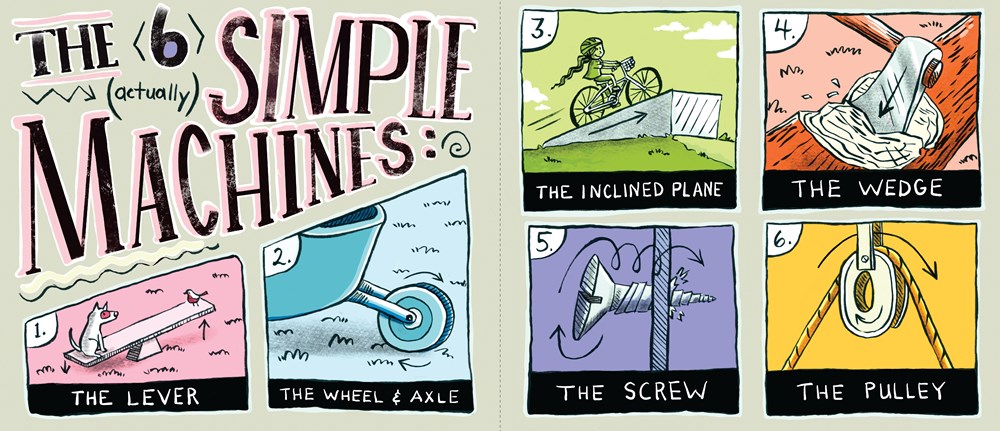
Rube Goldberg machines are, by design, whimsical - like the plant-watering machine. But the science behind them is real. Most are powered by gravity (things rolling, falling, swinging) and some combination of the six basic simple machines: lever, wheel and axle, inclined plane, wedge, screw, and pulley that are introduced on the front endpaper.


Back matter includes a section on How to Build a Rube Goldberg Machine in eight simple steps. My favorite is step 8: embrace Murphy's Law. You know - the one that says if anything can go wrong it will. Something will happen, writes author Catherine Thimmesh. "Something will fall off its track. Count on it." Just be ready to troubleshoot and fix it. There's also a glossary and lists of resources for curious inventors.

Thanks for dropping by today. On Monday we'll be hanging out at Marvelous Middle Grade Monday with other  bloggers. It's over at Greg Pattridge's blog, Always in the Middle, so hop over to see what other people are reading. Review copy provided by the publisher.


Friday, September 29, 2023

The Poetry of Science

There are so many ways to write nonfiction! I love that poets are exploring science, and finding different ways to talk about such things as physics and animals. I intended to review these in April for poetry month, but somehow they got buried at the bottom of my book basket – which I dumped out last week so I could see what all was in there. Besides books: dust bunnies and a sock. I know! So, on to books…

theme: poetry, science, dogs


Push-Pull Morning: Dog-Powered Poems About Matter and Energy
by Lisa Westberg Peters; illus. by Serge Bloch 
40 pages; ages 4-8
Wordsong (Astra), 2023

My new dog has one wet nose.
Me? No.

This fun book explores gravity, magnetism, electricity, friction, and states of matter through the friendship between child and dog. The first one is about “Stuff in Common” comparing things we don’t have in common, such as floppy ears, four paws with clicky nails – but helps us realize that we’re all made of “zillions of wiggly molecules and jillions of jiggly atoms.”

What I like about this book:  I love that a dog in motion will stay in motion until acted on by an outside force, and that you can’t make a dog go where they don’t want to because of the friction of claws digging into the carpet. Also, one of my favorite poems was about states of matter, where the dog was liquid when pouring itself into the basket to sleep. At the bottom of each spread the physics concept is printed in bold (to help parents, I’m thinking!). Oh, and did I say there was humor involved? Back matter provides a short definition for each physics concept, with a longer paragraph to explain the science. 

Galápagos: Islands of Change
by Leslie Bulion; illus. by Becca Stadtlander  
‎48 pages; ages 8-12
Peachtree, 2023   

The biogeographical history of the Galápagos Islands is told through a series of poems, from their beginning as volcanic hot spots through the evolution of life on each island. It is a complex story that begins in a fiery flash, and explores how plants and animals arrived on the rocky islands and adapted to the landscape. Now, the islands are populated with an array of plants, reptiles, and birds ranging from penguins to blue footed boobies.

As the poems celebrate the remarkable plants and animals, they highlight the unique ecosystem that has evolved on each island. One of my favorite poems is a short free verse about Zooplankton, “Mini-swimmers—most no bigger than the head of a pin…”

Another focuses attention on marine iguanas, “basking on a sun-soaked ledge” until they leap into the ocean and dive, their “flat-oar tails” whipping side to side as they plunge down to where the tastiest seaweed grows.

And then there are the penguins. Yes, the desert-dry islands have penguins!
On land they stand umbrella pose,
creating shade to cool their toes,
but underwater, watch them fly—
 
Courtesy of Peachtree Publishing Company Inc
 
 There are poems about the prickly pear cactus and the black carpenter bee and, of course, the very famous finches! The collection of poems is book-ended by expository text that introduces the Galápagos Islands in the beginning, and examines the challenges the unique plants and animals face in a warming climate and human impacts.

There is great back matter, beginning with a glossary and map – I did not know there were so many islands! There are poetry notes for every creature (what kind of poem, rhyme scheme) that will make this a great cross-curricular connection for language arts. And, in addition to the resources, there is a species list. 

Beyond the Books:

Play around with States of Matter and Physics. Here are a couple of resources with experiments and activities for younger kids here and here.

Explore the Galapagos Islands with ABC news and National Geographic Expeditions

Today we’re joining Perfect Picture Book Friday. It’s a wonderful gathering where bloggers share great picture books at Susanna Leonard Hill's website.  On Monday we'll be hanging out at Marvelous Middle Grade Monday with other  bloggers. It's over at Greg Pattridge's blog, Always in the Middle, so hop over to see what other people are reading. Review copies provided by the publishers.

Wednesday, September 12, 2018

Wednesday Explorers Club ~ Soccer ball science


Recreational soccer is in full swing now. So are the local school teams. And after a fantastic World Cup season, some kids have soccer on the brain. So now's as good a time as any to indulge in some soccer science.


 First, you need a soccer ball - and some others: a volleyball, basketball, and even a similar-sized beach ball. 

Now let's compare bounciness. Find a hard surface (a sidewalk, parking lot, or tennis court) for a bounce test. Hmmm - we need a way to measure how high balls bounce. how about taping a couple yard-sticks or tape measure to a fence, wall, or tree?

Testing time: Drop each kind of ball from a height of three feet and write down how high it bounces. Then, stand on a stool (or ask a really tall person) and drop each ball from six feet. Write down how high they bounce. Remember to do each bounce test three times so you get a fair idea of bounce height for each kind of ball. 

What do you notice?

So, if you're like my kids, you play soccer anywhere you have space: the back yard, school soccer field, packed earth driveway.... How does ball bounciness change with the playing surface? Try the bounce experiment on different surfaces. How does tall grass compare with mowed lawn? How does packed earth compare with a sandy surface?

OK - water break is over. Time to get back to the game!

Wednesday, April 11, 2018

Wednesday Explorers Club ~Science with (probably stale) Peeps

Science With Peeps began one year after Easter when the kids discovered that, though they loved marshmallows, they had not eaten the peeps. It was now ten days post-Easter and the peeps were getting tough (or as we gardeners like to say, hardened-off). Soon they could be used as hockey pucks.

"We could see how long they take to decompose in the compost bin," one kid suggested. OK, but who was going to collect that data?

"We could see how long they take to dissolve," said the other. (It takes longer than you think.)

"We could put them in the microwave," said one.
"And what?" I asked.
"Compare them to marshmallows."

First, it being science, we wrote a list of questions. Things like:
  • How long does it take for a peep to melt? 
  • How long does it take a marshmallow to melt? 
  • Does color matter? 
  • Does shape matter? 
  • Does staleness matter?
  • Does melting improve flavor? 
  • Can peeps be substituted for marshmallows in S'mores?
Then we tested them under various settings and... well, go do it and have fun.

We aren't the only ones to do Peep Science. NPR's Adam Cole used stale peeps to determine the speed of light. It's something you could do at home - here's a link to their video. All you need are stale peeps, a glass dish, and a microwave.

Friday, March 9, 2018

Recently hatched Bird Books!

Geese started flying north overhead a couple weeks ago! So I figured it's time to share some new books that feature birds.
themes: nonfiction, birds, poetry

For the youngest readers, a couple of board books that introduce colors paired with photographs of common birds.

 Look and Learn: Birds
24 pages (board); ages 2-5
National Geographic Kids, 2017

Splashy, splash, splash.

A red bird is taking a bath. Simple language introduces youngsters to colors, bird sounds, feathers and features such as a crest of feathers. Bright photos bring birds close to the reader. Fun and engaging, with some interactive components: touch the bird's feathers. I would have liked text to introduce the common names of birds.

My Colors (Early Birds series)
by Patricia Mitter
24 pages; ages 1-3
Cornell Lab Publishing Group, 2017

The Early Bird board books aim to introduce young children to nature and concepts. This one pairs colors to common birds children might see in their neighborhood.

What I like about this book: Each page features a bird, as well as a natural feature. For example, cardinal is paired with red berries. Text also describes the birds' calls. Tabs allow young children to grab hold for easy page-turning. At the back is a spread of all the birds introduced and QR codes linked to the sounds the birds make.

Bird Builds a Nest
by Martin Jenkins; illus. by Richard Jones
32 pages; ages 4-6
Candlewick, 2018

It's a beautiful day. Bird is up early - she's got a lot to do.

Breakfast, collecting nesting materials, and building a nest ... that's a long "to do" list. But Bird sets off, and soon she's found breakfast. A worm!
What I like about this book: it's about birds, sure. But also about physics and the forces Bird uses in her life. She pulls worms; they resist. She gathers twigs in her beak and, as she flies up, gravity pulls them down. When she builds her nest she has to push twigs and pull twigs to weave her home. Front and back matter include information about forces and some simple activities kids can do to explore them.

A Place to Start a Family, Poems about Creatures that Build
by David L. Harrison; illustrated by Giles Laroche
32 pages; ages 5-9
Charlesbridge, 2018

For thousands of years people have built shelters, writes David Harrison. Many animals are builders, too.

In this book he and illustrator, Giles Laroche, introduce readers to birds and other animal architects, and the cool shelters they construct.

The poem about Red Ovenbird is a list of questions: How do you hide your nest like that?  There is one about white storks and their nests high on chimneys. Poems also introduce wasps, spiders, moles, prairie dogs, and more.

What I like: that the poems raise questions for readers to consider. And I love the layered artwork. Laroch combines drawing, cutting, painting, gluing.... up to seven or eight layers in each illustration. Makes me want to get my fingers busy with art.

Beyond the Books:
Go on a bird walk! All you need is your legs, a place to walk, and a pair of binoculars. Take along a notebook so you can draw birds you see or write notes. Maybe you will hear an interesting song, or notice a nest. 

Make a list of the colors of birds you see. Learn a bird song.  

Make a nest! Gather some nesting materials and build a nest. Write down a poem about the shelter you built. Draw a picture of it.

Make your own layered art inspired by birds living in your area. Check out this post to learn more about how Giles Laroche does his artwork. Then have fun!


Today we're joining other reviewers over at Perfect Picture Book Friday, an event in which bloggers share great picture books at Susanna Leonard Hill's site. She keeps an ever-growing list of Perfect Picture Books. Review copies from the publishers.

Friday, January 26, 2018

Charlie Numbers celebrates Science and Diversity


Tomorrow is Multicultural Children's Book Day. So I'm taking the opportunity to share a novel that includes not only a diversity of characters, but a strong STEM component. If you are a fan of the TV series "Scorpion" (or the older "Numbers"), this will appeal to you.

Charlie Numbers and the Man in the Moon
by Ben and Tonya Mezrich
208 pages; ages 8-12
Simon & Schuster, 2017

Charlie Numbers is a smart kid. Fortunately he's got a gang of like-minded friends who, by banding together, manage to survive the hassles and bullying that middle school life can bring. We meet them in the early chapters, where they are hurrying to finish a project for school that involves baking soda and vinegar. And no, it's not a volcano.
Design
When Charlie is approached by a man and woman who say they are from NASA, he is intrigued. They need a favor - and in the process he and his friends get drafted to compete in a national paper airplane contest at the Smithsonian's National Air and Space Museum. Soon Charlie and his friends find themselves caught in a mystery filled with corporate espionage and lots and lots of calculations regarding lift, thrust, resistance, and gravity.

In addition to the science, math, and engineering that are essential to the plot and fabric of this book, there is a fun cast of wonderfully diverse characters who make up the Whiz Kids. Charlie is a numbers guy who has never done anything practical like paper airplanes. Crystal is passionate about geology, Kentaro is a linguistics genius, Marion  is an artist, and Jeremy has mad math skills.

What I like about the book - in addition to the STEM that is woven through every aspect of the story - is the understanding that we work better when we work together. Teamwork is vital to solving engineering problems, even if it is paper airplane engineering, and a team with diverse skills and personalities brings more to the group - at least that's my opinion.

Author Tonya Mezrich graciously answered a couple questions about the writing process. Turns out she's been helping Ben behind the scenes as a researcher for his other books....and when I asked about inspiration for this book, she confessed that Indiana Jones may have played a part.

authors Ben and Tonya Mezrich
Tonya: We were both fans (of Indiana Jones) and loved to imagine kids solving mysteries in the same exciting action-packed way. Another inspiration is Encyclopedia Brown and Harry Potter. We love the idea of creating a modern day Encyclopedia Brown with kids solving mysteries in today's settings. We also love the magic element of Harry Potter. For Charlie, math and science is his magic.

Archimedes: What makes a book "multicultural" and how does that relate to your book?

Tonya: Our book has a strong Asian character, Kentaro, who is integral in solving the mystery. I am Asian and was always faced with the typical stereotype that I should be good at math and science. (note: Tonya is... she's a dentist!) I didn't want to portray Kentaro that way, so we had his skill set based on words and spelling. He is a Scrabble whiz - and also graces the cover of our book. We've gotten great feedback from the multicultural community about it, which has come as a pleasant surprise.

Tonya and Ben focused on paper airplanes for this book because they are something that any kid can make. Try their design for the super fast dart - and let me know if you have better luck sailing it than I do! Maybe my folds aren't crisp enough, but my plane keeps nosediving.

On Monday we'll be hanging out on Marvelous Middle Grade Monday with other  bloggers over at Greg Pattridge's blog, Always in the Middle - so hop over to see what other people are reading. Review copy provided by author.


A little more about Multicultural Children's Book Day:  It was founded by Valarie Budayr from Jump into a Book and Mia Wenjen from PragmaticMom. The mission of MCBD is to raise awareness of the ongoing need to include kids' books that celebrate diversity on home and school bookshelves, while also working to get more of these types of books into the hands of young readers, parents, and educators.

MCBD has 28 Medallion level sponsors and 47 Author sponsors. The event relies on their impressive CoHost Team for hosting the book review link-up and spreading word of this event. Drop by the Multicultural Children's Book Day website for fabulous resources including free books for teachers and a free classroom empathy kit for homeschoolers, teachers, and others.

Remember to connect with MCBD on social media with #ReadYourWorld