Showing posts with label guest author. Show all posts

Monday, December 19, 2022

Writing in Season ~ by Lisa Amstutz

Many of my favorite childhood memories are seasonal in nature. Building snowmen and then warming up with hot chocolate. Growing pumpkins. Stomping in puddles. Running through the sprinkler. 

Holiday foods trigger memories as well—Mom’s turkey stuffing, Grandma's apple pie, Great-Aunt Ida's melt-in-your-mouth butter mints. I’m sure you have many delicious memories of your own!
 
These seasonal and holiday memories can be a rich source of story ideas. I've written about some of my own seasonal memories in Applesauce Day, which is based on our family tradition of making applesauce. Finding a Dove for Gramps, a story about the Audubon Society’s Christmas Bird Count, grew out of a memory of participating in a bird count with my father. Mining those memories—focusing on what I saw and felt at the time—helped bring the stories to life.

To a child, everything is new and exciting. Where adults see a messy morning commute, toddlers see something sparkly and surprising falling from the sky. Older kids see snow forts, sledding, and potential snow days. In truth, snow is all of those things; it’s simply a matter of perspective. When you write for children, try to see your subject through the eyes of a child—not your adult lens.

Think back to your own childhood. What memories stand out when you think about each season or holiday? Transport yourself back to that moment. What did it feel like, smell like, taste like? What delighted you—or even scared you? 

Take some time to jot down the answers to these questions, and consider how you could add them to your story. Capturing those sensory details will enliven your writing, and will be sure to delight your young readers as well!

Lisa Amstutz is the author of more than 150 children’s books. She specializes in topics related to science, nature, and agriculture. To learn more about Lisa and her books, visit www.LisaAmstutz.com


Monday, December 12, 2022

Inviting Curiosity, Inciting Wonder, by Kimberly Ridley

In the middle of a packed school assembly for my debut picture book The Secret Pool, a second-grader asked a question I couldn’t answer.

“Why are the yellow-spotted salamander’s spots yellow?”

I froze. I didn’t have a clue, despite the many hours of research I’d done on vernal pools and the salamanders and other animals who depend on them. The question hadn’t occurred to me. 

The second grader and her 400-plus schoolmates waited for an answer. I stared at the sequined rainbow glittering over a blue unicorn on her t-shirt, glanced at the gymnasium clock.

“I…don’t…know,” I stammered.

Silence.

But in that pause, mercifully, a lightbulb went off. 

“Let’s see if we can find out.” I said. 

When we gathered at the end of the day to celebrate the creative nonfiction stories the kids had written in my workshops, they were exuberant. Not only about what they had accomplished in their writing, but that they had found the answer to the second grader’s question. The salamander’s spots are yellow to warn predators such as raccoons that they’re poisonous. When a predator attacks, the yellow-spotted salamander oozes a bitter toxin from glands in its skin.  

Who knew? 

In the hundreds of school programs I’ve done with my children’s books since, I always write down kids’ questions on a big flip chart if I don’t know the answers, and we follow up later in the day. I also tell them that scientists might not yet have discovered the answers to their questions. This thrills them.   

As the author of nonfiction science and nature books for children (and their grown-ups) I think this is my most important job: to invite curiosity and incite wonder about the astonishing world right outside our door. It’s also my passion.

All of my books, including my latest, The Secret Stream arise from my own curiosity, often stemming from questions I’ve carried since I was a kid myself. Where does my favorite brook begin and end? What are these small, wriggly creatures clinging to the rocks underwater, and how do they not wash away in the current? Do fish live in here, and whose paw prints are these in the mud? 

As for wonder, I stumble upon it at every turn as I observe, interview scientists, and read mountains of material for each book. Researching The Secret Stream, I fell in love with our smallest waterways all over again—not to mention the extraordinary creatures who inhabit them. For example, I’ve become smitten with caddisfly larvae, who protect themselves from fish and other predators by building exquisite “cases” around their bodies with pebbles and grit or plant materials stuck together with their remarkable silk.   

Again, who knew?

We walk or drive by these amazing beings and places every day, often without a clue. But this is where wonder resides. All around us. Every day we have abundant opportunities to reconnect our kids and ourselves with the rest of the teeming, surprising and still vibrant world around us. That’s why I want to invite curiosity and incite wonder with my books and school programs. 

When I recently told a friend about my mission, however, he was skeptical.

“You can’t incite wonder,” he said. “Wonder is soft and childlike.”  

I beg to differ. To me, wonder is a birthright and a survival skill. There’s nothing soft about it. Wonder is clear-eyed, wild, and necessary. Which brings me to the words of Rachel Carson, my heroine since I learned as a kid that she once summered in my home state of Maine. 
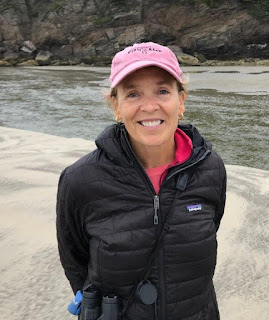
photo: Jean Fogelberg Photography
Carson wished for every child to be granted at birth “a sense of wonder so indestructible that it would last throughout life, as an unfailing antidote against boredom and disenchantments of later years, the sterile preoccupation with things that are artificial, the alienation from the sources of our strength.”

At the end of my school programs, I ask students if they want to help the wild places and creatures in their communities. Hands fly up, a resounding “yes.” And so I invite them to tell some-one at home at least one cool thing they’ve learned in our time together. This sharing, I tell them, will ripple out and inspire other people to learn about and together care for their patch of the planet.

This is how we incite wonder. This is how we cherish the intricate, fragile, and mysterious web of life that connects and sustains us all, every living being. This is a way to live in joy.

Kimberly Ridley is a science writer, essayist, editor, and children’s book author who writes about nature, science, health, and the environment. I reviewed her newest book, The Secret Stream here. You can find my review of her first picture book, The Secret Pool here, and my review of  Extreme Survivors, Animals the Time Forgot here. To learn more about Kimberly Ridley and her books, check out her website at www.kimberlyridley.org.


Monday, December 5, 2022

Geology in Action at Fagradalsfjall volcano, Iceland by Leslie Barnard Booth

Most of my ideas for picture books are inspired by questions my children ask. My debut nonfiction picture book, A Stone Is a Story, was inspired by a question my older daughter, then age 7, asked one evening at dinner.

“Where do rocks come from?” 

On its face, this question might seem simple, but it’s not! It led to a fascinating dinnertime conversation about Earth’s formation and structure, the rock cycle, and deep time. In fact, Earth’s rocks have always been here. They have been here since Earth formed. But they don’t stay the same. They are continually transforming. They melt, harden, break apart, and recombine as they move through the rock cycle. 

That’s why it was so wonderful, when, in 2021, I got to see rock transform right before my eyes. 

Summer in Iceland

USGS, public domain
That summer, my family traveled to Iceland for my husband’s work. For 3 months, we lived in a small cabin on a wind-whipped hill along a fjord in northern Iceland. During our stay, we learned that the nearby Fagradalsfjall volcano was erupting – and that it was possible to hike to a nearby ridge to see it in action. 

Known for its geothermal pools and bathing culture, Iceland is one of the most volcanically active places in the world. Iceland sits along a seam in Earth’s crust where two tectonic plates meet. These two plates, the Eurasian Plate and the North American plate, are slowly drifting apart, causing magma to well up between them. This magma sometimes erupts at the surface as lava. We decided that before we made the journey home, we had to see this geological phenomenon firsthand.

Fagradalsfjall 

To view the Fagradalsfjall volcano, we drove several hours to the Reykjanes Peninsula. We parked in a roped-off field among many other vehicles. People from all over the world had come to Iceland to see this natural spectacle, and many different languages swirled around us as we walked toward the stark, treeless mountains looming ahead. Together we marched, locals and tourists, young and old, up a ridge marked with stakes by Icelandic authorities. 

photo of Leslie's older daughter standing at the edge of the Fagradalsfjall lava flow. 
photo by Leslie Barnard Booth

We finally came to a fresh lava flow made up of still-steaming black rock, and we thought we must be close! But after several hours of hiking, we still hadn’t glimpsed the volcano. My daughters were getting tired. The mist had thickened around us. We were damp and cold. We kept hiking up, only to hike down, and then straight up again. We started to wonder if the volcano would even be visible today. Maybe it wouldn’t. Maybe the sky wasn’t clear enough. Maybe this whole torturous trek was in vain!

So we sat. And ate lots of Nutella. My younger daughter seemed to perk up. “Let’s go a little farther,” she said. “To where those people are sitting.” She pointed to some people on a ridge in the distance.

A Rock Is Born

Once again, we hiked down, then up again, toward that distant ridge. That’s when we heard the roar of the volcano, and saw its fiery light flashing through the mist.

Fagradalsfjall volcano. photo by Berserkur/Wikimedia Commons

We made it to the place my younger daughter had pointed out. We sat among people from all over the world, and watched as bright orange lava fountained into the air and poured downslope, scabbing black as it snaked into the valley, where it pooled and steamed and hardened, turning to rock.

As we made our way back down the ridge, my older daughter picked up a rock at the edge of the lava flow. Very recently, this rock had been a liquid. It had been magma flowing deep belowground, then lava surging into the air, and now it was a hard gray fragment she could hold and admire. And just like that, she held in her hand the answer to her question.

Photo Credit: Kristal Passy Photography

Leslie Barnard Booth is a member of STEAM Team 2023. Her book, A Stone Is a Story will hit bookstore shelves next summer.  You can learn more about her book – and find educational resources on the rock cycle and geology – at her website, lesliebarnardbooth.com


Monday, November 21, 2022

A Lifeline for Coral Reef Habitats ~ by Jessica Stremer

 I’m extremely excited to tell everyone about my debut picture book, Great Carrier Reef, illustrated by the incredibly talented Gordy Wright. It’s part of Holiday House’s Books for a Better Earth series and will be available next June, right around Word Ocean Day.


Great Carrier Reef shares the journey of the aircraft carrier USS Oriskany (nicknamed the Mighty O), as it’s stripped down to a steel shell in preparation for a new life below the waves as the world’s largest artificial coral reef. 

As a kid, I loved learning about nature and science. I used to sit and watch the show Animal Planet for as long as my mom would let me. I studied biology in college and dreamed of doing field work, but life had different plans. 

My husband is a pilot in the United States Marine Corps and has spent months living on aircraft carriers. Right before his most recent deployment my kids were begging for an extension of TV time. I agreed, only if they turned on something science/nature-y. My daughter chose a documentary about the sinking of ships, which happened to feature the Mighty O. My curiosity was piqued. Between my love for science and my identity as a military spouse, I knew I needed to share the Oriskany’s story with kids.

To distract myself from the upcoming deployment I dove into research. I read about the Mighty O’s time in service, what it takes to reef a ship, and the benefits of artificial reefs. All around the world coral reefs are suffering due to pollution and warming water temperatures. Artificial reefs benefit ocean ecosystems by helping to increase biodiversity. 

The Oriskany was specifically chosen for reefing because of its massive size, which gave coral polyps a large area to colonize. The structure also provides lots of places for marine animals to take shelter. 

Coral reefs can differ depending on where they are located. So I interviewed biologists who monitor marine life on and around the Oriskany to ensure I included the correct species in my book. When people look at Gordy’s amazing cover, they’ll get a glimpse at that marine life. 

I love writing STEM for kids because there are so many topics to cover, and so many new facts and discoveries just waiting to be shared. I’m particularly drawn to topics that tie in environmentalism and conservation. I feel that my book is perfect for kids who love science, engineering, the ocean and coral reef ecosystems, as well as boats and military history. You never know which of today’s readers will be the ones to go on to innovate and implement changes to help make Earth a better place for both people and wildlife. 

After reading my book, I hope kids will be inspired to innovate and think outside the box about ways we can restore ocean habitats. For those who want a deeper dive, I included back matter with more about the Mighty O’s history and the role artificial reefs play in repairing this fragile underwater ecosystem.

Jessica Stremer is a mom, military spouse, and biologist who loves spending time with her family traveling, hiking, and camping. She currently lives in Okinawa, Japan. Her picture book,  Great Carrier Reef comes out in the summer of 2023, and her second picture book, Lights Out will hit bookstores in 2024. You can find out more about Jessica and her books at her website, www.jessicastremer.com and you can watch the sinking of the USS Oriskany here.

Monday, November 14, 2022

Doing Our Illustrator Homework ~ by Jacob Souva

I’ve learned a lot over the past five years while focusing solely on illustrating picture books. I still feel like a “newbie” when I open a manuscript, tasked with adding my art to someone’s hard earned text: Where do I start? How do I get ideas? What does that thing or character look like? Am I really getting paid to illustrate poop?


Every book is different, but there are some common threads. No matter the style in which an illustrator works or freedom afforded by the art director, the story is set someplace with rules that apply to that world. The closer the world sits to reality, the more research an illustrator must do into that world. We owe that to our young audience. It’s important that we do our illustrator homework.

In the past two years I’ve had the opportunity to illustrate two books in a series that straddle the fiction/non-fiction line. The books are about real things in nature (the stuff of non-fiction) presented by a talking bug narrator (the stuff of fiction). In the books Butterflies Are Pretty… Gross! and it’s sibling Flowers Are Pretty… Weird! (written by Rosemary Mosco, published by Tundra Books), I knew that the easy part would be the narrator. I’m good at characters and have exercised the creative fiction side of my career my whole life. A spunky bumble bee waxing on about flowers tumbled out of my imagination rather easily.

What I didn’t know was what an Alcon Blue Butterfly caterpillar looked like or why a particular orchid was named “Monkey Orchid.”

It might seem obvious (and it is!) but a folder full of research and visual material is an absolute must for getting these details right. I’ve collected reference material several different ways, but always begin by using search engines to find images. I store them either in a hidden Pinterest collection or a folder on my hard drive, labeled carefully (important for recall). There are times when I’ll need to reach back out to the art director or editor about a specific detail. I also find myself reading papers or articles when the photo reference doesn’t give me enough to work with.

Details matter! I’ve been asked about the colorings of certain butterflies by feisty second graders. Parents reading these books to their kids might be experts in the field and will be great ambassadors for a book that gets the details right.   

I’ve just wrapped up the art for a book called Max And Ed Bike To Nome (by Matthew Lasley, releasing April 4, 2023 by West Margin Press). It’s based on the real-life bike ride of Ed Jesson during the Klondike Gold Rush in Alaska. I was super thankful to find photographic reference material from the 1890s! The State of Alaska has an amazing collection of old photos to dig through. The final art is built upon the visual information I was able to comb.

Lastly, reference is the greatest starting point for creativity. I’ve found that this is where the fun and magic of illustrating resides. A good base level of visual information is a great foundation to jump off and get creative with. As famous jazz improviser Charles Mingus said “You can’t improvise on nothing, man; you’ve gotta improvise on something.”  

 Jacob Souva is an illustrator/author of picture books. You can find out more about him and his books at his website, www.twofishillustration.com. I met him a few years ago, and reviewed his fun book about panning for gold, Pedro's Pan.

Monday, November 7, 2022

The Life Cycle of a Desert Poem ~ By Darcy Pattison

During the pandemic, we all looked around for things to keep us occupied. I joined the crowd looking around the internet for classes. At least I could learn something while stuck at home.

What about poetry?

Iambic pentameter. Haiku. Blank verse. Sonnet. As a writer, I’ve delved into poetry at different points in my career because poetry compresses emotion into a small packet. You must carefully choose each word so it evokes the feeling you want the reader to feel.

I signed up for the Language Lyrical Lab with amazing Renee LaTulippe. Her debut picture book, The Crab Ballet, (it came out in March 2022). I’d heard about her poetry class from many sources, always with glowing recommendations. She offers a self-study course, but during the pandemic I wanted interaction with real people so I chose the full class that included feedback on my poetry.

The lessons, clear and concise, prompted me to try different forms of writing. At the time I was working on Friday Comes On Tuesday: An Adventure at the Crystal Bridges Museum of American Art. It is written in prose, but then the editor asked if I wanted to write a dedication. Inspired by the class, this was my dedication to my husband – written as a humorous double dactyl poem. A dactyl is a three-syllable foot with one stressed syllable followed by two unstressed syllables. My husband’s name can be read a double dactyl: DWIGHT Nelson PATtison. The double-dactyl form was a natural choice because of his name and because it’s a humorous form.


QUIPSTER
Comical, farcical,
Dwight Nelson Pattison
Pokes at my prose till it
Warily sings.

Known for his drollery,
Uncompromisingly
Laughing and prodding and 
Keeping me sane.

Poetry Inspires Nonfiction

Inspired by the class, I returned to my files and pulled up one about a desert. I’ve written about deserts before in Desert Baths (NSTA Outstanding Science Trade Book) from Arbordale. But I had a new idea.

Years ago, I taught a writing retreat in Arizona, and the excitement of the day was whether or not we’d get a monsoon rain storm. I tried the story in multiple ways, but it never worked. I wondered if the poetry class could inspire a lyrical narrative. I decided to write the story as a narrative, following the growth of plants and animals across a couple days.

Did you just read that synopsis? It sounds … fascinating, right? Um, no.

Kids love stories with predators because the narrative is full of drama and possible danger. Plants? Not so much. To write this story, I had to find ways to build drama into the story.

This time as I wrote, I listened to the words, striving for rhythm, variety of stresses, and a build-up of tension in the story. It developed well with a strong narrative because I chose to write a mask poem. That means the story is written from the point of view of the desert, as if I—the author—had put on the desert’s mask and stepped into its persona. It needed to be a strong, compassionate voice and yet acknowledge the harshness of the habitat. I became the voice of the desert, lamenting the rapid birth, life, and death that its harsh environment demanded.


Hamilton-Inspired

While I was writing drafts of the desert story, the Wall Street Journal published a fascinating study of Hamilton, by Lin-Manual Miranda entitled, “How does ‘Hamilton,’ the non-stop, hip-hop Broadway sensation tap rap’s master rhymes to blur musical lines?” It’s fascinating look at how rappers use language by playing with rhymes at the beginning, middle, and ends of words. Near rhymes and internal rhymes are hallmarks of hip-hop. It includes assonance, consonance, and large-multisyllabic rhymes such as “be Socrates” and “mediocrities.”

The most fascinating thing about this article is that it makes the rhyming patterns visible through a specially designed algorithm. It invites you to input your text to see your pattern of language play. 

And play, I did. Section by section (it only allows a short text input), I evaluated and revised my desert text: 
…I’m flooded with redbluegreenyelloworangepurple
and buzzing with life—
gorgeous, outrageous…

The story developed from a moment of inspiration in Arizona, through a poetry class, and it was polished by an algorithm that visually analyzes hip-hop. And all the while I had to be faithful to the science, the facts of a desert habitat. The result is my newest picture book, I Am the Thirsty Desert (illustrated by Jordan Kim) which releases on March 14, 2023. 

When Darcy Pattison mentioned that she had written a book as a "pandemic project" I wanted to know more. She graciously agreed to share her experience her on Archimedes Notebook. Darcy has written tons of books and founded Mims House to publish books that are fun to read and fit in with curriculum standards. You can find out more about it here


Monday, October 17, 2022

Make the World a Better Place for Wild Things ~ by Lisa Kahn Schnell

I write and make art to make the world a better place. To me, that means protecting wild creatures and wild places, connecting people with the non-human natural world, and deepening and sharing those connections. That’s part of what made me curious to learn more about Rosalie Edge. 
Lisa's sketch of tree at Hawk Mountain

Mabel Rosalie Barrow Edge founded Hawk Mountain Sanctuary in 1934 as a response to the annual shooting of migrating raptors that passed along the main ridge that runs through southeastern Pennsylvania. Because hawks, eagles, falcons, and other birds of prey were considered vermin at the time, whole families gathered on rocky outcrops on Sundays each autumn to shoot the birds as they flew by. Rosalie, who by that point had dedicated her life to protecting wildlife of all sorts (not just the cute and cuddly kind), was horrified. After many ups and downs and a whole lot of work, she raised enough money to purchase the land and create the world’s first sanctuary for migrating raptors. 

I had worked and volunteered at Hawk Mountain Sanctuary for over ten years before I dove into the details of Rosalie’s story. Big posters of her greeted me every time I walked into the visitor center, and I had given presentations about her to tour groups and sanctuary visitors. But with her tidy suit, fancy hat, and heels, I always found her a bit intimidating. Her face did not just look out from those posters. It implored, with the fierceness of one of the raptors she so loved.

Red-tailed hawk sketch by Lisa
I have come to understand that fierceness as devotion to the causes she cared about. Hawk Mountain Sanctuary was definitely one of those causes! But her reach was broad, and whatever the topic, Rosalie took every opportunity to speak up—and encouraged others to do the same. By creating Hawk Mountain Sanctuary, she also made it possible to start collecting data about migrating raptors. This data set has continued to build to this day, and has been used by scientists far and wide (including Rachel Carson) to monitor raptor population trends. Rosalie listened to her heart, and her actions sparked great changes.  

But Rosalie hasn’t gotten as much attention as other environmentalists. I’m excited to share her story, both as a way to give back to Hawk Mountain Sanctuary—a place that has meant so much to me—and also to inspire others. By learning about her struggles and creative solutions, I hope that more people will use their own skills and ideas to make the world a better place for wild things and the humans who love them, too.     

Lisa at Hawk Mountain
One way you can help make the world a better place for wild things is to ask someone to tell you about an experience they had with nature. A lot can happen if you listen. However big or small the story—or the teller!—listening is a great reminder that these experiences and relationships with wild things are important. And who knows what good things will come of that. 

Lisa Kahn Schnell is the author of High Tide For Horseshoe Crabs and other books for young readers. She has worked and volunteered at Hawk Mountain Sanctuary for over 20 years. This year, Lisa has been sketching a tree every day. She’d love to hear your stories about a special tree you know, or other moments in the natural world. You can find her online at lisakschnell.com and @lisakschnell. 

Monday, October 10, 2022

Finding Fungi in Alaska ~ by Alisha Gabriel

 In June, I was very fortunate to take an Alaskan cruise with my husband. We saw beautiful mountains, waterfalls, eagles, glaciers, and…fungi! On some of the hiking trails, I couldn’t seem to walk more than a few feet without stopping to photograph something – usually some type of fungus, of course. My husband was the same way, but his passion is sound. He’s an audio engineer and works on video games. He brought along a hand-held recorder and kept stopping to record nature’s ambience. Isn’t great to walk with someone who doesn’t rush you?

The fungi that I found along Alaskan trails were a far cry from the fungi in my backyard in central Texas. Since the trip, I’ve tried to identify a few of the things I photographed. One favorite includes Fomes fomentarius, also known as tinder fungus or amadou. Sue and I highlighted it in chapter 8 of Funky Fungi: 30 Activities for Exploring Molds, Mushrooms, Lichens, and More in a section titled “From the Fungus Files.” And do you know what kept going through my head as I photographed them? I wish I could have used these photos in our book! By then, though, our book was already printed and about to be released to the public. 

But I can share them with you now. Just a few feet away from the tinder fungus was another type of polypore. I think they might have been red-belt conks (Fomitopsis pinicola).


As I walked alongside a trail in the Sitka National Historical Park, a beautiful lichen caught my eye. Nicknamed the “fairy barf” lichen (Icmadophila ericetorum), it was growing on a fallen log stained a blue-green color. I called out to my husband, “Spalted wood!” There are several types of fungi that discolor wood (one type of spalting), but it was the first time I had found one. 

Speaking of lichens, there are many diverse species in Alaska and it’s possible that I saw a few without realizing they’re lichens. When I began sorting through my photos and trying to figure out their names, I came across this PDF of Lichens of Alaska’s South Coast provided by the USDA Forest Service. If only I had researched some of the fungi before the trip! 


One of the coolest lichens I photographed would normally be dangling from a branch, but I found it crumpled on the ground. This stringy, mossy-looking lichen is probably Usnea longissimi, nicknamed Methusula’s beard. 

You don’t have to travel halfway across the country to find fungi, though. You can find lichens and mushrooms and other funky fungi in your own backyard! The more you look, the more you’ll find. Back in May, Sue and I wrote about how and where we find fungi in our backyards, and (of course) you can always check out the activities in our book. If you’re looking for more books, I’ve created a list of “fun”-gi books at bookshop.org, so check it out! 

In addition to writing books, Alisha is an elementary music teacher and adjunct professor at Southwestern University. Not only has she used her writing skills to win four grants to benefit her students, but she’s played flute and piccolo for  video games – and even a TV commercial! You can find out more about her books here.


Monday, October 3, 2022

Building Children’s Science Identities One Notebook at a Time ~ by Jessica Fries-Gaither

 I’ve loved the natural world my entire life. Thanks to a childhood full of hikes in metro parks, afternoons splashing in creeks, and workshops at a local science center, I grew into an adult who enjoys sharing these wonders with others. Becoming a science teacher was a natural step after I decided that the research life wasn’t for me. And eventually my other lifelong love—reading—caught up and led me to extend my influence beyond the walls of my classroom by writing my own books. 

In my 23 years as a science educator, I’ve become increasingly convinced that simply teaching science content is not enough. Rather, we need to help children build identities as scientists themselves. Being able to recite all the concepts and vocabulary in the world means little if kids can’t see themselves in science and see science as relevant to their lives. 

Here's something else I know to be true: while children don’t bring the traditionally accepted body of scientific knowledge to their interactions and explorations with the natural world, they are indeed scientists. Spend any amount of time with a curious preschooler and you’ll witness many sophisticated science and engineering practices at work: asking questions, testing variables, and iterative problem solving. 

Sadly, traditional means of schooling can drum the curiosity right out of kids. And the problem is only compounded when science is presented as the domain of dead white men. How can we better structure experiences both in and out of school to help students bolster their scientific identities? One of the most powerful practices I’ve discovered to link students to scientists is keeping a science notebook.


Anyone who pursues science for a career or a passion keeps records of some sort. Chemists, molecular biologists, geneticists, and others keep lab notebooks which record their experimental methodologies, data, and analysis. Ecologists, paleontologists, and geologists keep field journals which detail observations and findings on location. Even citizen scientists and hobby birdwatchers document their findings in notebooks or digital apps. The documentation of procedure and findings is an essential practice of science for a variety of reasons: archiving results for future reference, replicating experiments, and sharing findings with others.

Science educators often have students keep science notebooks as well. But simply requiring the notebook isn’t enough. To maximize on the identity-building potential of a notebook, students must understand that they are engaging in the same practice as that of professional scientists. Want students to record observations through sketches? Read about John James Audubon, Beatrix Potter, or Charles Darwin and view samples of their notebook pages before starting on your own. Need to focus on modeling? Galileo’s notebooks might hold inspiration. Planning experiments? Read about Charles Henry Turner’s groundbreaking work with insects. 

The recent explosion of picture book biographies provides a terrific opportunity to help kids make connections between their own work and that of scientists. I created a [partial] list of picture book biographies and their correlations to science and engineering practices from the Next Generation Science Standards on my own blog and try my best to keep it updated.

Additionally, my first picture book, Notable Notebooks: Scientists and Their Writings (NSTA Kids 2016), profiles a diverse group of historical and contemporary scientists and engineers for whom notebooks are an essential tool. There are some recognizable names (Galileo and Newton, for example) mixed in with unfamiliar ones (Lonnie Thompson), and ones that you might not have known were scientists at all (Beatrix Potter). Linda Olliver’s beautiful illustrations make the scientists come alive, and the addition of photographs of actual notebook pages are sure to intrigue readers. In one of those “I can’t believe this is my life” moments, my book was sent to the International Space Station and read aloud by astronaut Joseph Acaba through the Story Time from Space program. The video is available on the Story Time from Space website and is perfect for sharing with children at school or at home.   

For teachers looking for more guidance in this area, I published a book on the topic this year. Science Notebooks in Student-Centered Classrooms (NSTA Press 2022) is a practical and research-based guide to implementing a notebooking practice and a testament to how science notebooks support a sensemaking culture in elementary classrooms. 

It’s worth noting that science notebooks aren’t just for school. Explorations of science and nature happen outside of the classroom, and parents can encourage children to keep records of what they are doing and learning. Homemade notebooks with a few pieces of paper stapled together work just as well as a notebook purchased from the store. Read Notable Notebooks together, talk about the ways that scientists use notebooks in their work, and then put it into practice. Sketch the worm wriggling through the garden, or write the steps for creating that perfect batch of slime. Take that notebook on a visit to a local park or the beach, and encourage kids to draw, describe, question, and investigate. Give them time to share their work and reinforce the idea that by keeping their notebooks, they are, in fact, acting as scientists.

The notebook pages featured in this post come from Jessica's students. 

Jessica is an experienced science educator and an award-winning author of books for students and teachers. Her 20+ year teaching career spans elementary school through middle school science and math. She also spent five years in the College of Education and Human Ecology, School of Teaching and Learning at The Ohio State University where she directed NSF-funded projects and provided professional development for elementary and middle school teachers. She is currently the Science Department Chair and Lower School Science Specialist at the Columbus School for Girls in Columbus, OH. You can find out more about her and her books at her website, www.jessicafriesgaither.com

Monday, September 26, 2022

Notice, Wonder, and Seek ~ by Randi Sonenshine


Several years ago I wrote an artist statement – a sentence or two that described what I did as a writer. That was before my debut book was published and, subsequently, before I truly knew myself as a writer. More importantly, it was before I believed myself to be an artist (something I still question more often than I’d like!).

After giving it much thought, I landed on this statement: I write picture books and poems that take readers on nature-fueled and wonder-filled journeys. Those two phrases, nature-fueled and wonder-filled, capture my essence as a writer, which was in no small part influenced by a childhood steeped in nature.


I grew up on Maryland’s Eastern Shore, with the Chesapeake Bay just to the west, and the Atlantic Ocean just to the East, so there was no shortage of woods and watery places to explore. Wood-fringed ponds, creeks, rivers, marshes, and swamps, each with their own alluring mysteries, were all within close reach. My parents were nature-loving adventurers, so spring through fall, our family of five was off to one state park or another, our canoe-topped pop-up camper bobbing behind us with each dip in the road. 

Our trips always included nature walks and outings with the five of us (and our sixty-pound Irish setter) piled into our red Coleman canoe. My parents never missed an opportunity to educate us on the flora and fauna, though it was always in a way that taught us to notice, wonder, and seek rather than passively absorb information. 

We didn’t need to go camping to commune with nature, however; we only needed to walk out our back door, across the sloping backyard, and down the homemade log stairs into a primordial wonderland - the Swamp. Our Swamp.

Our Swamp, which fed from a pond and funneled into a Creek, was shaded by holly and bald cypress trees and ringed with cattails, sedges, jewelweed, and numerous other plant species. According to my mom, there were 37 different species of birds when we moved there in the winter of 1977.  Songbirds, ducks, geese, owls, herons, and a plethora of four-legged critters, like otters, rabbits, foxes, and white-tailed deer called the Swamp home. There were also snakes, frogs, turtles, and fish. 

My sisters and I, along with our neighborhood friends spent countless hours traipsing in the swamp and adjacent woods. Sometimes we took the canoe through the swamp all the way to the pond, maneuvering through the thick tangle of undergrowth and overgrowth. This often required getting out and carrying the canoe where it was too shallow, or some impenetrable jumble of green blocked the way. 

Though I’m sure I didn’t fully appreciate it then, this time spent in nature had a profound and lasting impression on me. Today, I write with the hope that my books will inspire readers, young and old, alike, to seek out the wild, wooded, and watery places and make their own wondrous discoveries. 

Randi Sonenshine grew up exploring the magical world of forests, streams, and ponds in a pair of trusty tennis shoes and a red canoe. Her debut picture book, The Nest That Wren Built (reviewed here), is a Junior Library Guild Gold Standard Selection and earned a place on many notable lists. Her newest picture book is The Lodge That Beaver Built and it releases this week!

In addition to writing for children, Randi is a literacy specialist and instructional coach in northwest Georgia, where she lives with her husband, two sons, and a sock-eating poodle. Learn more about Randi and her books on her website, www.randisonenshine.com, on Twitter @rsonenshine, and on Instagram @randisonenshine.

Monday, September 12, 2022

Haiku to the Rescue ~ by Kathy Halsey


Cosmic cliffs. Star birth.
Our past mysteries come alive.
Stellar nurseries.

I am thrilled to be guest blogger on author-friend Sue Heavenrich’s Archimedes Notebook today. Sue and I met at the WOW Nonfiction Retreat in the Georgia mountains 7+ years ago and blog together with other children’s writers on the GROG blog

I love writing nonfiction and informational fiction. The natural world is a muse that relaxes me and feeds my curiosity. A writing format that makes nature observation even more detailed and distilled is the seemingly simple haiku. I discovered haiku early in high school; Bashō and Issa were my favorites. 

Last August, after I received a professional critique that made me feel like I couldn’t write my way out of a paper bag, I stopped writing. Haiku came to my rescue. I sat on the back deck with my journal, sketched, and wrote. This simple joy soothed me. 


It's Just Stones!

Making something new
from ordinary unseen
elements is ART.

This year I began to take my haiku, photos, and photos of friends to Twitter weekly. I enjoy participating in #HaikuSaturday, created by Susan (Morhar) Andrews (@AndrewsSusanM).  As Susan says, “There aren't any rules-- just friends sharing haiku and having fun. Everyone is welcome.”  

Connecting to the natural world in an artistic form via haiku comes easily to me now. Through wonder, play and being outside, I meet science through nature’s magic. I observe, make comparisons, investigate, ask questions, take notes, and talk to experts—teachers, scientists, and, of course, I do research. I’ve even used haiku as a revision technique for a STEAM picture book. I’m sharing a few of my favorites to help you jumpstart your brain and see the world with fresh eyes.


Betta Dance

Bettas swim and swish.
Water ballet is their forte.
The tank? Their own stage.


Splendor Alights

Stillness. Perfection
lights upon sweet nourishment.
A moment in time.

For nature to shine.
For me to reflect beauty.
For splendor captured.


Whispering Pines

Fall calls. Reflections
gleam and mirror in the lake. . .
Time to reset. Pause.


Zebras as op art.
Nature's canvas paints a feast
For discerning eyes.


Kathy Halsey received a 2019 PBChat Mentorship and is Ohio SCBWI Central/South region’s newest ARA. Her first board book releases winter of 2023. She is a former K-12 school librarian, seventh grade English teacher, and Past President for The Ohio Educational Library Media Association. Kathy volunteers for the Choose to Read Ohio Advisory Council for the State Library of Ohio and learns about nature, flowers, plants, and vegetables by volunteering in a community garden. Kathy and Bob, her husband, live in Columbus OH with their rescue Corgi Scrappy Doo. Find Kathy online at 
her website ~ http://www.kathyhalsey.com
the GROG ~ http://groggorg.blogspot.com
twitter ~ https://twitter.com/infowoman1
facebook ~ https://www.facebook.com/kathy.halsey.5

Monday, August 15, 2022

Three Lessons For Writers ~ by Nancy Castaldo

Writers never stop learning, and with every book we write comes more lessons. The lessons learned from my latest book, The Wolves And Moose Of Isle Royale, began decades ago. 

Every college student knows how anxiety-ridden it can be to plan your course schedule. What if you don’t get into your most-wanted class? What if your classes conflict with each other? What if you’ve been excited about taking a class and find it not offered? The last predicament happened to me. The Ecology class I had been eagerly anticipating was not offered in my senior year. How could this be? Ecology was what I hoped to pursue after graduation. How could I leave college without it? 

Lesson one – Be persistent

Fortunately, I didn’t have to. I pleaded my case to my advisor, the chair of the science department, and my small, women’s college went into action. They hired an adjunct professor to teach the class. There were four of us who loved every minute of it.  Why am I telling you all of this? Well, that class had a profound impact on my career and directly led me to write The Wolves And Moose Of Isle Royale decades later. That professor introduced me to the wolf and moose predator/prey study on Isle Royale and researcher, Rolf Peterson. 

Lesson two - Be ready for opportunities.

Sometimes writing stories begins long before our fingers touch the keyboard. Sometimes they lay dormant just waiting to rise to the surface as this one did for me. But while this story was waiting to be told, I followed the ongoing research on Isle Royale, and when new developments took place, I was ready to dive into this book project. 

Lesson three - It takes a team for each story to be told. Build a great one!

That said, my writer friends in the region kept me apprised of local news stories that I didn’t see on national media. They became valuable team members for my book. 

When I reached Isle Royale and was able to interview Dr. Peterson, the story came full circle decades after it all began. 

Would I have written it if I wasn’t able to take that ecology class? Would I have been able to access a local point of view if not for friends in the field? I don’t know. What I do know is that sometimes lessons line up to provide us with what we need to tell our stories. I can’t wait to share this one with my readers. 

Nancy Castaldo , a founding STEM Tuesday team member, has written books about our planet for over 20 years including The Story of Seeds, which earned the Green Earth Book Award, Junior Library Guild Selection, and other honors. Nancy’s research has taken her all over the world from the Galapagos to Russia.  She strives to inform, inspire, and empower her readers. Nancy also served as Regional Advisor Emeritus of the Eastern NY SCBWI region. Her 2022 titles are When the World Runs Dry (Jr Library Guild Selection), The Wolves and Moose of Isle Royale (Scientists in the Field) and Buildings That Breathe. Visit her at http://www.nancycastaldo.com or follow at @NCastaldoAuthor.

You can read my reviews of some of Nancy's previous books here: When the World Runs DryBack from the BrinkBeastly Brains; and Sniffer Dogs.

Monday, August 8, 2022

For the Love of Snails ~ by Marla Coppolino

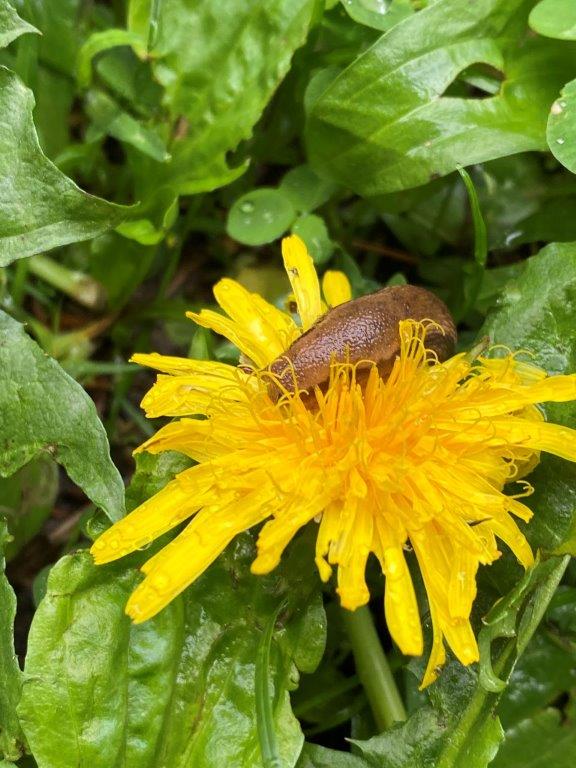
I've had more slugs in my garden this year than ever. So when I found a slug hanging out atop a dandelion after a rain, I asked Marla (a snail expert) whether it was nibbling the flowers or trying to keep its foot dry. One question led to another and finally I asked if she'd maybe just write a little bit about snails for this blog. I'm so happy she did.
 
Peer down into a patch of weeds, under a decaying log, or sift through some topsoil, and you might have the chance to meet the often-misunderstood underdogs of the animal kingdom: the land snails.

Why snails, and what exactly are these squishy, slimy creatures, you ask? As a malacologist specializing in land snails and an artist who likes to draw them, I’m happy to tell you. 

I first discovered snails as a young child. I remember turning over the stones in my backyard, where I discovered the universe of tiny snails that lived beneath them. I was intrigued that they led a seemingly mysterious life and had a beautifully coiled shell. I had to learn more, and so began my lifelong quest.

Slugs are snails too, except that they evolved to not need a shell, or some have a drastically reduced bit of shell under the skin behind the head. So when I refer to snails, I really mean snails and slugs.

by Marla Coppolino
In their hidden lives, native snails do lots of unseen good for the ecosystem. First, they act as clean-up crews, making meals out of leftovers like old, rotted mushrooms, dead plants, and even dead animals. You’re more likely to find them if you do a careful search in their natural habitats, like meadows, undisturbed woodlands, and limestone outcrops, where they glean vital nutrients from these materials, like calcium and magnesium. 

In turn, snails and slugs become food for many other animals of the food web. Firefly larvae feast upon them, salamanders snack on them, even some mammals – like chipmunks and squirrels – munch them. For many birds, snails are an essential source of nutrients important for laying viable eggs.

Some snails and slugs can be real garden pests, but you’re unlikely to find the native snails in your vegetable garden. Snails that have been introduced from other lands are the ones with large appetites, doing much damage to your Swiss chard, cucumbers, strawberries, and other veggies and fruits under the dark cover of night. As much as I like to help others learn about the benefits of native snails in the ecosystem, so many questions come my way about how to get rid of garden pest snails. I’m not the expert here, but I can share one trick: I pick the little buggers off my veggies by hand every morning and drop them off at least 100 feet from the garden. Labor intensive, yes, but there’s minimal damage to my garden.


Why do I like to look for, talk about, write about and draw snails so much? Maybe it’s because they need someone to be their megaphone. Spending time with snails reminds me to slow down in life, in a good way, to stop, ask questions, and stay curious. I hope these amazing animals can do the same for both my children and adult audiences. 

Marla develops online courses at the Cornell Lab of Ornithology, mostly to help people learn about birds, how to be stewards of nature, as well as fun things like drawing and painting birds. She enjoys researching and pulling together scientific information in a way that's broadly understandable and fun to learn. Marla also drew the illustrations for The Sound of the Sea, by Cynthia Barnett (W.W. Norton & Co. 2021). You can find out more about her art at her website, www.marlacoppolino.com


Monday, August 1, 2022

Curiouser and Curiouser ~ by Laura Zimmermann

Laura and Tivy
When I think of STEAM, I think of Alice’s Adventures in Wonderland. Without curiosity science wouldn’t exist. And wonders? You don’t need a white rabbit to tumble into those. The natural world is filled with them. Take fungi. They are bizarre and mysterious life forms with new mysteries uncovered with each new finding.

As a scientist and professor, I gravitate to STEAM topics. I’m always down one research rabbit hole or another. The e-books my university students and I created for children in Uganda, Ghana, and Sierra Leone led me to nonfiction writing for children—a path that created new rabbit holes that have led to the most unexpected places. 

For example, Mushroom Rain. Reading Beatrix Potter’s journal led me to mushrooms, which primed me to read articles about them and drew me to one, in particular, on how mushrooms help create rain. I had fallen into a world every bit as weird and wonderous as Wonderland.

In writing nonfiction picture books, I share things about the natural world that excite me and I hope will encourage my readers to follow their curiosity. For me that often begins with spare, lyrical language to draw readers in. For Mushroom Rain, Jamie Green’s wonderful illustrations captured that vision and took it in a direction more magical than I could have imagined. 

The back matter builds on this by adding more details and ways to engage with the material. Back matter is where my research side shines through. I love it. With a sparse story, I use backmatter to further explain things and fill in the blanks. I want to provide support to build young readers’ understanding. Then I consider what else my readers may want to know and what will spark them to discover more. I include fun facts and STEAM activities to help make that happen.

Reviewing Mushroom Rain, Jen Forbus wrote, “Together Zimmermann and Green prove how fascinating—and beautiful—science and nonfiction can be.” And there is nothing more wonderous than that.

You can read a wonderful interview with Laura over at the GROG blog. And I'll be reviewing her book here at Archimedes this Friday.

Laura K. Zimmermann is a college professor by day and children’s writer by night. She has a PhD in developmental psychology and has published numerous academic articles as well as nonfiction stories in children’s magazines. Mushroom Rain is her first picture book. When she’s not writing, Laura can be found teaching and conducting research at Shenandoah University or wandering through nature with her Goldendoodle, Tivy. You can find Laura online at laurakzimmermann.com and on Twitter, Instagram, and Pinterest at @LauraK_PBwriter.