Showing posts with label problem-solving. Show all posts

Friday, October 25, 2024

Look Up - Stars Are Falling!

 The annual Orionids meteor shower has been happening this week, and is predicted to peak this weekend. Just how many meteors are we talking about? According to the Washington Post, meteorologists are expecting about 23 meteors to shoot across the sky every hour. I can't think of a better time to check out this book!

The Meteor Shower: Kaleidoscope Club  
by Marie Mazas; illus by Joëlle Passeron 
128 pages; ages 7-10
‎Blue Dot Kids Press, 2024

This is book two in this fun, STEAM adventure series and Nour and August, best friends and tree-house engineers, are at it again. This time they are drawing up plans to build something cool for watching the meteor shower. But first, they need to convince the Mayor to turn off the lights so they can have a dark-sky night. There’s already a law on the books that requires public lighting – street lights, public buildings, monuments – to be off between 1 and 7 am in an effort to reduce energy consumption. But nobody is enforcing the law, and the Mayor isn’t interested in pushing the issue.

So Nour and August engage in a flyer campaign: Keep the Stars Bright! Turn off Your Lights! This is a bold initiative for August, who is afraid of the dark. 

Just as the community seems to rally around the Dark Night idea, a fair moves into town. People have been waiting for the carnival rides and the games for a whole year – but the carnival lights threaten Nour and August’s efforts for stargazing. And an unlikely friendship threatens the Kaleidoscope Club.


What I like about the book is that it focuses on problem-solving and includes lots of STEM stuff: 
  • designing and building a model space capsule using recycled materials (engineering, art);
  • migration and light pollution (biology, conservation science);
  • meteors and constellations (astronomy); and
  • kitchen chemistry
I also like the back matter, which discusses in more depth how light pollution disrupts animal ecosystems, wastes energy, and even affects human health. And there’s a list of “what you can do” about it.

Thanks for dropping by today – and remember to watch for the meteor shower this weekend!. On Monday we'll be hanging out at Marvelous Middle Grade Monday with other  bloggers. It's over at Greg Pattridge's blog, Always in the Middle, so hop over to see what other people are reading. Review copy provided by the publisher.


Friday, August 23, 2024

Small Seeds, Big Dreams

 
Saving Delicia: A Story about Small Seeds and Big Dreams 
by Laura Gehl; illus. by Patricia Metola 
40 pages; ages 3-7
Flyaway Books, 2024    

theme: seeds, trees, conservation

Every summer afternoon, Kari and Cookie sat in the shade of the beautiful Delicia tree listening to Old Otis tell tales from way back when.

Back then, the world was filled with delicia trees, but now only one remains. What happens if it disappears? Kari wants to make sure it won’t – that there will be delicia fruit for children in years to come. And she has an idea for how to do it. All she needs is the old freezer in Otis’s shed.

What I like about this book: Though it’s fictional, the story reflects some of the realities we see in our world. Disease and environmental changes have pushed many plants to the edge of extinction. People are trying to save those plants – especially crops – by collecting seeds and storing them in seed banks. Author, Laura Gehl goes into more details about seed banks in her author’s note at the back of the book. “Already,” she writes, “seed banks have helped restore crops around the world that were killed by natural disasters, wars, and pest infestations.” Seed banks play an important role in preserving our planet’s biodiversity!

I always love the opportunity to chat with Laura about her books, so I asked her a couple of questions. Okay, three.

Me: What inspired you to write about saving seeds (and creating a seed bank)?

Laura: When I first began learning about seed banks, I was fascinated. I was particularly amazed as I read about the Svalbard Global Seed Vault, which is located close to the North Pole. Picturing thousands of seeds stored safely for the future, in a plethora of shapes, colors and sizes, ignited my imagination. I knew I wanted to write about seed banks, but finding my way to the story took a long time. I tried a number of different approaches, trying to craft a story introducing seed banks to young readers that would be interesting, inviting, and inspiring. I hope I succeeded in the end! 

Me: Do you garden - and have you gotten any seeds through seed swaps or seed libraries? 

Laura: When my oldest two kids were little, we lived in an apartment building with a community garden, and we enjoyed growing tomatoes and other fruits and vegetables there. Then we had two more kids and life got too hectic for gardening to fit into our schedule. When COVID took over the world, my oldest son came home on the last day before schools closed with a tomato plant rescued from the environmental science class. That started a new spurt of gardening for our family, and we grew lots of tomatoes, lettuce, and herbs that summer. (My in-laws, who are avid gardeners, lived with us for a while during the lockdown, so we benefitted from their expertise.) But then life got hectic again, and gardening fell by the wayside. When I have my next spurt of gardening energy, I plan to get seeds from a seed library. There are several seed libraries in Maryland, and I am excited to give them a try. Eating heirloom tomatoes is one of my favorite summer activities…now I want to attempt growing some! 

Me: Do you think you'll try to save some seeds after having written about it?

Laura: Definitely! I want to try saving seeds when I get back to gardening, and I would love to host a neighborhood seed swap in the future.  

Beyond the Books:

What seeds would you save if you could? Beans? Apples? Tomatoes? Some of these seeds aren’t very hard to save. Tomatoes, for example – just squeeze (or scoop) seeds from a ripe tomato into a sieve and rinse them, and let them dry. Other seeds that aren’t too hard to save are pumpkin, melon, beans, and some flowers such as sunflowers, calendula, poppies, and lupine.

You can learn more about what a seed bank is here and about the Millennium Seed Bank at Kew Gardens here. Be sure to check out this video of how Native Seeds/SEARCH stores their seeds in their seed bank.

Laura is a member of #STEAMTeam2024. You can find out more about her at her website, https://lauragehl.com/

We’ll join Perfect Picture Book Friday once they resume. It’s a wonderful gathering where bloggers share great picture books at Susanna Leonard Hill's website. Review copy provided by Blue Slip Media.

Friday, March 8, 2024

It's Raining, It's Pouring ...

 
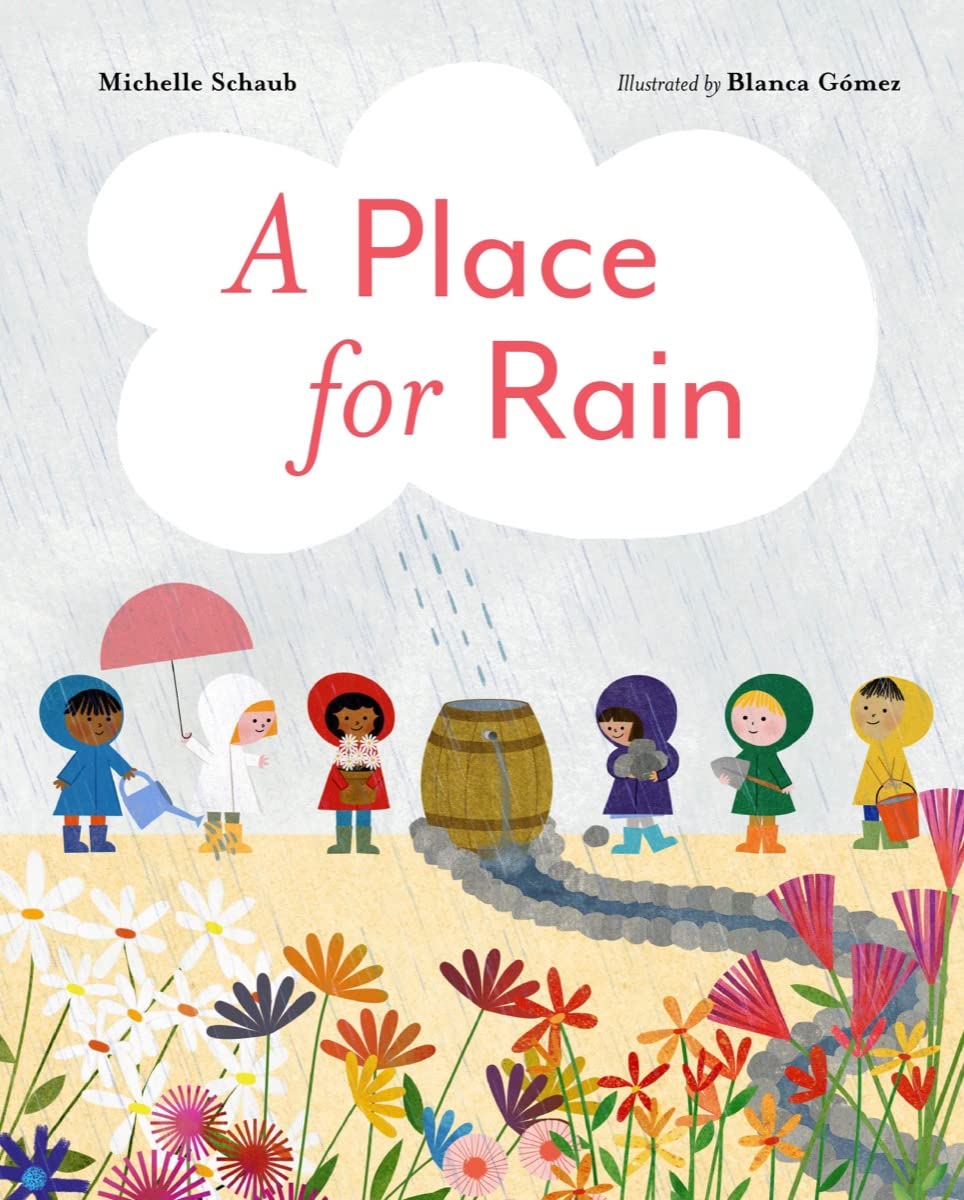
A Place for Rain   
by Michelle Schaub; illus. by Blanca Gómez 
32 pages; ages 4-8
‎Norton Young Readers, 2024

theme: rain, problem-solving, environment

Plink. 
     Plip. 
        Plop. 
We watch the raindrops drop.

Children, warm and dry inside, watch the rain pour down, puddle, pool, and fill the playground and parking lot, flood sidewalks, and run off into the road where it mixes with grit and grease. From there, the stream of water runs into storm drains and eventually into creeks, groundwater, or the ocean. 

The kids begin to wonder if they could collect some of that rain for a droughty day. And maybe they could keep it from pooling on the playground. Their solution: build a rain garden.

What I like about this book: I love the language, the onomatopoeia of plink, plop, pitter-patter, splutter-splatter. I like how Michelle Schaub highlights an important environmental issue by showing one solution –  a solution many cities are embracing as they focus on mitigating stormwater damage. And I really like that the Back Matter shows how people of all ages can Make Room for Rain with step-by-step instructions on how to build a rain garden.


A couple weeks ago, I caught up with Michelle (via the wonders of email) and asked her a couple questions.

Me: What inspired you to write a picture book about building a rain garden?

Michelle: I’ve always been passionate about using water and land sustainably, and I planted my first rain garden over ten years ago to help solve the problem of stormwater flooding my driveway. As I worked on the garden with my own children, I thought that the process would be fun to explain in a picture book.

Me: Why do you think this is an important story to share with children?

Michelle: In the face of doom and gloom news about climate change, A Place for Rain provides children with positive, attainable actions they can take to make a difference, whether it’s planting a full rain garden, or simply adding a rain barrel to a downspout to catch and reuse water.

Me: I agree, Michelle! Now for my favorite part of my Friday picture book reviews …

Beyond the Books:

Next time it rains, observe how and where the rain collects. What do you notice?

How much rain falls in a rainstorm? You can measure your rainfall if you have a big bucket and a ruler. Put the bucket in an open spot in your yard or driveway – not under roof eaves or trees. Then, after the storm measure how much rain fell.

Collect rainwater that comes off your roof by putting buckets under the eaves or a rain spout. How much collects? What could you use collected rainwater for? (water flowers, wash your bike, flush toilets…)

Michelle has written many books for kids, including Dream Big, Little Scientists. You can check out my review here on this blog

Michelle is a member of #STEAMTeam2024. You can find out more about her at her website.

Today we’re joining Perfect Picture Book Friday. It’s a wonderful gathering where bloggers share great picture books at Susanna Leonard Hill's website. Review copy provided by the publisher.

Friday, February 24, 2023

Problems with Plastic

I chose this book for it's title, because growing up I often heard someone exclaim "That's the last straw!" when they got frustrated. In this case, it's a call for action.

The Last Plastic Straw: A Plastic Problem and Finding Ways to Fix It (Books for a Better Earth)
by Dee Romito; illus. by Ziyue Chen 
40 pages; ages 6-9
‎Holiday House, 2023 

theme: environment, recycling, nonfiction 

Over five thousand years ago, the ancient Sumerians had a problem. They needed a way to avoid the icky substances in their beverages

Fortunately, these ancient folks were great problem-solvers and they came up with an idea: use a hollow reed to suck out the tasty liquid, leaving the sludgy stuff in the bottom of the cup. Even the Queen used a straw, though hers was a golden drinking tube encrusted with jewels.  

But there was another problem: some straw stems had residue that changed the flavor of the drink. Fortunately someone got the brilliant idea to wrap paper around a pencil to make a paper straw – and even patented the idea for how to do it! But there was another problem: could the top be bendy? And another problem…. And for each problem, people came up with a solution, and eventually plastic straws became ubiquitous.

Which led to an even bigger problem: too many plastic straws! Nearly 500 million straws are thrown out every day – in the US alone! And those plastic straws (and other things) don’t biodegrade. Instead, they break down into tiny bits called microplastics that stay around forever. They pollute oceans, endanger wildlife, and even show up in the food we eat! 

Fortunately, that’s a problem we can solve!

What I like about this book: I like the way Dee shows straws as a solution to a problem; even plastic straws solved a problem. I like how she focuses the end of the book on solutions. And of course, I like the back matter: an author’s note about more things that kids – and their families – can do, and a list of sources.

The Last Plastic Straw is part of the Books for a Better Earth series published by Holiday House. They  designed the series to inspire young people to become active, knowledgeable participants in caring for the planet they live on.

As a person who has tried to go straw-free, but still forgets to say “no straw” when ordering the occasional soda, I just had to ask Dee One Question:

Me: What was the last straw for you? And did you quit using plastic straws?

Dee: I’ve always tried to choose eco-friendly options, but wasn’t being as active as I wanted to be. Once I started researching and saw the photos of how much plastic pollution there is out there, we made the switch in our house away from plastic straws which has led to other earth-friendly choices. Sometimes we forget to say “no straws” or we’re on a road trip and the stainless steel are harder to keep clean, but we’ve started using agave straws (which are disposable and biodegradable) as our on-the-go option. And most of the time, you really don’t need a straw. It’s a habit and a convenience that I’m happy to give up for a cleaner earth and healthier sea creatures. As for writing this book, when I feel like the information I have can make a difference in the world, I want to write about it and share it!
Beyond the Books:

Find out more about alternatives to using plastic straws. Look for metal, bamboo, or even paper straws in stores or online. What other alternatives can you find?

Are there any companies manufacturing non-plastic straws near you? One company, Roc Paper Straws, makes paper straws Rochester, New York. The company is owned by a mother-daughter team who, when they started, had zero manufacturing experience and a giant dream. You can find out more about them at their website

Make your own paper straws. All you need is a pencil (or chop stick), some paper, glue, and wax. If you want your straws to be 100% biodegradable, use beeswax instead of paraffin to wax your straws. If you’re making straws for crafts, you don’t need to wax them. Here’s how to do it.
 
Dee Romito is a member of #STEAMTeam2023. You can find out more about her at her website, on Facebook, or on Instagram.

Today we’re joining Perfect Picture Book Friday. It’s a wonderful gathering where bloggers share great picture books at Susanna Leonard Hill's website. Review copy provided by the publisher.

Friday, September 17, 2021

Let's Do the Robo-Motion!


Robo-Motion: Robots That Move Like Animals 
by Linda Zajac 
32 pages; ages 4-9
Millbrook Press, 2021

theme: Engineering, animals, STEM

Animals are motion masters. They skitter, scuttle, grip, glide, spring, cling, and more.

In this book, Linda Zajac shows a diversity of robots that mimic animal movements. Octopus-inspired arms could help doctors perform surgeries, hummingbird robots are perfect for spy missions in cities, and the sticky feet of a gecko-bot make it perfect for repairing a spacecraft.

What I like about this book: I like the way each spread begins with motion. For example: “Swoop like a bat, flapping webbed wings.” Verbs highlight the actions that we will see the robot perform. In this case it’s a drone with flexible bat-inspired wings that allow it to dart and turn in flight. I like that there is a photo of the creature on one page, and the facing page has a photo of the robot – so readers can compare the two. And I really like that Linda ends with a challenge for young readers to take a close look at animals around them because the next discovery could be … YOURS! Back matter includes notes about “blueprints from nature” and a glossary.

This book pares down the technical stuff to the basics so well that I knew I just had to ask Linda One Question:

me: Can you share how you came to the structure for this book, presenting the movements of the animal and then how the robot uses those traits to do work for people?

Linda: That’s a great question. Since I was writing about biomimicry, specifically animal locomotion, I knew I wanted the book to include animals, robots, and motion. I considered different structures. I tried to turn it into a counting book and an alphabet book, but it felt like I was forcing the information into a format that didn’t quite work. Since both robots and animals are high-interest subjects, I liked the idea of giving them equal weight. To do this, I needed a line that worked for both, like Hannah Holt's text in The Diamond and the Boy. My first draft was verbose. I eventually pared those lines down to be the simple ones that appear in the book.

When I first sent it out, all the robot information was in the back matter. I was fortunate that my first editorial contact gave me a personal response. She thought the text was too sparse. It was a simple matter to move the robot info out of the back matter and into the main text.

Thanks, Linda! . 

Beyond the Books:

Observe an animal for a few minutes. Make a list of words that describe how it moves. Try moving like the animal moves. Then design a robot that could make those kinds of motions.

Build a scribble bot. All you need are some markers, a cup, and a motor – and lots of tape. Here's how to make it.

Check out these other books about robots and biomimicry here: two books about engineering and biomimicryEverything Robotics, and Cool Robots series

Linda is a member of #STEAMTeam2021. You can find out more about her at her blog.

Today we're joining Perfect Picture Book Friday, an event where bloggers share great picture books at Susanna Leonard Hill's website. Review copy provided by the publisher.

Friday, August 7, 2020

Solve it! for Kids ~ a podcast for all ages

Ever wonder how scientists, engineers, and experts solve problems? If so, you will want to check out the Solve It for Kids podcast. My friend and colleague, Jennifer Swanson co-hosts with Jed Doherty – and they get the scoop directly from experts on they solve problems in their really cool jobs.

New podcasts are released each Tuesday. Each podcast is a half-hour long interview with a scientist doing their thing. And they’re archived so you can catch up on any you’ve missed.

Want to know how to build teeth out of soap? You can find out here.
What about measuring particles that you can’t see? Or figuring out how to communicate with astronauts on Mars? You’ll find those here and here. Each episode includes a challenge for kids (and curious adults) – which is great because, as Jennifer and Jed say, “You’ve got what it takes to solve the world’s biggest challenges!”

Jennifer is a member of #STEAMTeam2020 and also the creator of the STEM Tuesday blog. You can find a review of her most recent book, Beastly Bionics here and find out more about her at her website.

Friday, October 11, 2019

This Math is For the Birds

Today's books play around with math. But before I get to them, I want to announce a fun costume contest - with PRIZES!


You can find rules for the contest here. Get creative! Have fun!
and now, for the books....

Don’t call these mathematicians “bird brains” – because they are busy solving problems.
theme: math, birds, imagination

Arithmechicks Add Up: A Math Story
by Ann Marie Stephens; illus. by Jia Liu
32 pages; ages 4-8
Boyds Mills Press, 2019

10 chicks head off to play.

Cheeping and chattering, they count rocks, flowers, and how many steps it takes to reach the park. Once there, they play – and add. With three chicks swinging high into the air, and six more at the lowest vertex of the arc, there are nine in all, swooshing through the air – while one holds up a scorecard so we can keep count.

What I like about this book: This is a great resource for teachers, homeschoolers, and parents who are looking for a fun way to introduce the idea of addition. Each spread shows a different way to add up the chicks – and back matter explains the different ways that you can use to represent addition. Most of us are familiar with basic equations and tally marks, but this book includes number bonds, counting on fingers (or feathers, depending on your species), number lines, and more.

Pigeon Math
by Asia Citro; illus. by Richard Watson
40 pages; ages 5-10
The Innovation Press, 2019

One bright and sunny morning, ten pigeons…

… well, there were ten pigeons sitting on the line until they got distracted by some bees – or maybe wasps – flying by. Still, some return to the line so the narrator continues the story. But this time he begins with four pigeons…

Wait! Pigeons are coming back! Now the narrator has to begin all over again. I’m sure the poor narrator has a story to tell, but with pigeons coming and going, will we ever get past the first line? Before pigeon bedtime? Meanwhile, there’s addition and subtraction happening all over the place.

What I like about this book: It’s funny, and fun to read out loud because every time you get settled and think the story will start there’s a …
           Hey! Wait! What do you think you’re doing?
….interruption. A great interactive read-aloud that offers plenty of opportunities to ask: how many flew away? How many came back? How many are there now?

Beyond the Books:

Make up your own story that involves some math – with or without birds. It could be about things you find outside, a tree losing its leaves, or anything that strikes your fancy. But definitely have some fun with it! Draw some pictures to go with it. Then share it with a friend.

Pigeons can count! Yes, scientists have really studied this, and counting might come in handy if you wanted to, for example, know how many eggs you had in your nest. Here’s an article about the pigeon study.

Birds can solve problems. You’ve probably heard about crows figuring out how to open containers or use hooks to get food. This National Geographic video shows a grackle solving problems.

Bird smarts are as much nature as nurture. Sure, your parents can teach you basic stuff like how to sing a tune. But city birds seem to learn more than their country cousins. Or maybe they just have more problems to deal with…

Today we're joining other book bloggers over at STEM Friday, where you can discover other cool STEM books. And we're joining Perfect Picture Book Friday, an event where bloggers share great picture books at Susanna Leonard Hill's website. Review copies provided by the publishers.


Friday, March 23, 2018

Izzy Gizmo shows us Girls can be Engineers

Got a problem? Then grab your tools and figure out how to solve it. That's something anyone can do regardless of their age or gender. Here are two books perfect for kids who hang out at the library maker-space or tinker in the basement.

theme: engineering, problem-solving

Izzy Gizmo
by Pip Jones; illus. by Sara Ogilvie
32 ages; ages 4-8
Peachtree Publishers, 2018

Izzy Gizmo, a girl who loved to invent, carried her tool bag wherever she went... 

Izzy mends things that don't work. She also tweaks them and embellishes them or invents something new. Her inventions are marvelous, magnificent ... and too often malfunction. Like the spaghetti-eating machine, and the nearly-automatic hair cutting robot. Just when Izzy is ready to quit in frustration, she finds a crow with a broken wing. Izzy knows she has to help.

What I like love about this book: I love the feisty and determined Izzy. I also like her patient and supportive grandpa who reminds her that inventors make a lot of mistakes before they get to "ah-ha!" What I really love, though, is when Izzy decides to help the crow regain flight. She'll invent wings. Sounds easy, but she's got to collect some materials (I love the scene where she liberates a couple engine sprockets from a motorcycle while the leather-jacketed guys aren't paying attention!).

I love the bright illustrations, the wonderfully expressive characters, and even the end pages that look like an erector set blew up and landed on the paper.

A few years back there was a wonderful book about Rosie Revere, Engineer. She's the shy girl who creates wonderful gizmos from recycled stuff... including a flying machine. It flops, but Rosie keeps on tinkering until she overcomes the problems. The book is fun, and inspired a lot of girls to grab their own tools and engineer their own solutions. So I was really happy when, last year the publishers released a wonderful, fun activity book for Rosie Revere fans.

Rosie Revere's Big Project Book for Bold Engineers
by Andrea Beaty; illus. by David Roberts
96 pages; ages 5-7
Abrams, 2017

If you have not read Rosie's story, fear not - this book begins with the original story (though condensed onto fewer pages). Then there's a great list of stuff you should have in your "inventor's toolbox" and 40+ things to invent, draw, and make.

First thing: a page for you to write down questions. Because engineering begins with a question. How can we do this? How can we make that better?

What I like love about this book:  There's space for you to reinvent the wheel (yes! really!) and instructions for constructing a catapult. There are challenges, places to write notes, graph paper, and inspiration for inventing.


Beyond the books:
Check out what engineers do - from creating structures to coding programs to creating ways to keep our environment healthy.

Create structures using jellybeans and toothpicks. You might find jellybeans on sale this week, and you can check this site for inspiration.

Construct things, like a Marble Roller Coaster or a Snack Cracker Pulley machine.

Today we're joining the STEM Friday roundup - and we're also joining others over at Perfect Picture Book Friday, an event in which bloggers share great picture books at Susanna Leonard Hill's site. She keeps an ever-growing list of Perfect Picture Books. Review copies provided by publishers.

Friday, March 17, 2017

Beastly Brains

Beastly Brains
by Nancy Castaldo
160 pages; ages 12 & up
HMH, 2017

Do animals think? Solve problems? Do math? Understand the concept of fairness?

You bet, says Nancy Castaldo, and she offers up a wealth of examples shoeing how animals think, talk, and feel. In one chapter she describes and experiment in which scientists gave monkeys tokens that they could use to buy treats. The monkeys quickly learned to take advantage of "sales" (when they could get more than the usual item for the same cost). They also stole tokens from others.

Other scientists wanted to know whether dogs feel jealousy. So they tested pairs of dogs. One was asked to "shake" without any reward. Then another dog joined them and when it "shook" paws it was given a treat. Do you think the first dog kept giving her paw when asked to "shake"? No! She went on strike! Unfair!

Castaldo has filled this volume with stories that will amuse you, make you think, and maybe even inspire you to test your own pet's intelligence. There is a wonderful section at the back ("Inquiring Minds Want to Know") that outlines how you can do your own animal intelligence studies. There are also tons of other resources: places where your pets can get involved in studies, organizations that advocate for animals, videos and books, plus a glossary and source notes.

Today we're joining the STEM Friday roundup. Drop by STEM Friday blog for more science books and resources. Review copy provided by publisher.


Friday, December 18, 2015

Brain Games!

Brain Games ~ The Mind-blowing Science of Your Amazing Brain
by Jennifer Swanson
112 pages; ages 8-12
National Geographic Kids, 2015

"Your brain is the most powerful and complex supercomputer ever built," writes Jennifer Swanson. It's about the size of a softball, weighs about three pounds, and looks like a wrinkled up sponge - but it pretty much runs this show we call our body.

Every chapter focuses on a different aspect of the brain: how it creates memory, controls emotions, makes decisions, and solves problems. There are plenty of challenges (can you solve a Rubik's cube?) sidebars filled with fun facts and fancy words, and cool trivia. You'll learn about earworms - which are delightfully different from earwigs, but just as annoying - and why heart-pumping music helps you make better decisions.

I especially like the Brain Breaks - diverse puzzles and games that provide a break from reading and a chance to kick back and play - and the "try me" activities. Want to try an experiment right now? Smile. Yup, that's all: just smile. Smile for as long as it takes you to count to 10. Feel any better? (if not, smile longer)
What happens if you smile at other people? How do they respond? For a real challenge: try smiling instead of yelling at your brother... and observe what happens to you and to him.

There's even a section for people with busy busy crammed full busy lives - about multitasking. Our brain might do better if, instead of trying to do lots of things at once, we do one thing for a short period of time and then move to a different task (sequential tasking). Jennifer's "Rule of 20" goes like this: focus on one task for 20 minutes (set a timer). When it buzzes, take a breath, stretch your legs, then set the timer for 20 minutes and go on to a different task. Try this with your homework... your brain  cells will thank you. But remember Archimedes' Rule of 40: after 40 - 50 minutes of sitting, get up and move around for 10 minutes. Your body will thank you for that!

Today's review is part of the STEM Friday roundup. Drop by STEM Friday blog for more science books and resources. Review copy from the author & the folks at the GROG blog.


Friday, April 11, 2014

Smart Crows!

Some crows have learned that it's important to use the right tool for the job. For example: if you're hungry and want a tasty beetle larvae tucked inside a tree trunk, the right tool would be a stick. You hold the stick on your beak and poke it into the hole where there's a beetle grub. That irritates the beetle larvae which snaps its jaws tight on the stick. Then all a crow has to do is pull it out.

But what if food is in a small bucket with a handle? And it's stuck in a tube? A stick won't work - but a piece of wire might. In 2002 some scientists gave a female New Caledonian crow a bit of wire and that very problem She bent the wire into a hook that allowed her to grab the bucket handle and retrieve the food. She did it not once, but nine times in the subsequent ten trials.


Now, scientists in New Zealand have shown that crows can solve puzzles to get food. They offered crows food that was floating on top of water in tubes. The problem: the tubes were narrow, so only their beak fit in. And the water level was so low the crows couldn't reach the food. Fortunately, the scientists provided the crows with an assortment of blocks and other heavy items. The crows figured out that if they dropped the blocks in the tube they would displace the water, raising the food to a level where they could reach in and grab it with their beaks.


Crows aren't the only birds to use tools. The Woodpecker Finch (Galapagos Islands) uses a cactus spine to dig grubs out of holes. Egyptian vultures drop stones on ostrich eggs to break them. And some herons use breadcrumbs or insects as bait to lure fish into reach.

Are there any tool-using animals in your neighborhood? Drop by STEM Friday to see what other science books and resources bloggers are sharing.

Friday, October 18, 2013

Bedtime Math - what an excuse to stay up late!


Bedtime Math: A Fun Excuse to Stay Up Late
by Laura Overdeck; illustrated by Jim Paillot
ages 3-8; 96 pages
Feiwel & Friends, 2013

Laura Overdeck loves numbers. Granted, she's got a degree in astrophysics, so she gets an automatic pass into the math world.... but numbers shouldn't be scary, she thinks. To anyone, whether they're a teacher or a parent or a kid. So when her first child was two years old, Laura and her husband started counting out stuffed animals and creating bedtime riddles. It was when their third child demanded math problems that they realized they were on to something: a flashcard-free home where math had become a favorite bedtime activity, much like reading a story is.

Now Laura's pulled some of her favorite problems into a book, Bedtime Math. I posted a review of the book over at STEM Friday, but here's a sample of one of her problems - a seasonal one at that:
 If you have giant pumpkins that weigh 1,000 pounds each, and your car weighs 4,500 pounds, how many whole pumpkins do you need to outweigh your car? For big kids she asks: what weighs more, 4 of the 900-pound pumpkins or 5 of the 700-pound zucchinis?

A few weeks ago Laura graciously answered a few questions about why Bedtime Math is so important. It started back in college when she was figuring out such things as how much the universe weighs and whether the universe is growing or collapsing. Astrophysics, says Laura, is a lot of math!

Laura: I took a teacher prep class, and that got me thinking how math and science are taught - and how we make this stuff approachable. Years later, as a mom, I see how math anxiety pervades our society. There are elementary teachers who are afraid of math, and parents. We need to break this cycle. (check out Laura's TED talk below)

Archimedes: In your book you mention that math literacy is every bit as important as language and reading.

Laura: Yes! Parents read to kids all the time, and children have a positive view of reading. So why not math? Even if parents don't love math, they can weave it into daily life in a way that makes math fun. That way children can see that math is fun before they set foot into their first classroom. The thing is, we use math every day, and it shouldn't be relegated to the "homework" category. We can play with math while in the car, or before breakfast or any time that is not school - and that way the message becomes "math is not homework; it's part of everyday life."

Archimedes: Aside from never saying "Oh, I never did well in math...", how can math-phobic parents help their kids fall in love with math?

Laura: There are so many simple things. When playing with toy trucks you can ask: if the truck drives 2 feet this way and then 3 feet that way, how many feet does it drive? There are so many ways to draw children into mathematical thinking, and the more you explore, the more likely a child can find a math area where he or she has strength. Children have different math intelligences- some have an easier time with geometry and spatial orientation, while another might be more inclined towards engineering and another more in tune with the language of algebra.
Head over to Laura's website,Bedtime Math - and sign up to get a nightly problem. Today's review is part of the STEM Friday round-up. Check out the other science books and resources reviewed this week. Then on Monday, we're joining Abby the Librarian for Nonfiction Monday.
 Review copy provided by publisher.