Showing posts with label writing. Show all posts

Monday, October 24, 2022

The Stories This Rock Could Tell


Every rock has a story.

For this rock, it could be the story about how it used to be a chunk of shiny fool’s gold until it got covered by the gravel from Lake Bonneville. That gravel was heavy, and compressed the rock into a matrix of limestone. Over time, limonite replaced the beautiful pyrite crystals, turning them brown. Eventually the water receded, leaving the rock high and dry, allowing opportunity for wind and rain to erode the limestone.

Or it could be the story about one city car, two cowboys, three girls and their parents, and four stuck tires. A story that begins with dad packing the car for a grand adventure and mom packing sandwiches and kids arguing about who gets to sit where. A story that wonders why a car that had no business being there, found itself stuck in a creek bed that, in drier weather, passed for a road. And honest-to-god cowboys with strong quarter horses and thick ropes who rescued said vehicle and then offered the girls a ride to the quarry because they were heading that way anyway to check on the herd.

It could be a story of who, what, when, where, how, and why. For example: why would someone carry that rock across the entire country, twice, when there are other, smoother, prettier rocks to tuck into a pocket? Or a story that has no grounding in our shared reality.

On the other hand, it could be a story about a rock that remembers those cowboys, and the lake, and the time it was new and shiny and had great expectations for the future.

Next time you find a rock, sit down with it and ask its story. You'd be surprised how much a rock has to say.

Monday, September 26, 2022

Notice, Wonder, and Seek ~ by Randi Sonenshine


Several years ago I wrote an artist statement – a sentence or two that described what I did as a writer. That was before my debut book was published and, subsequently, before I truly knew myself as a writer. More importantly, it was before I believed myself to be an artist (something I still question more often than I’d like!).

After giving it much thought, I landed on this statement: I write picture books and poems that take readers on nature-fueled and wonder-filled journeys. Those two phrases, nature-fueled and wonder-filled, capture my essence as a writer, which was in no small part influenced by a childhood steeped in nature.


I grew up on Maryland’s Eastern Shore, with the Chesapeake Bay just to the west, and the Atlantic Ocean just to the East, so there was no shortage of woods and watery places to explore. Wood-fringed ponds, creeks, rivers, marshes, and swamps, each with their own alluring mysteries, were all within close reach. My parents were nature-loving adventurers, so spring through fall, our family of five was off to one state park or another, our canoe-topped pop-up camper bobbing behind us with each dip in the road. 

Our trips always included nature walks and outings with the five of us (and our sixty-pound Irish setter) piled into our red Coleman canoe. My parents never missed an opportunity to educate us on the flora and fauna, though it was always in a way that taught us to notice, wonder, and seek rather than passively absorb information. 

We didn’t need to go camping to commune with nature, however; we only needed to walk out our back door, across the sloping backyard, and down the homemade log stairs into a primordial wonderland - the Swamp. Our Swamp.

Our Swamp, which fed from a pond and funneled into a Creek, was shaded by holly and bald cypress trees and ringed with cattails, sedges, jewelweed, and numerous other plant species. According to my mom, there were 37 different species of birds when we moved there in the winter of 1977.  Songbirds, ducks, geese, owls, herons, and a plethora of four-legged critters, like otters, rabbits, foxes, and white-tailed deer called the Swamp home. There were also snakes, frogs, turtles, and fish. 

My sisters and I, along with our neighborhood friends spent countless hours traipsing in the swamp and adjacent woods. Sometimes we took the canoe through the swamp all the way to the pond, maneuvering through the thick tangle of undergrowth and overgrowth. This often required getting out and carrying the canoe where it was too shallow, or some impenetrable jumble of green blocked the way. 

Though I’m sure I didn’t fully appreciate it then, this time spent in nature had a profound and lasting impression on me. Today, I write with the hope that my books will inspire readers, young and old, alike, to seek out the wild, wooded, and watery places and make their own wondrous discoveries. 

Randi Sonenshine grew up exploring the magical world of forests, streams, and ponds in a pair of trusty tennis shoes and a red canoe. Her debut picture book, The Nest That Wren Built (reviewed here), is a Junior Library Guild Gold Standard Selection and earned a place on many notable lists. Her newest picture book is The Lodge That Beaver Built and it releases this week!

In addition to writing for children, Randi is a literacy specialist and instructional coach in northwest Georgia, where she lives with her husband, two sons, and a sock-eating poodle. Learn more about Randi and her books on her website, www.randisonenshine.com, on Twitter @rsonenshine, and on Instagram @randisonenshine.

Monday, September 12, 2022

Haiku to the Rescue ~ by Kathy Halsey


Cosmic cliffs. Star birth.
Our past mysteries come alive.
Stellar nurseries.

I am thrilled to be guest blogger on author-friend Sue Heavenrich’s Archimedes Notebook today. Sue and I met at the WOW Nonfiction Retreat in the Georgia mountains 7+ years ago and blog together with other children’s writers on the GROG blog

I love writing nonfiction and informational fiction. The natural world is a muse that relaxes me and feeds my curiosity. A writing format that makes nature observation even more detailed and distilled is the seemingly simple haiku. I discovered haiku early in high school; Bashō and Issa were my favorites. 

Last August, after I received a professional critique that made me feel like I couldn’t write my way out of a paper bag, I stopped writing. Haiku came to my rescue. I sat on the back deck with my journal, sketched, and wrote. This simple joy soothed me. 


It's Just Stones!

Making something new
from ordinary unseen
elements is ART.

This year I began to take my haiku, photos, and photos of friends to Twitter weekly. I enjoy participating in #HaikuSaturday, created by Susan (Morhar) Andrews (@AndrewsSusanM).  As Susan says, “There aren't any rules-- just friends sharing haiku and having fun. Everyone is welcome.”  

Connecting to the natural world in an artistic form via haiku comes easily to me now. Through wonder, play and being outside, I meet science through nature’s magic. I observe, make comparisons, investigate, ask questions, take notes, and talk to experts—teachers, scientists, and, of course, I do research. I’ve even used haiku as a revision technique for a STEAM picture book. I’m sharing a few of my favorites to help you jumpstart your brain and see the world with fresh eyes.


Betta Dance

Bettas swim and swish.
Water ballet is their forte.
The tank? Their own stage.


Splendor Alights

Stillness. Perfection
lights upon sweet nourishment.
A moment in time.

For nature to shine.
For me to reflect beauty.
For splendor captured.


Whispering Pines

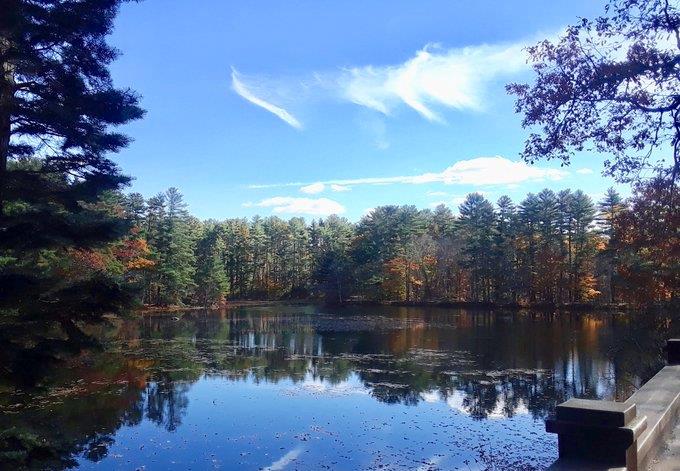
Fall calls. Reflections
gleam and mirror in the lake. . .
Time to reset. Pause.


Zebras as op art.
Nature's canvas paints a feast
For discerning eyes.


Kathy Halsey received a 2019 PBChat Mentorship and is Ohio SCBWI Central/South region’s newest ARA. Her first board book releases winter of 2023. She is a former K-12 school librarian, seventh grade English teacher, and Past President for The Ohio Educational Library Media Association. Kathy volunteers for the Choose to Read Ohio Advisory Council for the State Library of Ohio and learns about nature, flowers, plants, and vegetables by volunteering in a community garden. Kathy and Bob, her husband, live in Columbus OH with their rescue Corgi Scrappy Doo. Find Kathy online at 
her website ~ http://www.kathyhalsey.com
the GROG ~ http://groggorg.blogspot.com
twitter ~ https://twitter.com/infowoman1
facebook ~ https://www.facebook.com/kathy.halsey.5

Monday, August 22, 2022

Bringing Back the Words

Words are important. At least, being a writer, I like to think so. Words connect us to ideas. Words connect us to our culture, history, family and community. And words connect us to nature. 

I was a kid who kept lists of nature words: names of the rocks we hunted for; names for the squirrels and birds I learned to identify; names for wild places hidden in vacant lots and parks around the city. Pooh had the Hundred Acre Wood; my friends and I had the Secret Forest – though it wasn’t very secret and only had a handful of trees. Something inside me felt that if I could name an animal, flower, rock, I might know it a little better.

So I was surprised, taken aback, even appalled to learn that a children’s dictionary was removing words about nature to make more room for words about technology. This started in 2007 when the Oxford Junior Dictionary deleted a slew of nature words: dandelion, acorn, magpie, otter – seriously? Who removes those cute, fluffy critters from a children’s dictionary? But the facts are that the children’s dictionary has a limited number of pages upon which to print words, and the words children are using (or being forced to use in school) are changing. In place of the nature words, they put in voice mail, broadband, BlackBerry – a now obsolete phone, not the tasty Rubus spp we continue to pick from prickly vines to this day.


This losing of nature words rubbed a lot of people the wrong way. Teachers and scientists sent emails to the Oxford dictionary folks. And author Robert Macfarlane teamed up with painter, Jackie Morris to create a lovely book, Lost Words. I discovered this book in 2019 and fell in love with it. It’s presented as a “spellbook for conjuring back those lost words” – those words snatched from the language of children before they even had a chance to learn about conkers and newts, bluebells and brambles. The pages held not just poems, but spells that might – through the magic of being spoken aloud – bring back those lost words into a child’s language. Ours, too.

How we perceive and talk about the natural world affects how we relate to it, and that affects how we care for it. Or how we don’t. I sometimes catch myself talking about going out to the garden to chat with plants or listen to the bees. When I hear a bird song I don’t recognize, I often ask, “who’s that?” 

I think that having words to share our observations about nature and the ecology around us is vitally important. Not only does it give us a language to converse in, but it strengthens our connections to the natural world. These connections are critical, especially now. In the past 50 years, human activities have contributed to a loss of nearly 70% of the world’s wildlife.


Can we reverse our environmental losses by changing the language we use? I think so. What if, instead of “profit” we talked about “environmental sustainability?” Instead of “weeds” we used words like “dandelion” and “pussy toes” and “plantain?” What if, like wildlife rehabilitators, we released wild words, like "kingfisher" back into our lexicon?

The Lost Words folks have created a wonderful Explorers Guide for teachers and parents and curious naturalists. You can find it at the John Muir Trust website (www.johnmuirtrust.org/john-muir-award/ideas-and-resources/literacy-and-nature/the-lost-words). It is packed with activities across the curriculum ~ poetry, science, things you can do outside and things you can do inside. You’ll also find articles and other resources there.

And if you’re interested in becoming a keeper of nature words, here’s another book you might want to check out: The Keeper of Wild Words, by Brooke Smith. Check out my review here.

Monday, August 15, 2022

Three Lessons For Writers ~ by Nancy Castaldo

Writers never stop learning, and with every book we write comes more lessons. The lessons learned from my latest book, The Wolves And Moose Of Isle Royale, began decades ago. 

Every college student knows how anxiety-ridden it can be to plan your course schedule. What if you don’t get into your most-wanted class? What if your classes conflict with each other? What if you’ve been excited about taking a class and find it not offered? The last predicament happened to me. The Ecology class I had been eagerly anticipating was not offered in my senior year. How could this be? Ecology was what I hoped to pursue after graduation. How could I leave college without it? 

Lesson one – Be persistent

Fortunately, I didn’t have to. I pleaded my case to my advisor, the chair of the science department, and my small, women’s college went into action. They hired an adjunct professor to teach the class. There were four of us who loved every minute of it.  Why am I telling you all of this? Well, that class had a profound impact on my career and directly led me to write The Wolves And Moose Of Isle Royale decades later. That professor introduced me to the wolf and moose predator/prey study on Isle Royale and researcher, Rolf Peterson. 

Lesson two - Be ready for opportunities.

Sometimes writing stories begins long before our fingers touch the keyboard. Sometimes they lay dormant just waiting to rise to the surface as this one did for me. But while this story was waiting to be told, I followed the ongoing research on Isle Royale, and when new developments took place, I was ready to dive into this book project. 

Lesson three - It takes a team for each story to be told. Build a great one!

That said, my writer friends in the region kept me apprised of local news stories that I didn’t see on national media. They became valuable team members for my book. 

When I reached Isle Royale and was able to interview Dr. Peterson, the story came full circle decades after it all began. 

Would I have written it if I wasn’t able to take that ecology class? Would I have been able to access a local point of view if not for friends in the field? I don’t know. What I do know is that sometimes lessons line up to provide us with what we need to tell our stories. I can’t wait to share this one with my readers. 

Nancy Castaldo , a founding STEM Tuesday team member, has written books about our planet for over 20 years including The Story of Seeds, which earned the Green Earth Book Award, Junior Library Guild Selection, and other honors. Nancy’s research has taken her all over the world from the Galapagos to Russia.  She strives to inform, inspire, and empower her readers. Nancy also served as Regional Advisor Emeritus of the Eastern NY SCBWI region. Her 2022 titles are When the World Runs Dry (Jr Library Guild Selection), The Wolves and Moose of Isle Royale (Scientists in the Field) and Buildings That Breathe. Visit her at http://www.nancycastaldo.com or follow at @NCastaldoAuthor.

You can read my reviews of some of Nancy's previous books here: When the World Runs DryBack from the BrinkBeastly Brains; and Sniffer Dogs.

Monday, August 1, 2022

Curiouser and Curiouser ~ by Laura Zimmermann

Laura and Tivy
When I think of STEAM, I think of Alice’s Adventures in Wonderland. Without curiosity science wouldn’t exist. And wonders? You don’t need a white rabbit to tumble into those. The natural world is filled with them. Take fungi. They are bizarre and mysterious life forms with new mysteries uncovered with each new finding.

As a scientist and professor, I gravitate to STEAM topics. I’m always down one research rabbit hole or another. The e-books my university students and I created for children in Uganda, Ghana, and Sierra Leone led me to nonfiction writing for children—a path that created new rabbit holes that have led to the most unexpected places. 

For example, Mushroom Rain. Reading Beatrix Potter’s journal led me to mushrooms, which primed me to read articles about them and drew me to one, in particular, on how mushrooms help create rain. I had fallen into a world every bit as weird and wonderous as Wonderland.

In writing nonfiction picture books, I share things about the natural world that excite me and I hope will encourage my readers to follow their curiosity. For me that often begins with spare, lyrical language to draw readers in. For Mushroom Rain, Jamie Green’s wonderful illustrations captured that vision and took it in a direction more magical than I could have imagined. 

The back matter builds on this by adding more details and ways to engage with the material. Back matter is where my research side shines through. I love it. With a sparse story, I use backmatter to further explain things and fill in the blanks. I want to provide support to build young readers’ understanding. Then I consider what else my readers may want to know and what will spark them to discover more. I include fun facts and STEAM activities to help make that happen.

Reviewing Mushroom Rain, Jen Forbus wrote, “Together Zimmermann and Green prove how fascinating—and beautiful—science and nonfiction can be.” And there is nothing more wonderous than that.

You can read a wonderful interview with Laura over at the GROG blog. And I'll be reviewing her book here at Archimedes this Friday.

Laura K. Zimmermann is a college professor by day and children’s writer by night. She has a PhD in developmental psychology and has published numerous academic articles as well as nonfiction stories in children’s magazines. Mushroom Rain is her first picture book. When she’s not writing, Laura can be found teaching and conducting research at Shenandoah University or wandering through nature with her Goldendoodle, Tivy. You can find Laura online at laurakzimmermann.com and on Twitter, Instagram, and Pinterest at @LauraK_PBwriter.

Monday, May 30, 2022

A Link between Moving and Creativity

Do we get our most creative ideas when walking? Some scientists think so. Since the time of the ancient Greek poets, people have known that moving helps us to think creatively. Which begs the question: why do I tend to sit at my desk to do my writing?


The fact is, I come up with some wonderfully creative ideas when I’m walking. But is it the movement or the change of scenery around me that stimulates my mind? And it’s not just walking. I have come up with some of my best ideas while turning the compost pile, planting seeds, spading my garden beds, and raking leaves. Sometimes it’s a matter of just having time away from a project, and letting my mind go into neutral while I do something physical. 

Recently, Barbara HÀndel, a neuroscientist at the University of WÃŒrzburg, wanted to know more about how movement is connected to creativity. What happens in our brain when we walk? she wondered. And are people who don’t move less creative?

What she learned is that movement isn’t necessarily the thing that helps us think more flexibly. Rather, she says, it’s the freedom to make movements without having those movements forced into regular patterns…  which is too often what happens when you focus on a small screen for long periods of time.

She’s not the only one who has looked into this in a scientific way. A few years ago a Stanford study showed that creative thinking improves while a person is walking – and even afterwards.

I'd love to elaborate, but I'm heading outside for a walk!

Monday, May 16, 2022

Writing Begins with a Question ~ by Roberta Gibson

What does it take to write STEAM books for children?

First, it takes curiosity. 
Almost every day, a question pops into my head. Can you grow the seeds inside a kiwi fruit you buy in the grocery store? Do ant larvae make sounds to call to the workers inside the dark nest? What causes iridescent clouds?

Then it takes effort.
Many times other people have had the same question and the answer is a mouse click or trip to the library away. For example, iridescent clouds — which glow with pastel colors like the surface of a soap bubble —show up when clouds are full of small, uniform ice crystals or water drops that diffract light waves. 

eventually one may sprout!
Sometimes the answers aren’t clear, but the questions are too expensive or time consuming to investigate. I recently found a scientific article about Myrmica ant pupae that can make noise by stridulating. At this moment, however, I’m not in the position to test whether the larvae different kinds of ants can stridulate. Perhaps someday I’ll interest an expert in this question. 

The lucky few are questions that beg for an experiment or test. If you are curious about kiwi seeds, save some seeds from a kiwi fruit and try to germinate them. If that doesn’t work out, get some commercial seeds —for a control to show that your method works— and design an experiment. 

I wondered recently what happens when you drop bird feathers one by one from the second floor. Do tail feathers sail differently from wing feathers than soft down feathers? Turns out that wing feathers tend to helicopter. Cool!

I absolutely love this hands-on fiddling aspect of STEAM and youngsters do, too.  

Now here’s the secret sauce:  keep a journal. 
Every time you have an idea, or do an experiment, write it down. Draw illustrations to help you remember what you did and what happened, plus take tons and tons of photographs. 

When the question or idea leads to more and more questions, and if the topic just won’t go away, then the journal entries may grow into a book. 
 
Nothing is better than that.
 
Thank you for joining us today, Roberta.  Last year I reviewed Roberta's picture book, How to Build an Insect. We also got together to chat about bugs over on the GROG Blog. You can visit  Roberta's website here and make sure to drop by her wonderful blog, Growing with Science.

Monday, April 25, 2022

Inspiration along the Writing Journey

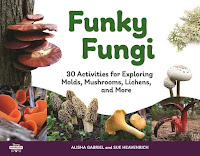
As we worked on Funky Fungi, Alisha and I discovered a couple of books that inspired us on our writing journey. They engaged our curiosity and prompted several conversations that led us to look more closely at the fungi surrounding us.

Entangled Life, by Merlin Sheldrake

You know it’s going to be a fun book when the first thing you read is “What is it like to be a fungus?” Merlin Sheldrake gives us a tour of the kingdom from a fungal point of view. If we want to understand how ecosystems work, we need to understand the mycorrhizal fungi beneath our feet. Fungi challenge the way we think about evolution and intelligence, even what makes an individual. 

In one chapter Merlin takes us on a hunt for truffles; in the next we watch mycelium solving a maze. My favorite, though, was the dive into lichens. Lichens are relationships between algae and fungi, but what exactly do the fungi do? Then there’s the connection of fungi with roots, and mycelial webs connecting entire forests (and other plants) into an internet of sorts. Throughout, he cites research, both past and ongoing, that contribute to our current understanding of fungi. Underlying it all is the caveat that what we think we know now will undoubtedly change as we learn more. 

Finding the Mother Tree, by Suzanne Simard 

I picked up a copy of this book the day it hit the bookstore. I love how Suzanne Simard took me right into her world of trees. Born and raised into a logging world (the rainforests of British Columbia, Canada), she spent her days learning about – and from – the trees surrounding her. In this memoir, she writes about her work in forestry and her research in the forests. Suzanne’s language transported me deep into the northwest forests. Reading it on my porch on warm summer days, I could almost smell the pine needles and the earthy soil of the rainforest.

The book’s focus is Dr. Simard’s studies on how trees communicate through underground mycelial networks, how they care for each other and mount defenses against natural enemies. I particularly liked the sections where she detailed the methods of her scientific inquiry. She does not gloss over the hard work: fencing study sites, transplanting trees, digging, watering, camping out, even the failures due to weather and other elements. And there were plenty of failures – that’s part of the scientific method, right? 

Nor does she gloss over how the scientific community responds to new ideas that challenge the status quo. By the end, I gained a better understanding about the connectedness of the “Mother Tree” that nurtures the forest. More important, I gained appreciation for how important these underground connections are for the survival of both forest and human. 

Remember to check out our Funky Fungus Fridays over at my author Facebook page, and Alisha’s #FungiFriday posts on Twitter

Check back next month for another post about our book-writing journey.  Funky Fungi, 30 Activities for Exploring Molds, Mushrooms, Lichens, and More is part of the Chicago Review Press “Young Naturalists” series. You can find out more about our book at the publisher’s website. It will hit bookstore shelves in two months, but you can pre-order it at your favorite local bookstore, or online at Bookshop.org


Monday, April 18, 2022

Inspiring Readers to Save the Planet ~ by Christy Mihaly


Happy Earth Week! The first Earth Day in 1970 focused on air and water pollution. Back then, factories spewed so much oil into water that rivers caught fire. Air pollution gave people cancer. But folks generally assumed this was the price of "progress." 

Christy appreciates water!
Rachel Carson's 1962 book, Silent Spring, helped wake Americans up, and Earth Day inspired broad action. I celebrated the first Earth Day with the Girl Scouts, collecting trash at a creek. But in 1970, we didn't appreciate the full extent of the manmade crises facing Earth. 

Today, I worry kids may see climate change as too big to solve, too daunting to fight. But then I watch young people, teens and younger, raising their voices, demanding action, inventing solutions. There's hope. 

That's why I write what I write. I want to give kids information and incentive to save the planet. Books have the power to do that.

I recently wrote a picture book about water. Why water? It's an ordinary, everyday substance—and central to life. I lived a couple decades in California, where water is often scarce. I worked with diverse stakeholders to negotiate a fair division of the waters of the Sacramento River system (leaving enough for the fish), because users held legal "rights" to an amount of water that exceeded the actual flow. Moving to Vermont in the 2000s, I was struck by the moist greenness and the ubiquity of streams and ponds. But I saw that even where water is so plentiful, we must steward it. 

In Barefoot Books WATER: A Deep Dive of Discovery, I wanted to share my deep appreciation of the science and the wonder of water. Working with the talented Barefoot Books team, we developed an engaging, interactive book.

We created a "water droplet" (fictional cartoon character) to offer funny comments and fun facts. We incorporated experiments, activities, and calls to action for that hands-on element, adding flaps and gatefolds too. And while we confirmed that all infographics and illustrations were scientifically accurate, we left room for the amazing illustrator, Mariona Cabassa, to explore the world of water with colorful, imaginative scenes. 

I used playful language, noting, for example, that water is a "shape-shifter," and wrote poetic passages as well. Together I hope that all these aspects of the books help WATER to capture kids' interest and passion and inspire them to be water stewards.

Thank you for joining us today, Christy.  I chatted with Christy about her book, WATER  back in October over at the GROG Blog. And she shares some hands-on water exploration activities on Patricia Newman's Lit Links blog here. You can visit Christy's website here.

Monday, March 21, 2022

We Write to Learn

 One of the reasons I write for kids – well, for anyone, really – is because I want to know more about something. And that curiosity has led me on a lot of discovery adventures. For example, I knew that fungi were all around and that they play an important role in the environment. But I hadn’t realized how extensive their mycelial networks are.

Alisha: I agree, Sue. My curiosity has driven me to research and explore a variety of topics. Some colorful fungi caught my eye more than ten years ago, but when I began considering their importance and the ways we use fungi, from food to medicine, I realized it was a topic that could fascinate kids, too. 

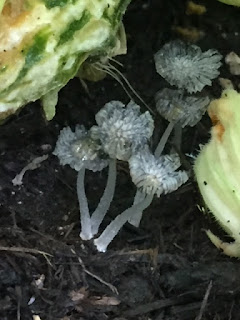
Sue: Another thing I learned was just how diverse Fungi are. This past summer was a good one for fungi, and I saw them popping up everywhere. As I learned more about them, I found even more fungi growing around me – because I knew where to look, and what to look for.

funky fungi, captured by Alisha

Alisha: Me, too! When I took a closer look in my yard, I discovered several different kinds right under my nose! Over the years, I’ve noticed lichens, bird’s nest fungi, and little brown mushrooms, but this year I found inky cap mushrooms, several types of shelf fungi, chicken of the woods, and even a lichen-covered insect wobbling across a trimmed branch. 

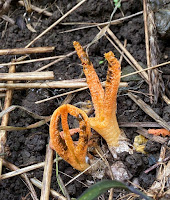
in Sue's garden

Sue: I was surprised by the beauty of the fungi growing in my garden. One looked like an orange octopus emerging from the mulch! Or maybe a chicken foot? Another was so dainty that by the time I got my camera, it had melted into an inky spot. I learned my lesson: stick the camera into my pocket whenever I head out to the garden – or any place outside. Because you never know what you’re going to find.

Speaking of cameras and fungi photos, I’ll be posting photos of mushrooms every Friday this spring and summer over at my author Facebook page, and Alisha will post frequently on Twitter. Look for the hashtag, #FungiFriday


Check back next month for another post about our book-writing journey.  Funky Fungi, 30 Activities for Exploring Molds, Mushrooms, Lichens, and More is part of the Chicago Review Press "Young Naturalists" series. You can find out more about our book at the publisher’s website. It will hit bookstore shelves in three months, but you can pre-order it at your favorite local bookstore, or online at Bookshop.org

Monday, January 10, 2022

Writing about Nature...

Every morning I spend time with a cup of coffee and my notebook. Sometimes I write about what I see outside my window. Sometimes I write about a fungus or insect I observed the day before. Sometimes I've got an idea for a story, and other times I'm left wordless.

It was on one such wordless day that I threw down my pencil in disgust (fortunately missing the coffee) and flipped through the pages of my notebook in search of inspiration. Anything. A list of words to get me going - heck! even one word would do. 

I didn't find a list, but I did remember something: back in October some of my illustrator friends participated in an "art-ober" challenge to draw a sketch each day based on a list of prompts. Hmmmm, I thought, I could sure use something like that. A list of words biased toward my science interests. 

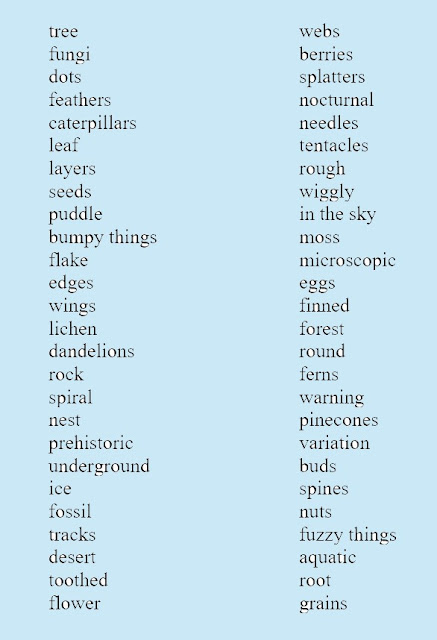
So I began scribbling as many as I could think of: obvious ones, like tree and fungi. Words with texture and edges and layers and smells. Words that sprouted in gardens and pushed up through moldering leaves of a forest floor.

Here are a few of them. Ration 'em out one a week and you've got a year's worth of nature-writing prompts. Meanwhile, I've got a blank page in my notebook just waiting for more fun nature words to drop by.

 
Nature Words


Friday, February 5, 2021

Nonfiction Writing Comes from the Heart

 
Nonfiction Writers Dig Deep: 50 Award-Winning Children's Book Authors Share the Secret of Engaging Writing 
by Melissa Stewart 
190 pages
National Council of Teachers of English, 2020

Back in 2017, award-winning author Melissa Stewart was a featured panelist at the National Council of Teachers of English (NCTE) Annual Convention in St. Louis, Missouri. The panel was called “The Secret of Crafting Engaging Nonfiction” and Melissa shared the platform with Candace Fleming and Deborah Heiligman (also award-winning authors) and moderator Alyson Beecher. A couple questions were raised that session: what fuels their work,  and why did they dedicate years of their lives to a single manuscript?

“As we compared our thoughts and experiences, we came to realize something critically important,” Melissa said on her website. “Each of our books has a piece of us at its heart.” It’s that personal connection that keeps nonfiction authors working on a story. 

Other writers shared similar thoughts, and what began as a nebulous thought grew into a book filled with essays – and heart from 50 nonfiction writers. They write about choosing topics that fascinate them, about finding the focus for their books, about their personal connection to what they write. 


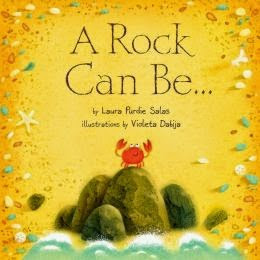
“…there’s a common, crushing misconception that fiction is creative writing drawn from the depths of a writer’s soul, while nonfiction is simply a recitation of facts…” writes Laura Purdie Salas. If you’ve read any of her books you know that she’s a master of lovely, lyrical language that seduces you into wanting to know more about leaves, water, rocks.

Many teachers and students have the impression that writing nonfiction is all about pulling together research and then “cobbling together a bunch of facts.” But the truth is, Stewart continues“the topics we choose, the approaches we take, and the concepts and themes we explore are closely linked to who we are as people – our passions, our personalities, our beliefs, and our experiences in the world.” Put facts through those personal filters and you get the secret sauce for nonfiction books that engage readers and make them want to learn more.

The cool thing about this book: it contains a treasure trove of ideas for things to do in the classroom – or homeschool – to help young writers develop their own “secret sauce” for writing nonfiction. Things like idea boards and other cool things I’m going to try in my own writing.

For nonfiction writers, not only does this book share secrets of the soul, it’s a great resource if you’re looking for mentor texts. As for me, I’m keeping my copy of this book right here at my desk because I know I’ll be referring to it now and then. And also to remind me to share more from it over the course of this year. 

Find out more about this book and the contributors here at Melissa’s website. Review copy provided by the publisher.