Showing posts with label forests. Show all posts

Friday, May 1, 2026

STEM in Graphic Novels

Picture books depend on the combination of text and illustration to tell the story. You know what else does that? Graphic novels. Today I’m exploring two recently published books that combine science and art.

theme: STEM, comics, art

Fiddlehead Forest (Little Habitats, 2) 
by Jana Curll 
92 pages ; ages 6-9
Greystone Kids, 2026

When a tree falls in the forest…

does anyone hear it? The answer depends on your definition of “anyone” – but in this case, the answer is definitively YES. Fern and friends not only hear their tree fall, but they are determined to help raise it back to its previous – and grand – height. Even if it takes (checks calendar) a few years. After trying a few things, Millipede, Moth, Slug, Lichen, Mushroom, and Fern decide on their plan of action: hang out with tree and do nothing. Well, nothing except what they normally do every day.

What I like about this book: I love that the story begins the minute you open the cover. That’s where we meet the characters, when Fern does a roll call to make sure his best buddies are safe after the storm. 


I like the puns that run throughout the book, from the table of contents (chapter four: Aiming for slug-cess) to mushrooms im-spore-tant information. Each chapter focuses on how one of the characters helps tree to find their new growth as a nurse log. Detailed sidebars in each chapter clarify the science that’s going on – often beneath the surface and out of sight. For example: mushroom’s underground mycelium network and slug’s recycling superpowers. 

Fiddlehead Forest is book two in a series that began with Barnacle Bay. That book opens with Crab, who is SO tired of every day being the same old thing. On his way out, he runs into Larva, who is floating in on the tide. Crab, who really does have a kind heart, agrees to show Larva around the neighborhood, and introduce him to the other residents: kelp, oysters, mussels and clams… the writing is just as playful (and pun-full) as Fiddlehead Forest.


We Are Dwarf Sperm Whales!: A Graphic Guide to Cetaceans 
by Anne Lambelet 
80 pages; ages 7-11
Graphic Universe/Lerner, 2026

It’s the first day of school for Kogi, but he’s not headed for the school of fish. Kogi is a sperm whale, in the class of Cetaceans which aren’t fish at all! They don’t have scales, and they don’t lay eggs. But whales can grow to enormous lengths. Except dwarf sperm whales. And whales sing long songs heard for miles beneath the ocean. Except for dwarf sperm whales. And some whales can swim as fast as 20 miles per hour! Except for …

yeah, you guessed it, dwarf sperm whales. Is there anything that Kogi can possibly be good at? 

What I like about this book: I love that Kogi eventually learns what his dwarf sperm whale superpowers are, because I was starting to worry about the little guy. Well, OK, not so little (average length is 9 feet). The pages are filled with cetacean info, and there’s a Very Helpful Glossary at the back of the book.

Some observations about STEM graphic novels and graphic nonfiction:
The books I’m sharing today are fiction because they have characters, and because in the real world fiddlehead ferns don’t talk (neither do dwarf sperm whales). But there are nonfiction graphic books – and here’s the thing: in our library they are cataloged JNF as though they are all graphic novels. So next time you’re looking for an informational book about science or history, or perhaps about a person or a place, remember that  nonfiction options exist on the graphic novel shelves.

Why give your kid a graphic novel?
  • Graphic books help readers develop visual literacy. That’s the ability to understand and interpret nonverbal imagery – a skill that’s becoming increasingly vital in our information age.
  • Graphic books help make complex ideas easier to understand with addition of visual elements and dialog.
  • Also, illustrations add context clues that aid comprehension, so a graphic book can be more approachable than traditional texts for people with diverse learning styles.
  • Graphic nonfiction is a fun – and fast – way to explore a new topic.
Beyond the Books:

Do you have a favorite animal or plant? Or maybe a rock or mushroom? Draw them as a character.

Create a comic strip where your character introduces us to where they live.

Make some silly puns about plants or animals that live in your yard or neighborhood. For example, there’s a couple ferns living in my garden. They’re close fronds with the poppies.

Turn your pun into a comic!

Today we’re joining Perfect Picture Book Friday. It’s a wonderful gathering where bloggers share great picture books at Susanna Leonard Hill's website.  On Monday we'll be hanging out at Marvelous Middle Grade Monday with other  bloggers. It's over at Greg Pattridge's blog, Always in the Middle, so hop over to see what other people are reading. Review copies provided by the publishers.

Friday, August 29, 2025

This Tree Needs Fire to Survive!

 
Pine Cone Regrown: How One Species Thrives After Fire 
by Elisa Boxer; illus. by  Kevin and Kristen Howdeshell 
32 pages; ages 5-8
Sleeping Bear Press, 2025 

theme: forest, ecology, trees

Nestled in the needles, seeds sealed inside, the pine cone hangs high out of harm’s way…

For those of us who grew up with Smokey Bear and posters reminding us that Only You Can Prevent Forest Fires, the idea that forest fires are necessary comes with a bit of trepidation. Fires destroy so much: animal homes, timber, wildlife food sources… and often the wildlife themselves. But some trees require fire.

In this book, Elisa Boxer introduces readers to lodgepole pines, one of the serotinous trees that can only produce new seedlings when their cones burst open from the heat of flame. Once the flames clear the canopy, the seeds fall down onto soil filled with nutrients from the ash and begin to germinate. Over time, the forest renews itself.


What I like about this book: I like how Elisa uses lyrical prose to bring us into what could be a scary story. I like the way she shows how fire is integrated into forest ecology. Not only do certain trees require heat to germinate their seeds, but other plants and fungi require fire to thrive. I like the back matter! Elisa reaffirms that fires are destructive and come at an environmental and health cost. At the same time, she points out that fire has always been part of a healthy forest ecosystem. 

Beyond the Books:

Find out more about how trees have adapted to fire, and the plants that grow back in a burned area. An article about trees from the National Forest Foundation, and a couple articles about other fire-adapted species from the Teton Chapter of the Wyoming Native Plant Society and “fire followers” in Southern California.

What trees and plants move into burn areas in the environment where you live? (If you live in a city, look to the surrounding areas)

If you’re interested in learning more about wildfire ecology, I’ve posted reviews of a couple books right here on the blog: The Glorious Forest that Fire Built, by Ginny Neil and Fire Escape: How Animals and Plants Survive Wildfires , by Jessica Stremer.

Check out why some folks use controlled burns to restore health and diversity to natural lands here. 

We’ll join Perfect Picture Book Friday once they resume. It’s a wonderful gathering where bloggers share great picture books at Susanna Leonard Hill's website. Review copies provided by the publishers.

Friday, August 22, 2025

How To Plant a Forest


The Blue Jays That Grew a Forest 
by Lynn Street; illus. by Anne Hunter 
48 pages; ages 4-8
‎Peachtree/Margaret Quinlin Books, 2025

theme: ecology, autumn, birds

How does the mighty oak create more oak trees? By making acorns.

But here’s the thing about acorns: they are heavy! (I know this because I’ve had a few fall on my head.) They are too heavy to blow on the breeze, so they plunk right down to the ground. Right under the tree. Here’s another thing about acorns: they need sun and water and room to grow. And how can they get that if they’re laying on the ground in the shade with all the other acorns? Well, if they’re from the white oaks next to my house they get picked up and moved by squirrels and birds, carried away, and buried in the ground. 

And sometimes those acorns get forgotten and they sprout into tiny oak seedlings (I know this because I’ve had more than a few grow in my vegetable patch!). 

In luscious, lyrical language, author Lynn Street pulls readers into the acorn-caching behavior of blue jays who hide their treasure – like pirates! “With their beaks, the jays tap, tap, tap the acorns into soft ground…” she writes. The jays have to move fast, because there’s competition. Squirrels, turkeys, mice, chipmunks, deer … they are gathering up acorns too.


What I like about this book: I mentioned the language. Here’s what I mean: “Back and forth— flashes of sapphire in the sun— blue white, blue white.” Even without an illustration you can picture this blue jay flapping across the sky. I like that Lynn takes us through an entire year: winter when jays dig up the acorns to eat, spring when they feed their nestlings bugs (because acorns are too big for babies…),  and fall, when the young jays join the “blue crew” and help their parents collect acorns for the winter. I like the back matter, too! More information about oak trees and jays, and how human interaction has changed the nature of oak forests. There’s also a great list of books for further reading and some websites to visit.

Lynn’s inspiration for this book came from a photo of a blue jay carrying an acorn. In addition to researching books and articles about blue jays and oaks, she spent lots of time watching jays. So I had to ask her A Couple Questions:

Me: What cool insights have you gained from the jays visiting your backyard? (ours are raucous thieves!)

Lynn: I watched blue jays in my backyard as they interacted with a pin oak just over the fence. From a second story window, I was able to see into the oak’s canopy as jays pried acorns from the tree. Over several fall seasons, I spotted more and more of this acorn gathering in real time.

I noticed, too, where the peanuts from my bird feeder were being hidden. One jay buried a peanut under leaf litter. Another time I spotted a jay leaving a peanut in the rain gutter of my neighbor’s house. I also watched a blue jay pull an acorn out from between flagstones on my patio.

Me: Jays are related to crows, and crows are pretty smart birds. How do jays exhibit their corvid intelligence?

Lynn: Blue jays are part of the corvid family, which includes crows, magpies, nutcrackers, and ravens. Blue jays are very intelligent. They have an amazing spatial memory, which helps them locate thousands of buried acorns. The blue jay that dug up an acorn from my patio knew exactly where it was hidden. It landed, plucked it out, and was flying again a few seconds later. 

Blue jays are also great mimics. Their calls can sound like a hawk, or a squeaky gate. The hawk call may alert other jays to predators nearby or trick other birds into thinking a hawk is present. I hear the hawk call often, and the jays always fool me. I look outside when I hear it, but each time it’s a blue jay perching in a nearby tree. Only one time was it a hawk circling high above my street.

In captivity—but not in the wild—blue jays have been observed using tools to rake food into their cages.

The black markings on their faces and throats (called a bridle or necklace) vary and may help the jays to tell each other apart. Do you think you can tell the blue jays at your feeder apart?
 
Beyond the Books:

Watch some blue jays this fall.  Draw a picture of what your jays look like – and make sure to note the markings on their faces and throats.

This one comes from Lynn: Watch your jay’s behavior. Is the bird eating? Is it hiding food or plucking an already buried acorn out of the ground? Blue jays move quickly, so pay close attention!

Do you have oak trees in your neighborhood? If so, get to know them. Draw a map of where the oak trees are growing. 

In the spring, look for oak sprouts. You might find one in your yard or neighbor’s garden. If it’s “in the way” ask if you can dig it up. Then put it in a pot and watch it grow,

Lynn is a member of #STEAMTeam2025. You can find out more about her at her website, lynnstreetbooks.com 

We’ll join Perfect Picture Book Friday once they resume. It’s a wonderful gathering where bloggers share great picture books at Susanna Leonard Hill's website. Review copy provided by the publisher.

Friday, April 11, 2025

When a Tree Falls....


When a Tree Falls: Nurse Logs and Their Incredible Forest Power 
by Kirsten Pendreigh; illus. by Elke Boschinger 
44 pages; ages 6-9
Chronicle Books, 2025

theme: trees, ecology, nonfiction

A tall tree suns and sways. She is a place to grow, to rest, to shelter.

Over time and seasons we see what animals nest on the boughs, chip into the bark and, after the tree crashes to the forest floor, hide beneath the fallen trunk. Using lyrical language, Kirsten Pendreigh shows readers how the fallen tree nurtures new life.

What I like about this book:

The language is beautiful and spare – just enough words to convey meaning without cluttering up the page. This leaves lots of room for the beautiful illustrations by Elke Boschinger. I love how she tucks fungi along the edge of the tree, and the details of the mosses growing on the trunk – these are the same things I find on fallen trunks in the woods behind my house.


I like the arc of the story, which spans many years over which children grow into adults with their own children, who they bring into the forest to admire the trees. And I really like that Kirsten includes back matter that explains what nurse logs are, how they nurture new life, and how they keep the forest healthy. 

Kirsten graciously answered a Couple Questions: 

Me: When did you know you had to write this story about Doug fir and hemlock?

photo by Carrie Marshall
Kirsten: I've been fascinated by nurse logs since I first moved to the West Coast 30 years ago. Trees growing out of other trees! I felt there was something profound happening, and noticed how kids gravitated to these tree nurseries. About six years ago, while hiking the trails near my home, a refrain came into my head and became kind of an incantation. "A tall tree suns and sways...she is a place to grow, to rest, to shelter." The words kept building and became a life cycle story I was excited to write, and share with little ones.

Me: I love that you say in back matter that all species are connected and we all need to help one another. Did this guide your writing of this book?

Kirsten: I'm not sure it guided the writing but it was just organically there all along. I didn't know when I started writing that Douglas firs themselves typically don't grow out of nurse logs even though nurse logs in this part of the world are typically fallen Douglas firs! Western hemlocks are the most common species to grow out of Douglas fir nurse logs, so right there is a clear example of a deep connection. I learned that nurse logs help salmon survive, when they fall across streams they create sheltered pools for young salmon to grow. We are starting to understand how crucial it is to have diversity in the forest; how webs of life depend on a variety of species, how single species stands of trees are not as resilient as diverse forests. The more you look, the more you see these interconnections in nature. There is such strength in diversity. I hope it's an understanding people can take beyond the forest.

Beyond the Books:

Observe a tree. Describe what does it look like from far away. Now get under it and look up. How would you describe it? Draw a picture or take photos of your tree from different points of view. 

Examine a fallen log. What do you notice growing on the trunk? What about beneath it? Can you tell what kind of tree it is and how old it is? Are there any baby trees growing on it?

Stand tall like a tree. Here’s a video showing a kid-friendly yoga “tree pose.” Can you feel yourself rooting into the earth?

Kirsten is a member of #STEAMTeam2025. You can find out more about her at her website, www.kirstenpendreigh.com

Today we’re joining Perfect Picture Book Friday. It’s a wonderful gathering where bloggers share great picture books at Susanna Leonard Hill's website. Review copy provided by the publishers.

Friday, August 18, 2023

If you Burn a Forest Down...

Devastating wildfires have been in the news all summer, from Canada to Hawai’i, too often with deadly consequences for people and wildlife living in the path of flames. After a fire, people might choose to rebuild their homes and communities. But what about the forest? 

The Glorious Forest that Fire Built 
by Ginny Neil 
32 pages; ages 6-8
Amicus Ink, 2023

theme: ecology, wildfires, nonfiction

I am the forest. I am the fire, with flames whirling round. I swallow the forest…

When a fire consumes a forest, not much is left but black ground. But seeds fall, fungi sprout, flowers bloom, brambles and berries begin to grow, and animals move in. In this book Ginny shows the process of succession, from meadow back to forest.

What I like about this book: I like the cumulative way the story builds, adding one thing at a time to create a new forest where trees once stood. Succession is a process, and it happens bit by bit. Ginny tells a tale using rhyme and a familiar structure that kids will recognize. I like that it’s told from the point of view of the forest, and that once the trees have grown tall, there’s the realization that change is a constant in the environment. And I like the back matter, with a timeline of forest succession. 

What I like Best: This book ends with actions kids can take to protect forests from fire and a warming climate. In her author’s notes, Ginny admits that writing about fire when so many people have been affected is difficult. “The long view reveals that they also give much back to the land that they have ravaged,” she writes. She explains that the combination of fire suppression and climate change has contributed to the huge, catastrophic wildfires we’ve been seeing most recently. 

I wanted to know more about Ginny's writing, so I asked her  
A Couple Questions:

Me: What inspired you to write about fire succession?

Ginny: As a teenager, I spent my summers at a great camp in Virginia. The leader, John Ensign, took us on forest walks and one day he pointed out to us that hardwoods are the air conditioners of the earth. I began to wonder what would happen if they disappeared. That was a very early seed for the book.

After I married, we took our family out west to Colorado and drove through areas that had just been burned. I was intrigued to see bits of green poking up here and there – another seed.
 
Ten years ago, I retired from full time teaching and began writing. By 2017 I had a manuscript in progress called “This is the Forest that Wind Built” but in 2020 the news was all about forest fires and I remembered that trip to Colorado. I turned my focus to thinking about what happens to a forest after a fire. 

Me: How did revising/revisioning help you clarify the story you were writing?

Ginny: I think you finally know you are a writer when you recognize the importance of drafting. There were 42 drafts of The Glorious Forest that Fire Built, maybe more. 

I've learned to trust my gut. I will get a certain feeling when something is as good as I can get it and that's when I need to put my pencil down. 

This story started in 2017 with these lines, "This is the forest the wind built..This is the field that is home to forest the wind built...." About draft ten, fire made an appearance, but this manuscript still had a long ways to go...First lines were, "These are the flames that danced bright and hot..."

In 2021, on my 20th draft, I tried writing it in first person and suddenly I knew I was closer to saying what I wanted to say. The first three lines were almost word for word what is currently in the book, but the rest was a mess.

Ten drafts later, my agent Lisa Amstutz began helping me refine it, but it was pretty close at that point. We were just tweaking meter and rhyme.

This amount of drafting is pretty normal for me. I'm not sure how it is for other authors. Sometimes, I don't even know what I want to say until I have tried it a lot of different ways.  I do not like first drafts, but I can also spend too much time agonizing over every single word in a rewrite. I am trying to find a happy medium.

Me: Thanks for sharing your process, Ginny.

Beyond the Books:

Go for a forest walk. What do you notice about the temperature when you are walking beneath the trees? What do you hear as you walk in the forest? What kinds of plants do you see? What does your forest smell like?

Draw a picture of one of the trees that lives in a wooded park or forest near you. If you can, do a bark rubbing, collect a leaf, take a photo.

You can learn more about forest fires and succession here.

Ginny Neil is an award-winning teacher, a master naturalist, and a member of #STEAMTeam2023. You can find out more about her at her website. 

We’ll join Perfect Picture Book Friday once they resume. It’s a wonderful gathering where bloggers share great picture books  at Susanna Leonard Hill's website. Review copy provided by the publisher.

Friday, July 16, 2021

A Walk in the Woods

 theme: nature, STEAM, observation

This month I’m reviewing books that explore different habitats and biomes. Today we’re off to the woods.

Look What I Found in the Woods 
by Moira Butterfield; illus. by Jesus Verona 
32 pages; ages 2-5
Nosy Crow (Candlewick), 2021

Follow me. I know the way.
We’re walking through the woods today.
Look what I found!

This is such a fun book to read before you head of on a walk through the woods. And maybe to carry along with you. It’s part field guide and part treasure hunt. Some spreads invite you to look for specific things: a signpost, wild strawberries, beetles. 


 Other spreads explain how to identify things, such as what kind of snail shell you’ve found, and how to tell a tree by its leaves or needles.


What I like about this book: It’s fun! I love the die-cut cover, and the scavenger-hunt type lists of things to find. I love that this book is all about observations, and the questions support visual literacy. And that the author asks young naturalists to be thoughtful while exploring, and only collect things they find on the ground (if you’re going to use items in art or to study).

If I gave stars, this book would get some.

Beyond the book:

Collect seeds from trees and observe them. Take them apart and learn more about how those trees grow. Try planting some seeds. I once planted a maple seed, and it grew! And every spring I find baby oaks growing from acorns that squirrels have buried in my garden.

Make some rubbings of tree bark. Put paper against a tree and rub the side of the crayon against the paper. The design of the bark will show. Now compare your rubbing to the tree’s bark. Are there some details your crayon couldn’t pick up?

Draw a picture of something you see on your walk in the woods. It could be a mushroom or a bird or a flower… Then give it to a friend and tell them where to find it. 

Go on a woodland scavenger hike – but instead of collecting items, take photos or draw pictures. Here's a place to find a woods walk printable scavenger hunt.

We’ll join Perfect Picture Book Friday once they resume. It’s a wonderful gathering where bloggers share great picture books at Susanna Leonard Hill's website. Review copy provided by the publisher.

Friday, May 29, 2020

Get to know the trees...

If you can’t get out for a walk in the woods, then check out these “armchair” forest walks. One takes you high into the tree tops, the other deep into the woods.

theme: trees, animals, habitat

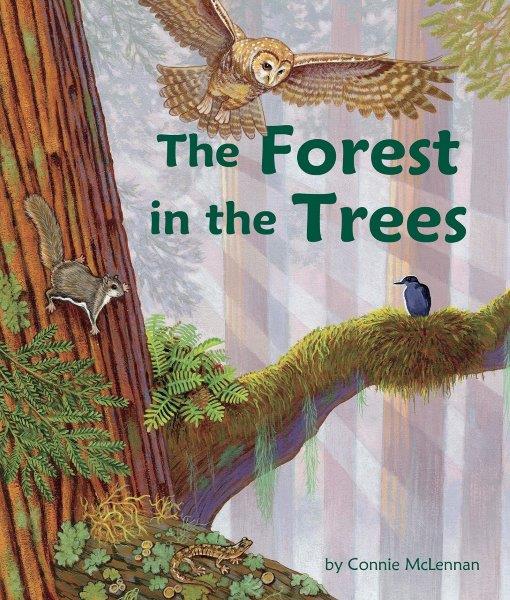
The Forest in the Trees 
by Connie McLennan
32 pages; ages 4-8
Arbordale Publishing. 2019

Deep in the woods near a foggy sea, there’s a hidden forest in the trees.

Coast redwoods are the world’s tallest trees, stretching up, up, up nearly 380 feet into the sky. To get that high in a city, you’d have to climb to the 37th floor of a skyscraper. If you could climb up into a redwood tree, you’d find … more redwoods growing! New trees growing up from the branches of the old tree. And on those branches, soil collects, ferns and moss sprout – even elderberry shrubs take root. Salamanders and squirrels, butterflies and birds make their homes in this forest in the sky.

What I like about this book: It’s fun to read, with one level of text building layer upon layer using “the house that Jack built” structure. A second level of text is found in sidebar boxes, additional information for older readers and parents who want to know more about the animals and plants living high on the redwood’s branches. And there is back matter: four pages of activities and challenges “for creative minds”

Can You Hear the Trees Talking? Discovering the Hidden Life of the Forest 
by Peter Wohlleben
84 pages; ages 8 - 10
Greystone Kids, 2019 (English reprint edition)

Let’s go on a journey of discovery. 

This book is a walk through the woods, broken into seven chapters. We begin by exploring how trees work, how they grow, then learn about friends and enemies, animals that live in and around then, and what makes trees awesome and important. Peter Wohlleben devotes each full spread to a single question: how do trees drink? Do trees make babies? Can they talk? What are trees afraid of, and are some trees braver than others? Do they sleep? Can they make it rain?

What I like about this book: It is a perfect mix of information and discovery. I love the one-question quizzes scattered through the pages, the “Look” sidebars inviting you to notice something, and the “Try This” activities that provide some hands-on STEM activities to explore the forest around you. I also love that the pages are edged in green, giving one the feeling of having fallen into the deep, deep woods.

Beyond the Books:

Play Tree Bingo. You can download these cards from Mass Audubon – or make up your own tree bingo cards for a family walk.

Go on a tree seed safari. Some trees produce fruit. Others make pods, or prickly balls, nuts, or samaras that helicopter to the ground. Some trees make their seeds in summer, others in fall. Check out what the trees in your neighborhood do.

Make a neighborhood tree guide. You might need to collect leaves to press, or draw pictures or snap photos … and you might even need a field guide to help identify the trees you find. But once you’ve gotten to know your neighborhood trees, figure out a way to share them with other people. Here’s one way.

Today we're joining Perfect Picture Book Friday, an event where bloggers share great picture books at Susanna Leonard Hill's website. Review copies provided by the publishers.

Friday, September 20, 2019

The Lost Forest

The Lost Forest 
by Phyllis Root; illus. by Betsy Bowen
40 pages; ages 4 - 9
Univ Of Minnesota Press, 2019

theme: maps, forests, wildlife

How do you lose a forest?

Especially when trees are so tall you can’t see their tops. So big it takes two or more people holding hands to reach around. You’d think a forest of trees like that would be easy to find – but in 1882, in Minnesota, a survey crew lost an entire forest. It disappeared right off their maps! Great news for the trees – they kept right on growing. Great news for the other plants and the animals living in the forest – they kept on raising seeds and babies and continuing their community of life.

For more than 75 years the mistake stayed on the map, protecting the trees from the lumberjacks’ saws and axes. Now the forest is protected and you can go visit 350-year old pines. So it is a lost-and-found forest, right?

What I like love about this book: I love the way Phyllis Root tells her story, with a sly wink to the reader. “If you were trying to turn this rollicking land into straight lines on paper, you might make a mistake,” she writes.  She reminds readers that the trees had never been lost. Neither had the orchids, porcupines, and other wild plants and animals. They knew exactly where they were!

I love the illustrations by Betsy Bowen. They pull you right into the woods. I like the endpages – maps of the township – and the plentitude of back matter. There you’ll find out more about old growth forests and some of the species you might find there. You can find out more about surveying, and there’s a fun section called “how to talk like a surveyor”.

Beyond the Books:

Map your backyard. Here’s a great blog post to inspire you. And another link.

Use legos to build a map of a place you know, or a place in a story. Get some ideas here.

Today we're joining other book bloggers over at STEM Friday, where you can discover other cool STEM books. And we're joining Perfect Picture Book Friday, an event where bloggers share great picture books at Susanna Leonard Hill's website . Review copy provided by the publisher.

Friday, February 2, 2018

Geoengineering Earth's Climate

This has been a crazy winter. One day it's in the 50s (Fahrenheit) and the next it's 16. Or 4 degrees which, with windchills, starts feeling like minus 20! In short, this is perfect weather for hunkering down with hot coffee and a book about climate change.

Geoengineering Climate Change
by Jennifer Swanson
96 pages; ages 8-12
Twenty-First Century Books, 2017

Floods! Tornadoes! Super-hurricanes! Blizzards! Wildfires! Mudslides! These weather events and catastrophes have been increasing in the past couple decades and are related to climate change caused by a warming earth. Most scientists agree that human activity - primarily burning fossil fuels - is responsible. And of we don't take action to prevent further warming, we'll see even more drastic changes.

What can we do? The most obvious solution would be to stop burning fossil fuels. But some engineers propose we tackle the problem with ... engineering. The propose constructing large-scale technologies to counteract climate change. Installations that would physically remove carbon from the air, or sequester carbon somehow. Some engineers propose crating artificial clouds to shade the earth, or send mirrors into space to reflect sunlight. Or shooting salt into clouds to make it rain.

Sounds farfetched, right? But scientists and agencies are already studying whether cloud-seeding is an effective way of manipulating where and when rain or snow falls. The problem: seeding clouds in one place can result in rain miles away, where it's not needed. Still, China used cloud-seeding to maintain clear skies for the 2008 Olympics, Swanson writes.

As for carbon sequestration - why not simply plant more trees, and protect forests from clear-cutting? The amount of trees cut every year in tropical rainforests would, if left in place, absorb up to 2 billion tons of carbon dioxide. Left in place they also protect against erosion and provide habitat. There are other, less technical "engineered" solutions, too. Painting roads and rooftops white would reflect the sun's rays. Planting more trees along roadways would shade and offer flood mitigation.

Swanson notes there are some sustainable things we can do right now to help mitigate climate change. In addition to planting trees we can insulate our homes and schools so they require less energy to heat and cool. We can conserve the energy we use by driving less, sharing rides, walking, and riding bikes. We can promote local renewable energy projects. And a big one: use less plastic. That's because the production of plastic uses fossil fuels.

Back matter includes a great list of books for further reading and websites where you can learn more about projects around the world.

Today we're joining the STEM Friday roundup - Review copy from the publisher


Friday, December 15, 2017

Forest World and Calpurnia Tate, Girl Vet

I love it when I'm reading a novel and find that the author has a passion for animals, nature, math - and has incorporated STEM into their story. Here are two recent books where the science and environmental issues are integral to the plot. If you're still seeking a gift for your science-loving kid, these fit well into stockings (and budgets).

Forest World
by Margarita Engle
208 pages; ages 10 & up
Atheneum Books for Young Readers, 2017

Edver isn't happy about being shipped off to Cuba to see the father he barely knows. He definitely isn't expecting to meet a sister he didn't know existed! And he most certainly didn't plan to capture a wildlife poacher.

But what we, the readers don't expect, is to be completely immersed in a Cuban jungle. In the first twelve pages, Margarita Engle introduces us to bee-sized hummingbirds, condors, zombie cockroaches, and the seemingly opposing forces of survival and conservation on a small island. And she does all this in poetry.

What I like LOVE about this book: tucked into every page is a connection to the world beyond humans. There's a discussion of convergent evolution and, later, biodiversity and the advantages of variability in a world being changed by global warming. Layered over this are the real-world concerns of kids: if their mama loves them, why is she off doing research, and what can they do to bring her home? Back matter includes a list of "truly cool biodiversity words".

A couple years ago I reviewed Engle's picture book about Louis Fuertes who, like Audubon, painted birds from life.

 Who Gives a Hoot (Calpurnia Tate, Girl Vet)
by Jacqueline Kelly
112 pages; ages 7-10
Henry Holt & Co, 2017

If you have a girl who wants to be a veterinarian- or who just loves wild animals - get this book into her hands. Eleven-year-old Calpurnia Tate - yes, the very same Calpurnia from The Evolution of Calpurnia Tate - explores the natural world around her Texas home. She learns about wildlife right in her backyard (or, in this case, a neighboring farmer's field) and helps the veterinarian mend their injuries. What's cool is that the book is set at the turn of the 20th century - the beginning of the 1900s - when veterinarians focused on livestock.

What I like about this book: Kelly's attention to details: mockingbird songs, what happens to a wet owl - those sorts of things. I also like the illustrations of Calpurnia's field notebook, and her "strong girl" attitude. She's not afraid to help an injured owl, even though it means catching mice for its meals. And she helps solve the mystery of what made the owl sick. A hint: it has to do with food chains.

 On Monday we'll be hanging out on Marvelous Middle Grade Monday with other  bloggers over at Shannon Messenger's blog, so hop over to see what other people are reading. Review copies provided by publisher.


Friday, November 18, 2016

Because of an Acorn

Because of an Acorn
by Lola Schaefer and Adam Schaefer; illus. by Frann Preston-Gannon
36 pages; ages 3-6
Chronicle Books, 2016

I love the simplicity of this book:
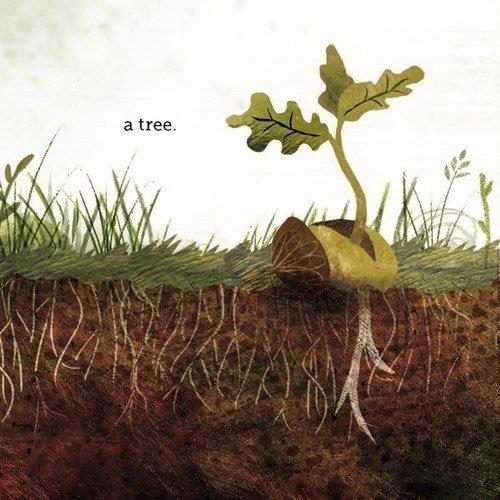
Because of an acorn, a tree.
Because of a tree, a bird.

I love the ecological layers in this book: food, shelter, seed, transport. Everything - everything - is connected.

I love the illustrations. Simple, soft, just enough detail. And cumulative. Plus there are some interesting die-cuts where the shape created the image on one page, but the coloring is from something different on the next.

See what I mean? Seedling and grass roots and soil particles... how cool is that!

I love the back matter. That's where you can learn more about the white oak tree - a "foundation species", and what an ecosystem is, and what role saplings play in the food chain. That's where you get the nitty-gritty details about forest inhabitants and why we need forests.

And that's where you'll find four things you can do to help forests.

By this time in November, most of our acorns are gone - eaten by turkeys or buried by squirrels. But I know that I'll find tiny oak sprouts in the spring... in my gardens and in the middle of the yard. And there's always plenty of acorn caps to use for art projects.

Today's review is part of the STEM Friday roundup. Drop by STEM Friday blog for more science books and resources. Review copy provided by publisher.

Friday, November 11, 2016

Squirrels Leap, Squirrels Sleep


Squirrels Leap, Squirrels Sleep
by April Pulley Sayre; illus. by Steve Jenkins
40 pages; ages 4-8
Henry Holt and Co, 2016

themes: animals, nonfiction

Squirrels wrestle.
Squirrels leap.
Squirrels climb.
Squirrels sleep.

Active, rhyming text takes readers through a day in the life of a squirrel - from climbing branches to storing seeds ... to flying. We meet four kinds of squirrels native to North America who demonstrate the things squirrels do. For example, squirrels use their tails as an umbrella and to help for balance.

What I like LOVE about this book: Sayre's spare text leaves plenty of room for Jenkins's wonderfully detailed cut-paper collages. The illustrations will have kids pausing before page-turns just do they can take a closer look at a squirrel running up a tree with a mouth full of leaves.  What are those leaves for? There are buried acorns that germinate into oak seedlings, and a groundhog - what's he doing in the picture?

There's back matter! Four pages of luscious extra details about the squirrel species, what they eat, the kinds of nests they make, and how they (unintentionally) help plant trees. Pulley includes scads of resources and some notes for kids who want to dig deeper into squirrel science and environmental issues.

Beyond the book: What kinds of squirrels live near you?
Go on a squirrel hike. Take some photos or jot down notes of the kinds of squirrels you see: their color, what their ears look like, their tail, whether they have stripes.

Squirrel-watching. Once you find squirrels (for instance, raiding your bird feeder every afternoon) - watch what they do. How do they run? How do they climb trees? How do they go down trees? Do they jump from one tree to another - and if so, how far?

Learn to speak squirrel. They make all kinds of wonderful sounds from alarm calls (kuk-kuk-kuk) to gentle murmels that mean "feed me". If you need help, try this video.  

If you have a bird feeder then you know that squirrels will overcome just about any obstacle to get food. Here's one video of a squirrel overcoming obstacles to reach food. And here's a video of a squirrel stealing candy bars from a vending machine!

Today's review is part of the STEM Friday roundup. Drop by STEM Friday blog for more science books and resources. We're also joining PPBF (perfect picture book Friday), an event in which bloggers share great picture books at Susanna Leonard Hill's site. She keeps an ever-growing list of Perfect Picture Books.  Review copy from publisher.

Friday, October 24, 2014

Beetle Busters & author interview


Beetle Busters: A Rogue Insect and the People who Track It (Scientists in the Field)
by Loree Griffin Burns; photos by Ellen Harasimonwicz
64 pages; ages 10 - 14
Houghton Mifflin Harcourt, 2014

This is a book about one gorgeous beetle (look at the beautiful antennae), the damage it does to forests, and the scientists and citizens who are trying to save their trees. The Asian Longhorn Beetle, also known as the ALB, came from China tucked into wood used to ship products to the US. Now it's infesting trees from Massachusetts to New York and into Canada, and foresters are in a race to control its spread. But is cutting thousands of trees the answer?

In this book Loree Burns takes a close look at the beetle - its life cycle inside and outside the trees - and the scientists tracking the insect. She talks trees: bark, tree rings, leaves and buds. She takes us into the woods with the beetle busting team for some surveying and a bit of tree climbing (don't worry; we're roped in), then into the lab. Beetle busting is hard work, and the scientists need help. That means we - yes, just ordinary citizens - need to help track and report beetle break-outs. Even if it means losing a tree we love.

Burns includes diagrams, sidebars, author's notes and resources for curious beetle naturalists. Ellen  Harasimonwicz's photographs are integral to this book. She traipsed from field to lab and her photos of beetles, trees, and scientists in action help us understand the complexity of the problem.

Loree has been traveling this fall, but she took a few minutes to answer some questions about her new book. You can find out more at her website.

Archimedes: Did this book evolve from an experience with a tree?

Loree: It began with several trees, actually. At the time, my family and I lived on a single acre and were the proud stewards of many trees, including several mature shagbark hickories that I particularly loved. And we were surrounded on two sides by 20 acres of forested conservation land. When I first began to read and hear about an invasive beetle and a program to eradicate it that involved cutting trees, I became very, very defensive. My first instinct was “No! Not our trees!”

So I went to an information session that was being held at the town library. The meeting was run by Clint McFarland, who was directing the eradication program in Worcester, and I learned a lot about the beetle, its strange life cycle, the damage it causes trees, the process involved in eradicating it, and the breadth of what was at stake. I could see the dilemma: cutting trees here NOW would save trees in lots of other places later, but cutting trees here NOW might also mean losing most of the trees that surrounded us.

I attended several more community meetings and, eventually, approached Clint with some tough questions. His patient and honest answers—he understood my stance but was firm in his own—convinced me that this complicated issue was worth exploring more deeply. And the beetle provided an incredible story in which to explore it. It finally occurred to me that this could be an interesting book.

Archimedes: Tell me about your research process for this book.

Loree: I had to do a lot of background reading to learn about beetles in general and ALB in particular, the history of ALB in North America, the history of ALB in its native home, and so on.

I also had to go out into the field and see how Clint, Mike Bohne, Kevin Dodds, and their colleagues work. This story was unusual because there are so very many different players: tree surveyors who work on the ground, tree surveyors who work in the canopy, foresters who study beetles in the wild and scientists who raise and study them in the lab, and so on. Over the course of two years, I conducted more than thirty-five individual interviews, many of them in the field. It was thrilling.

Archimedes: Did you ever go along on an ALB survey?
 
(photo by E. Harasimonwicz)
Loree:  Yes, I went on several (see photo). A few were with Clint’s team, and in those cases I carried a notebook and a camera (and in some cases Ellen was there with her camera) and recorded everything I saw.  A few others, though, were with local land trust organizations that were working to educate the public about the beetle and get them involved in finding them. In these cases I brought binoculars and was taught how to identify the twelve species of trees that the beetle prefers and how to scan those trees, methodically, for signs of ALB. 

The first thing I can tell you is that identifying trees to species can be difficult. The trees have unique shapes and bark patterns and leaf/needle shape, and these are super-helpful identification clues. But these characteristics are different on a sapling than on a teenaged tree than on the mature, adult tree. It’s a tricky thing. I actually spent months practicing to ID trees (with help from an ALB project member, Amy Stauffer) and I’m still not super good at it. 

The next thing that stood out was how hard it is to spend hours looking up. Within the first hour of my first field survey, my neck was aching. Really aching. You have to build up a stamina for this work.

Once you’ve learned trees and built up the stamina to study them closely through binoculars—on top of all that—its VERY hard to notice dime-sized holes in tree canopy. Especially at certain times of day. What I learned, beyond the technical procedures of surveying, was how very hard this work is. The people who do it are incredibly talented and dedicated.

Archimedes: It sounds like kids can get involved in participating in ALB surveys. But what else can kids do to help save the trees in their neck of the woods?

Loree: I think the best thing they can do is pay attention to them. Notice the way they naturally change over the course of a year, and take note when something unusual happens. Study the critters that live in and around your trees and, again, pay attention to anything unusual.

I think it’s important for kids to realize, too, that there are many other invasive beetles to be on the lookout for. Here’s a list fromthe US Forest Service; you can click on the beetle’s name to see its photo and learn more about where it is from and where it has invaded.

If you see any of these insects, or think you do, take photographs. Make notes. Contact someone through the website above, or at a local nature organization, to let them know what you’ve found.

And if you happen to live somewhere that an eradication program is underway, a great way to help is to care for replanted trees. Where I live, tens of thousands of trees have been cut, and thousands have been replanted. These newly planted trees need people to monitor water, prune, and protect them as they become established in their new location.

Archimedes: These beetles spend so much time inside the trees - are there any natural enemies?

Loree: There are in Asia, where ALB is native, but we don’t know much yet about what its natural enemies might be here. Surely there are parasitic wasps that will, eventually, take advantage of this new host species. And surely there are birds and other animals that will eat the beetle. It is just going to take some time for equilibrium to establish and for these enemies to keep the population in check.

Archimedes: Is there anything you’d like to add?

 Loree: I’d just like to mention that photographer Ellen Harasimowicz was a crucial part of telling this story. She attended many of the field events and caught a lot of the crucial details on film.  This makes the storytelling easier for me, and makes reading Beetle Busters a visual delight.

Thank you, Loree. Today we're joining STEM Friday - head over to that blog to see what other people are reviewing. On Monday we'll join the roundup over at the Nonfiction Monday blog where you'll find even more book reviews. Review copy provided by publisher