Showing posts with label language. Show all posts

Friday, March 8, 2024

It's Raining, It's Pouring ...

 
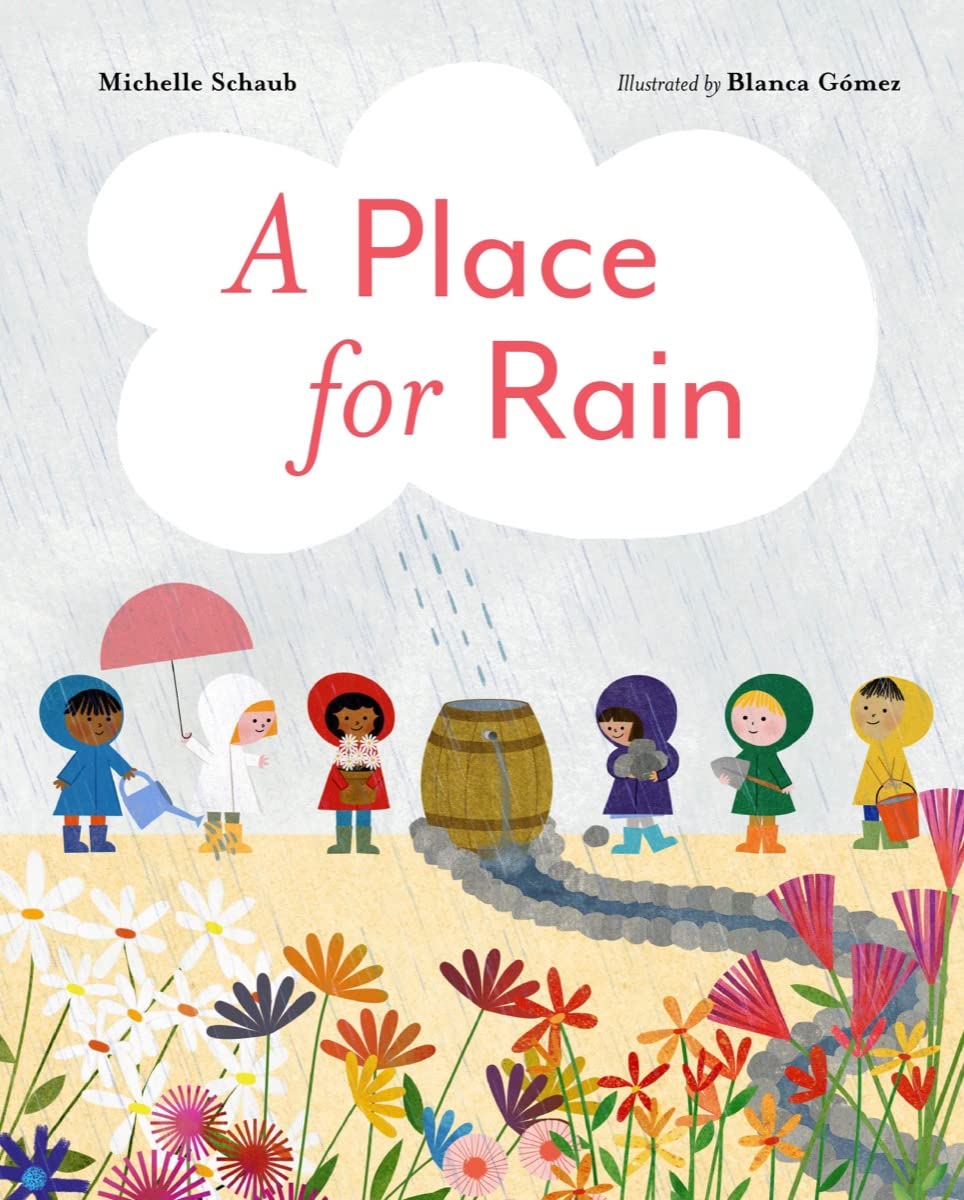
A Place for Rain   
by Michelle Schaub; illus. by Blanca Gómez 
32 pages; ages 4-8
‎Norton Young Readers, 2024

theme: rain, problem-solving, environment

Plink. 
     Plip. 
        Plop. 
We watch the raindrops drop.

Children, warm and dry inside, watch the rain pour down, puddle, pool, and fill the playground and parking lot, flood sidewalks, and run off into the road where it mixes with grit and grease. From there, the stream of water runs into storm drains and eventually into creeks, groundwater, or the ocean. 

The kids begin to wonder if they could collect some of that rain for a droughty day. And maybe they could keep it from pooling on the playground. Their solution: build a rain garden.

What I like about this book: I love the language, the onomatopoeia of plink, plop, pitter-patter, splutter-splatter. I like how Michelle Schaub highlights an important environmental issue by showing one solution –  a solution many cities are embracing as they focus on mitigating stormwater damage. And I really like that the Back Matter shows how people of all ages can Make Room for Rain with step-by-step instructions on how to build a rain garden.


A couple weeks ago, I caught up with Michelle (via the wonders of email) and asked her a couple questions.

Me: What inspired you to write a picture book about building a rain garden?

Michelle: I’ve always been passionate about using water and land sustainably, and I planted my first rain garden over ten years ago to help solve the problem of stormwater flooding my driveway. As I worked on the garden with my own children, I thought that the process would be fun to explain in a picture book.

Me: Why do you think this is an important story to share with children?

Michelle: In the face of doom and gloom news about climate change, A Place for Rain provides children with positive, attainable actions they can take to make a difference, whether it’s planting a full rain garden, or simply adding a rain barrel to a downspout to catch and reuse water.

Me: I agree, Michelle! Now for my favorite part of my Friday picture book reviews …

Beyond the Books:

Next time it rains, observe how and where the rain collects. What do you notice?

How much rain falls in a rainstorm? You can measure your rainfall if you have a big bucket and a ruler. Put the bucket in an open spot in your yard or driveway – not under roof eaves or trees. Then, after the storm measure how much rain fell.

Collect rainwater that comes off your roof by putting buckets under the eaves or a rain spout. How much collects? What could you use collected rainwater for? (water flowers, wash your bike, flush toilets…)

Michelle has written many books for kids, including Dream Big, Little Scientists. You can check out my review here on this blog. 

Michelle is a member of #STEAMTeam2024. You can find out more about her at her website.

Today we’re joining Perfect Picture Book Friday. It’s a wonderful gathering where bloggers share great picture books at Susanna Leonard Hill's website. Review copy provided by the publisher.

Friday, September 9, 2022

Finding Fall Treasures


On a Gold-Blooming Day: Finding Fall Treasures 
by Buffy Silverman
‎32 pages; ages 4-9
Millbrook Press, 2022

theme: autumn, seasons, poetry

On a gold-blooming, bee-zooming, sun-dazzling day…

creatures are busy! Crickets are chirping, butterflies slurping, squirrels nut-burying, mushrooms popping up after a fall rain, and leaves are falling! 

What I love about this book: The language! Lines rhyme and make it a perfect read-aloud. And the language is lively – as in, there are lots of wonderful verbs used in oh-so-many ways. They show action (seeds drift) and describe the sort of day it is (nut-crunching).

I love the photos. They are big, bold, filled with fall colors and scenes of nature.

And (of course) I love the back matter: four pages packed with additional information about the plants and animals you find in fall, a glossary, and a list of books for curious young naturalists (and the adults who read the books to them).

I’ll be interviewing Buffy over at the GROG Blog on the First Day of Fall, but today I just had to ask her One Question about her book!

Me: What are some of your favorite words from the fall season?

Buffy: My favorite fall words from On a Gold-Blooming Day are: "Cranes rattle. Fish skedaddle." In the fall, sandhill cranes gather in large numbers in the swampy end of the lake near our house, rattling late into the night (in fact, I can hear a few cranes right now!) Lots of animals skedaddle during autumn, hurrying to find food or make other preparations for winter. Although it still warm in Michigan, I am looking forward to crisp, crunchy, goose-honking weather!


Beyond the Books:

Go on a fall treasure hunt. Notice the different kinds of leaves on the trees and see if any are changing color. It might be too early – but that’s OK because you can do this activity all fall until the last leaf falls. While you walk, collect different kinds of leaves, acorns, sycamore balls, seeds, and other things for some leaf-art activities.

Make leaf rubbings and leaf people. You can make leaf people by gluing leaves to a sheet of paper like this, or you can create 3-D leaf people puppets like this.

Write your own list of Fall Words. They could be colors, sounds, smells of fall or the things you notice animals and plants doing. If you have crayons, you can write the words in fall colors. Turn your words into a Fall Chant or a song or a wish-list or …. Whatever you want to do.

Need more ideas for celebrating the coming of fall? Check out this list of 100.

Buffy Silverman is a member of #STEAMTeam2022. You can find out more about her at her website, https://buffysilverman.com/

Today we're joining Perfect Picture Book Friday, an event where bloggers share great picture books at Susanna Leonard Hill's website. Review copy provided by the publisher.

Monday, August 22, 2022

Bringing Back the Words

Words are important. At least, being a writer, I like to think so. Words connect us to ideas. Words connect us to our culture, history, family and community. And words connect us to nature. 

I was a kid who kept lists of nature words: names of the rocks we hunted for; names for the squirrels and birds I learned to identify; names for wild places hidden in vacant lots and parks around the city. Pooh had the Hundred Acre Wood; my friends and I had the Secret Forest – though it wasn’t very secret and only had a handful of trees. Something inside me felt that if I could name an animal, flower, rock, I might know it a little better.

So I was surprised, taken aback, even appalled to learn that a children’s dictionary was removing words about nature to make more room for words about technology. This started in 2007 when the Oxford Junior Dictionary deleted a slew of nature words: dandelion, acorn, magpie, otter – seriously? Who removes those cute, fluffy critters from a children’s dictionary? But the facts are that the children’s dictionary has a limited number of pages upon which to print words, and the words children are using (or being forced to use in school) are changing. In place of the nature words, they put in voice mail, broadband, BlackBerry – a now obsolete phone, not the tasty Rubus spp we continue to pick from prickly vines to this day.


This losing of nature words rubbed a lot of people the wrong way. Teachers and scientists sent emails to the Oxford dictionary folks. And author Robert Macfarlane teamed up with painter, Jackie Morris to create a lovely book, Lost Words. I discovered this book in 2019 and fell in love with it. It’s presented as a “spellbook for conjuring back those lost words” – those words snatched from the language of children before they even had a chance to learn about conkers and newts, bluebells and brambles. The pages held not just poems, but spells that might – through the magic of being spoken aloud – bring back those lost words into a child’s language. Ours, too.

How we perceive and talk about the natural world affects how we relate to it, and that affects how we care for it. Or how we don’t. I sometimes catch myself talking about going out to the garden to chat with plants or listen to the bees. When I hear a bird song I don’t recognize, I often ask, “who’s that?” 

I think that having words to share our observations about nature and the ecology around us is vitally important. Not only does it give us a language to converse in, but it strengthens our connections to the natural world. These connections are critical, especially now. In the past 50 years, human activities have contributed to a loss of nearly 70% of the world’s wildlife.


Can we reverse our environmental losses by changing the language we use? I think so. What if, instead of “profit” we talked about “environmental sustainability?” Instead of “weeds” we used words like “dandelion” and “pussy toes” and “plantain?” What if, like wildlife rehabilitators, we released wild words, like "kingfisher" back into our lexicon?

The Lost Words folks have created a wonderful Explorers Guide for teachers and parents and curious naturalists. You can find it at the John Muir Trust website (www.johnmuirtrust.org/john-muir-award/ideas-and-resources/literacy-and-nature/the-lost-words). It is packed with activities across the curriculum ~ poetry, science, things you can do outside and things you can do inside. You’ll also find articles and other resources there.

And if you’re interested in becoming a keeper of nature words, here’s another book you might want to check out: The Keeper of Wild Words, by Brooke Smith. Check out my review here.