Showing posts with label Funky Fungi. Show all posts

Monday, May 27, 2024

Explore Outdoors ~ Fungus Among Us!

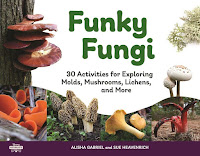
Last week I had the marvelous opportunity to share science fun with a student at our local elementary school. She is passionate about mushrooms, and had checked out my book, FUNKY FUNGI (written with Alisha Gabriel). The school librarian asked whether I could spend half an hour with her exploring mushrooms. So of course, I said YES!

I shared around 50 photos of mushrooms and coral fungi and staghorns and lichen that I'd found in my garden, yard, and nearby woods. Then we dissected a portobello mushroom from the local grocery store, following the directions listed in the activity from FUNKY FUNGI. We had So Much Fun! 

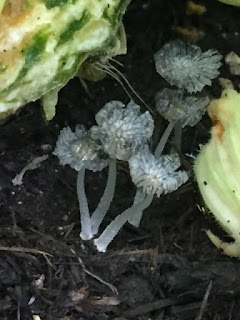
Over the long Memorial Day weekend, I went walking through the woods again and I added a few new fungi photos to my collection - check them out. 

What Cool Fungi will You Find this Summer?


Monday, June 20, 2022

Happy Birthday FUNKY FUNGI

Two important things are happening this week. It’s Pollinator Week – and that means I’ll be posting photos of pollinators and otherwise celebrating them all week long!


And secondly – it’s a Book Birthday! That’s right, tomorrow Funky Fungi hits the shelves of a bookstore near you. To celebrate, we’re having a Blog Book Birthday Party with cake and party favors, and even a song. It being a blog, you'll have to bake-and-make your own... so gather your art supplies and join in the celebration!  


First, grab a cupcake. They look like yummy mushrooms, right? That’s because I over-filled the cupcake papers so the tops spilled over. Then I poked white chips into the frosting. (you’ll have to bake your own)

I was going to set up a game of pin-the-spots-on-the-mushroom, but I dropped the bowl of spots and they’re all over the floor. So how about a rousing round of the mushroom song instead? 

Mushroom Song (Sung to: Down by the Station)

Out in the front yard just above the garden,
See the little mushrooms standing in a row.
Down comes the rain and up sprout the fungi,
Each by itself but connected down below.

Party Favor Time!


If you’ve got some plain colored cupcake liners, craft sticks, glue, white paint and a paint brush or Q-tip, you can make a collection of mushroom fans. Here’s how.

You can download this free mushroom coloring sheet here.

And if you like glitter globes, here’s how you can make one. All you need is a jar with a lid, a waterproof mushroom toy, some glitter, and some waterproof glue. 

Remember to check out our Funky Fungus Fridays over at my author Facebook page, and Alisha’s #FungiFriday posts on Twitter

Funky Fungi, 30 Activities for Exploring Molds, Mushrooms, Lichens, and More is part of the part of the Chicago Review Press “Young Naturalists” series. Look for a copy at your favorite bookstore.


Monday, May 23, 2022

There is Fungus Among Us

 Fungi are everywhere, but sometimes you don’t see them because they are small. Or they don’t look like a typical mushroom. The trick with finding fungi – well, with finding anything, really – is to learn enough about them so you know what to look for. And once you know what to look for, you begin finding fungi all around:
  • Growing in the mulch beneath the tomatoes
  • Popping up in the lawn after a week of rain
  • In the tops of downed branches
  • Growing on old logs
  • Decomposing a stump in the yard
  • In the breadbox and pushed to the back of the fridge
Sue: I remember the first time I saw a coral fungus. It looks just as the name suggests: like a bit of coral pushing up from the leaves. Used to finding turkey tails and mushrooms, I had no idea it was a fungus. Now I see it everywhere in the wooded area behind our garden.
 
Alisha checking out fungi at Highlights
Alisha: One Saturday morning I drove to Austin to meet up with a friend that I’ve hardly seen in the last two years. I parked under a tree and hustled inside for a visit. When I returned to my car, I noticed beautiful polypore mushrooms on the tree. How did I miss them when I arrived? Probably in too much of a hurry. While researching and writing Funky Fungi, I realized there were many specimens of fungi that were there all along, but I never noticed.  

Sue: When we started talking about Funky Fungi, I got a field guide (confession: I had an entire shelf of field guides but not one about mushrooms!) so I could begin to recognize the fungi growing around me. Then I discovered an amazing reference in our library system, The Book of Fungi: A Life-Size Guide to Six Hundred Species from around the World by Peter Roberts and Shelley Evans. In addition to having wonderful photos, there’s a distribution map for each fungus. It clocks in at 656 pages and weighs as much as a hefty bag of sugar (5#). I don’t own a copy, and I hate to even speculate what the delivery guy mutters every time I request it through the library system.

Sue finds mushrooms in the yard

But here’s the thing. Paging through these books, looking at the photos, reading the descriptions … it’s made me not just more aware of the diversity of fungi, but curious about what I might find outside my door.

Alisha: Last summer my husband trimmed some branches from an oak tree. As I helped him cut them into smaller pieces, I noticed a little waving movement on one of the branches. I stooped down for a closer look. It appeared to be a piece of lichen balancing on the branch like a tight-rope walker. It wobbled from side to side and inched forward a tiny bit – an insect covered in lichens! The insect was using lichen as camouflage, maybe to protect itself from predators, or to sneak up on unsuspecting prey, or both! Before researching fungi for this book, I didn’t know that some insects cover themselves in lichens. But armed with that info, I was ready to discover one in my own backyard. Who knows what else I’ll discover!


Remember to check out our Funky Fungus Fridays over at my author Facebook page, and Alisha’s #FungiFriday posts on Twitter

Check back next month for our Happy Book Birthday celebration! Funky Fungi, 30 Activities for Exploring Molds, Mushrooms, Lichens, and More is part of the Chicago Review Press “Young Naturalists” series. You can find out more about our book at the publisher’s website. It will hit bookstore shelves next month! But if you can’t wait, you can pre-order it at your favorite local bookstore, or online at Bookshop.org

Monday, April 25, 2022

Inspiration along the Writing Journey

As we worked on Funky Fungi, Alisha and I discovered a couple of books that inspired us on our writing journey. They engaged our curiosity and prompted several conversations that led us to look more closely at the fungi surrounding us.

Entangled Life, by Merlin Sheldrake

You know it’s going to be a fun book when the first thing you read is “What is it like to be a fungus?” Merlin Sheldrake gives us a tour of the kingdom from a fungal point of view. If we want to understand how ecosystems work, we need to understand the mycorrhizal fungi beneath our feet. Fungi challenge the way we think about evolution and intelligence, even what makes an individual. 

In one chapter Merlin takes us on a hunt for truffles; in the next we watch mycelium solving a maze. My favorite, though, was the dive into lichens. Lichens are relationships between algae and fungi, but what exactly do the fungi do? Then there’s the connection of fungi with roots, and mycelial webs connecting entire forests (and other plants) into an internet of sorts. Throughout, he cites research, both past and ongoing, that contribute to our current understanding of fungi. Underlying it all is the caveat that what we think we know now will undoubtedly change as we learn more. 

Finding the Mother Tree, by Suzanne Simard 

I picked up a copy of this book the day it hit the bookstore. I love how Suzanne Simard took me right into her world of trees. Born and raised into a logging world (the rainforests of British Columbia, Canada), she spent her days learning about – and from – the trees surrounding her. In this memoir, she writes about her work in forestry and her research in the forests. Suzanne’s language transported me deep into the northwest forests. Reading it on my porch on warm summer days, I could almost smell the pine needles and the earthy soil of the rainforest.

The book’s focus is Dr. Simard’s studies on how trees communicate through underground mycelial networks, how they care for each other and mount defenses against natural enemies. I particularly liked the sections where she detailed the methods of her scientific inquiry. She does not gloss over the hard work: fencing study sites, transplanting trees, digging, watering, camping out, even the failures due to weather and other elements. And there were plenty of failures – that’s part of the scientific method, right? 

Nor does she gloss over how the scientific community responds to new ideas that challenge the status quo. By the end, I gained a better understanding about the connectedness of the “Mother Tree” that nurtures the forest. More important, I gained appreciation for how important these underground connections are for the survival of both forest and human. 

Remember to check out our Funky Fungus Fridays over at my author Facebook page, and Alisha’s #FungiFriday posts on Twitter

Check back next month for another post about our book-writing journey.  Funky Fungi, 30 Activities for Exploring Molds, Mushrooms, Lichens, and More is part of the Chicago Review Press “Young Naturalists” series. You can find out more about our book at the publisher’s website. It will hit bookstore shelves in two months, but you can pre-order it at your favorite local bookstore, or online at Bookshop.org


Monday, March 21, 2022

We Write to Learn

 One of the reasons I write for kids – well, for anyone, really – is because I want to know more about something. And that curiosity has led me on a lot of discovery adventures. For example, I knew that fungi were all around and that they play an important role in the environment. But I hadn’t realized how extensive their mycelial networks are.

Alisha: I agree, Sue. My curiosity has driven me to research and explore a variety of topics. Some colorful fungi caught my eye more than ten years ago, but when I began considering their importance and the ways we use fungi, from food to medicine, I realized it was a topic that could fascinate kids, too. 

Sue: Another thing I learned was just how diverse Fungi are. This past summer was a good one for fungi, and I saw them popping up everywhere. As I learned more about them, I found even more fungi growing around me – because I knew where to look, and what to look for.

funky fungi, captured by Alisha

Alisha: Me, too! When I took a closer look in my yard, I discovered several different kinds right under my nose! Over the years, I’ve noticed lichens, bird’s nest fungi, and little brown mushrooms, but this year I found inky cap mushrooms, several types of shelf fungi, chicken of the woods, and even a lichen-covered insect wobbling across a trimmed branch. 

in Sue's garden

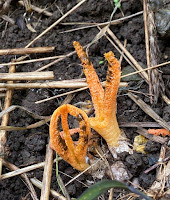
Sue: I was surprised by the beauty of the fungi growing in my garden. One looked like an orange octopus emerging from the mulch! Or maybe a chicken foot? Another was so dainty that by the time I got my camera, it had melted into an inky spot. I learned my lesson: stick the camera into my pocket whenever I head out to the garden – or any place outside. Because you never know what you’re going to find.

Speaking of cameras and fungi photos, I’ll be posting photos of mushrooms every Friday this spring and summer over at my author Facebook page, and Alisha will post frequently on Twitter. Look for the hashtag, #FungiFriday


Check back next month for another post about our book-writing journey.  Funky Fungi, 30 Activities for Exploring Molds, Mushrooms, Lichens, and More is part of the Chicago Review Press "Young Naturalists" series. You can find out more about our book at the publisher’s website. It will hit bookstore shelves in three months, but you can pre-order it at your favorite local bookstore, or online at Bookshop.org

Monday, February 28, 2022

How a Walk Grew into a Book

 Nearly a decade ago, I shoved a notebook and handful of pens into my duffel and headed off to a Highlights Foundation workshop that focused on Writing Nonfiction for kids. The only thing I had to guide me was a well-worn map with the route highlighted in yellow and some notes jotted down from an email.  What I remember most from my time there was heading out for a walk with another writer – that would be you, Alisha.

photo by Alisha Gabriel
Alisha: That was my first time attending a Highlights workshop and it made a huge impact on my writing! I remember that walk, and stopping to photograph a mushroom along the side of the trail. As we talked, we realized we both had book ideas that involved fungi.

Sue: For different reasons, we ended up putting our fungi projects on hold. But that was okay because something else grew out of that fortuitous forest amble: a partnership.

Alisha: Yes. After the workshop, I was fortunate to join a newly formed critique group with you and a couple other nonfiction writers. We’ve been critiquing and encouraging one another for almost ten years!

Sue: Fast-forward to the pandemic lockdown of 2020, when Alisha emailed me. Remember that cool mushroom from Highlights? she asked. Let's work on a fungus book together.

Alisha: It took me awhile to reach out and ask. I wasn’t sure if you’d be interested in co-authoring a book about fungi, but due to our shared interest in the topic, I figured it was worth a shot. Plus, it was the middle of a pandemic and, other than work, I wasn’t getting out much.

Sue: Plus two heads are better than one. If I found some interesting fungus facts, I could share them with Alisha. What I really loved was when Alisha emailed me photos of fungi she found in her garden. It inspired me to look more closely at what was growing in my lawn and garden. We also got to play around with – I mean, test drive – a bunch of activities.

Alisha: And share really bad jokes. Hey Sue, why didn’t the Fungus come to the Pizza Party?

Sue: I don’t know. (shudders at the thought of fungal fruiting bodies on a pizza)

Alisha: Because there wasn’t Mushroom!

Check back next month for another post about our book-writing journey.  Funky Fungi, 30 Activities for Exploring Molds, Mushrooms, Lichens, and More is part of the Young Naturalists series. You can find out more about our book at the publisher’s website. It will hit bookstore shelves this June, but you can pre-order it at your favorite local bookstore, or online at B&N or Amazon.