Showing posts with label women's history. Show all posts

Friday, April 18, 2025

Stories Start with a Seed

 As a gardener, I’m always looking for new picture books about seeds, gardens, and the gardeners who plant them. 

themes: seeds, science, perseverance
     
Beansprout 
Art and words by Sarah Lynne Reul 
48 pages; ages 4-7
Charlesbridge, 2025 

This book opens with students gathered on a rug as their teacher says, “In this paper bag.. I have one hundred secrets. One hundred tiny surprises. Because this bag contains one hundred … Mystery Seeds!”

Each student chooses a seed to plant. They draw what they think will grow, and water their seed, and watch and wait for something to poke up out of the soil. Everyone’s seed sprouts except for Ben’s. The sprouts grow into seedlings, but not the nothing in Ben’s pot.  And then Ben discovers the bag filled with seeds that weren’t chosen and comes up with a new idea.

What I like about this book: As one who has planted seeds that haven’t germinated, I identify with Ben! I, too, have wondered when something – anything – will sprout. I like how Sarah Lynne Reul shows Ben’s excitement at planting time, his dismay – and then second-guessing his seed’s (and his) worth – and his teacher explaining that “sometimes things don’t grow and we don’t know the reason why.” I love that even as Ben considers never planting another thing, he discovers the bag of leftover seeds teetering on the edge of the teacher’s desk, way too close to the garbage can! I love the back matter: what is a seed? How does a seed know when to grow? What can you do if a seed doesn’t grow? 


And I really, really LOVE the art! Sarah’s illustrations are done in mixed media, with watercolor paints, tissue paper prints, and collage. The edges are cleanly cut, not torn, and give the feel of more than 2-D.  Make sure you spend time with the front AND back end papers!

Not only is March the perfect time to be thinking of seeds to plant, it’s Women’s History Month. And I have the perfect book, which was published last year - today I’m celebrating its One Year Anniversary.

Gifts from Georgia's Garden: How Georgia O'Keeffe Nourished Her Art 
by Lisa Robinson; illus. by Hadley Hooper 
‎40 pages; ages 4-8
Neal Porter Books, 2024  

Georgia painted flowers so lush and large they filled the canvas – petunias, poppies, lilies, and more…

But she was also a gardener who tended her crops using organic methods, planting marigolds to protect her plants from pests. And while she waited for her seeds to sprout, she painted. She raised her food, sewed her clothes, ground grain for bread – and all the while painted the skulls and bones and things she found in nature.

What I like about this book: Lisa Robinson shows that the act of tending her garden and feeding friends inspired Georgia O’Keefe’s art. I like that back matter shares more about Georgia O’Keefe and some of the basic concepts of sustainable gardening: conserving water, companion planting, attracting beneficial insects, and composting. There’s also a recipe to try.

Beyond the Books:

Plant some seeds. Think about things you like: beans, flowers, carrots … maybe a pumpkin? Before you plant your seed, take a good look at it and write down some of the things you notice. 

Watch your plants grow! Draw pictures of what you see as your plant grows. What do the leaves look like? How tall does it grow? When does it begin to flower? Do any insects hang out on your plant, eat the leaves, or gather pollen from the flower? NOTE: if you don’t plant any seeds, or if your seeds don’t grow, you can “adopt” a plant you find already growing – maybe in a neighborhood garden or park.

my attempt at a poppy!
Paint a flower ~ or make a collage of a flower in the style of  Georgia O’Keefe. She painted her flowers large, so viewers could really see the details. Look into the center of the flower and think: how can I show this using paint or paper? Or both? Then make art!

Today we’re joining Perfect Picture Book Friday. It’s a wonderful gathering where bloggers share great picture books at Susanna Leonard Hill's website. Review copies provided by the publishers.


Friday, March 24, 2023

Women Find the Cure!

March is Women’s History Month and today I’m reviewing books that highlight the contributions of women in STEM. I paired these books because they both deal with medical discoveries that were vital to understanding the COVID-19 pandemic.

theme: women’s history, medicine, nonfiction

Never Give Up: Dr. Kati Karikó and the Race for the Future of Vaccines 
by Debbie Dadey; illus. by Juliana Oakley 
40 pages; ages 5-10
‎Millbrook Press, 2023  

By the time the morning sun shone on the reed roof of Kati’s one-room home in Hungary, she had already fed the chickens, collected eggs, and been chased by a rooster.

Kati learned about animals at home – but at school she learned about science. And when the teacher showed the class how to use a microscope to see cells, Katie was hooked. She wanted to be a scientist! She attends science camps, competes in the Science Olympics, conducts research in mRNA, and begins asking whether (and how) mRNA might be used to help fight disease. Her experiments fail, and people question whether her idea is going anywhere. But Dr. Kati doesn’t give up and eventually has a breakthrough that leads to…
  • The founding of Moderna
  • A job at BioNTech
  • And the work that went into creating the COVID vaccine

What I like about this book: it is timely! It shows the additional hurdles women in STEM fields face in their research. And, we learn that Dr. Kati isn’t finished. Now she wants to find out if mRNA can cure or prevent other diseases! Back matter includes timeline of Kati’s life, steps to making a vaccine, glossary, source notes, and suggestions for further study.

June Almeida, Virus Detective!: The Woman Who Discovered the First Human Coronavirus 
by Suzanne Slade; illus. by Elisa Paganelli 
40 pages; ages 6-9
Sleeping Bear Press, 2021

June’s favorite days were school days.

She couldn’t wait to get to class – especially science, which she loved. But with no savings, she had to get a job instead of attend college. So she applied to work at a hospital, where she used a microscope to examine cells from sick people.

Using an electron microscope, she created pictures of viruses and their antibodies. One of those viruses looked like a blob with tiny dots circling it like a crown – she had discovered coronavirus.

Back matter includes more biographical information about June, and some photos of her working with an electron microscope, as well as a timeline of her life. Turns out that discovery of human coronavirus was published in 1967! Seems like ancient history, and yet so important to recent medical science.

Beyond the Books:

Do you know any women who are doctors or are doing research in medicine

If you could find a cure for a disease, what would you cure? 

Learn more about Dr. Kati Karikó. Here’s one article

Find out more about June Almeida. Here’s an article.

Today we’re joining Perfect Picture Book Friday. It’s a wonderful gathering where bloggers share great picture books at Susanna Leonard Hill's website

Because these books appeal to older readers as well, we’ll be over at Marvelous Middle Grade Monday, too. That happens at Greg Pattridge's blog, Always in the Middle, so hop over to see what other people are reading. Review copies provided by the publishers.

Friday, March 17, 2023

Women Invent Solutions!

March is Women’s History Month and today I’m reviewing books that highlight the contributions of women in STEM. 

theme: women’s history, invention, math

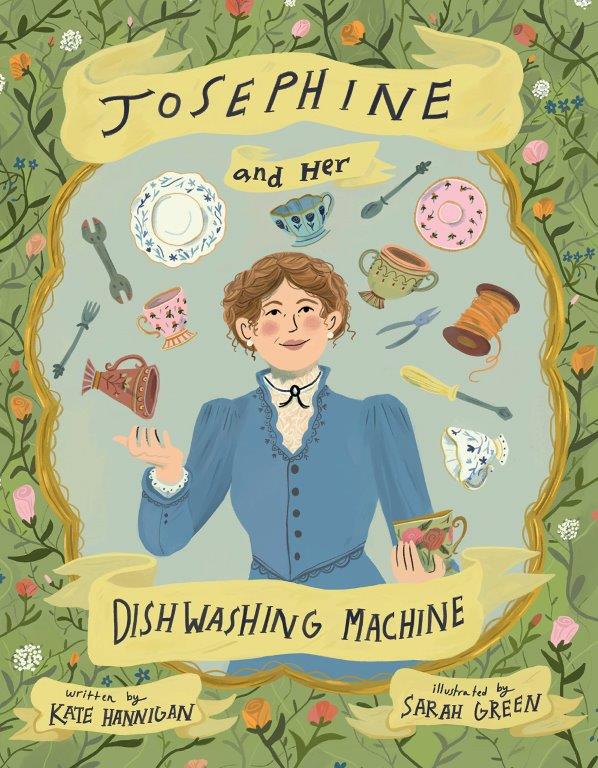
Josephine and Her Dishwashing Machine: Josephine Cochrane's Bright Invention Makes a Splash 
by Kate Hannigan; illus. by Sarah Green 
40 pages; ages 7-10
Calkins Creek, 2023

Josephine Garis Cochran was a modern woman who wasn’t afraid to get her hands dirty.

But, one night after a dinner party she’d had enough of dirty hands – and dirty dishes! There must be a better way, she mused. Inventors were busy at work, devising machines and tinkering with electricity and even making a telephone. So Josephine decided to invent a machine to wash dishes.

What I like about this book: I love the language. There’s alliteration: saucers and soup bowls, tested and tinkered, pushed and persevered. There’s rhyme: pliers and wires. And I like the emphasis on revising, reworking, and rethinking.

Josephine’s first machine doesn’t work well at all, but she learned from her mistakes. And each time she redesigned her machine, she fixed a problem until at last – she had a working dishwashing machine!

I like that there is back matter: an author’s note about dishwashers and Josephine, and an introduction to more than a dozen notable women inventors. There’s also a timeline of “fascinating inventions” and a whole bunch of resources for kids who want to learn more.

The Brilliant Calculator: How Mathematician Edith Clarke Helped Electrify America 
by Jan Lower; illus. by Susan Reagan
40 pages; ages 7-10
Calkins Creek, 2023


Edith Clarke devoured numbers. Conquered calculations. Cracked puzzles.

She loves math, and dreams of building dams and bridges. Instead, she is sent to boarding school to learn manners and music and finished her schooling at the dawn of the twentieth century. Cars are on the road, inventors are testing flying machines – and Edith sees a place for her and her math in these new modern times.

She teaches physics, and eventually begins work as a human “computer” with engineers who are stringing the first phone wires across America. Why do voices fade on wires as distances grow? Edith finds out. In her free time she tackles problems related to electrical transmission lines, invents a tool that helps engineers solve problems faster, and sets the stage for our modern “smart electric grid.”

What I like about this book: One of my favorite spreads is the city street, with wires crossing every which way and a biplane above. Equations are integrated into the buildings to show how Edith saw the world. 

I also like the illustrations that show how she invented her calculating device and the pages that highlight quotes from Edith’s own writing. And there is back matter: an author’s note about Edith and more about her contributions to engineering; a timeline of Edith’s life; glossary; and short bios about more women mathematicians, inventors, and engineers.

Beyond the Books:

Learn more about women inventors. Need a place to start? Check out this post on A Mighty Girl blog.

Find out how modern dishwashers work. If you have one, take a good look inside – maybe the owner’s manual has some drawings. Or you can check out this video.

Be an inventor. What job do you do that you would like to see done mechanically? Invent a way! Think about what needs to be done, and how it could be done. Then draw up your invention designs.

Today we’re joining Perfect Picture Book Friday. It’s a wonderful gathering where bloggers share great picture books at Susanna Leonard Hill's website

Because these books appeal to older readers as well, we’ll be over at Marvelous Middle Grade Monday, too. That happens at Greg Pattridge's blog, Always in the Middle, so hop over to see what other people are reading. Review copies provided by the publishers.

Monday, March 13, 2023

It's Women's History Month!


When you think of inventors, chances are the names that come first to mind are Alexander Graham Bell, Thomas Edison, the Wright Brothers. What names are on the tip of your tongue when you think about great scientists? Darwin? Einstein? Maybe Marie Curie (she did, after all, receive two Nobel prizes for her outstanding work in chemistry and physics).

But here’s the thing: even as the guys were inventing flying machines and phones, women were building airplanes and bridges. And seriously, would a man ever even think of inventing a dishwashing machine?

Women have long contributed to our history as rulers, pirate queens, explorers, political leaders, artists, composers, musicians, scientists, engineers, doctors …  Too often their contributions were overlooked, overshadowed, or simply erased from the history books.

So for the rest of this month I will be posting reviews of books about women who have contributed to the STEM fields. If you are looking for books to share in a classroom or to read at home with your kids, check out my “Women in STEM” page – the link is at the top of the blog. I’ve curated a list of books that I’ve reviewed here on Archimedes or elsewhere, along with some reviews by colleagues. There are picture books and books for older readers.

And, hey – if you come across a great book about a STEM woman, let me know so I can add it to the list.

Friday, March 6, 2020

Numbers in Motion

Numbers In Motion: Sophie Kowalevski, Queen of Mathematics 
 by Laurie Wallmark; illus. by Yevgenia Nayberg
32 pages; ages 8-12
Creston Books, 2020

themes: biography, math, women in history

Sophie carefully pulled the string, and the top spun across her desk.

But Sophie’s not a kid playing with the top. She is a mathematics professor and she is trying to describe the tops rotation in an equation. It’s a difficult problem, and many others have tried – and failed. But Sophie won’t give up. If she succeeds, “her math might help scientists calculate the path of planets,” writes author Laurie Wallmark.

What I like about this book: The minute you open the cover, you know you’re in “mathland” – the end page (also serving as title page) is graph paper. I like that Laurie introduces me to a woman in math who is not well-known. And she doesn’t make light of the challenges Sophie faced, wanting to attend college at a time when women were not allowed in the lecture rooms. And I like the message of hope this book gives to girls interested in numbers.

Laurie ends with an author’s note about Sophie, and more about her math (partial differential equations). There’s also a cool bit about the many spellings of Sophie’s name due to transliterating names from the Cryllic alphabet to Roman alphabet.

This is Laurie's fourth book about a Woman in STEM, so I had to ask her One Question ~

Archimedes:  How did you come to choose Sophie as a subject for a book?

Laurie: I've loved math ever since I was a kid, so I wanted to write about someone who was known for her mathematical discoveries, not just computer scientists who were also mathematicians. I had never heard of Sophie before, but I came across her when researching possible subjects. I chose her for two reasons: First, her work on the rotation of solid bodies--like planets, footballs, and tops--was something kids could relate to. Second, the problem she solved was called a mathematical mermaid, and I thought kids would find that fun.

Beyond the Books:

Learn more about Sophie Kowalevski here.

Make your own spinners! Try turning an old CD and a marker into a simple spinner - here's how.
Or construct a top using Lego pieces. For a real challenge, fold a spinning top out of a piece of origami paper. Here’s a video showing how.

Laurie Wallmark is a member of #STEAMTeam2020. You can find out more about her at her website.  Today we're joining Perfect Picture Book Friday, an event where bloggers share great picture books at Susanna Leonard Hill's website. Review copy provided by the publisher.

Friday, September 7, 2018

Science Girls! Rachel Carson and Ada Lovelace

I love reading stories about real people - especially when those people use science to solve problems. Here are two women who have made big contributions to our understanding of the world around us.

Themes for the day: ecology, computers, biography

Spring After Spring, How Rachel Carson Inspired the Environmental Movement
by Stephanie Roth Sisson
40 pages; ages 4-8
Roaring Brook Press, 2018

It was dawn when the chorus began.
cheerily! fee bee! jurit jeroo!
Rachel didn't want to miss a note.

 Rachel Carson grew up surrounded by the sounds of nature. She paid attention to them season after season. So when spring sounded a little too quiet, she knew something was wrong. What was happening to the birds and insects who filled the air with song?

What I like LOVE about this book: I love that in the first few pages Stephanie R. Sisson has put the calls of birds and other creatures into speech bubbles. It's fun, and helps me hear the symphony of music Rachel heard around her. There's also a vertical illustration, so you have to hold the book a different way - which makes me take a closer look at the illustration and where the story is going.

I like the way Sisson portrays Rachel Carson - as a scientist who studied sea creatures but, when she noticed something was wrong, she used all her science skills to figure out what the problem was. She observed closely. She listened carefully. And she learned as much as she could by reading reports and articles - and then pulled the facts together into a narrative that explained how chemicals used to control insect pests were getting into the food chain and killing birds and other animals. The chemicals were making egg shells so thin that eagle eggs broke in the nest. And then Rachel did a brave thing. She wrote about it. She went to Congress and talked about it. Most of all, she inspired people to take better care of the earth.

I also like that there's back matter. (but frequent readers already knew that!)

Who Says Women Can't be Computer Programmers? The Story of Ada Lovelace
by Tanya Lee Stone; illus. by Marjorie Priceman
40 pages; ages 6-9
Henry Holt & Co (BYR), 2018

On the outskirts of a lovely village in County Kent, England, down a long driveway lined with lime trees, lived a young girl with a wild and wonderful imagination. As Ada was often left alone, she grew quite good at entertaining herself with interesting ideas.

Ada's mom, Lady Byron, worried about Ada's imagination, so she trained Ada to think like a mathematician. No poetry for her! And when Ada wanted to design a flying machine, Lady Byron gave her more hours of math studies instead of the bird -drawing books that Ada had asked for.

What I like about this book: We get a sneak peek into the life and times of the woman who created computer programming. Bored with high society and not terribly interested in the traditional role assigned to women in the early 1800s Ada preferred to hang out with thinkers - men like Charles Babbage who was inventing a calculating machine.

I love how author Tanya Stone brings in the math and computing power of the Jacquard loom, and how that served as an inspiration for ways to program a calculating machine. And, of course, there's ... Back Matter! Plus, consider this: if Charles Babbage and Ada Lovelace had funding to build their machine, we would have had computers 100 years sooner! Think about how that might have changed history!

Beyond the Books:
Learn More about Rachel Carson. Here's one website that talks about Silent Spring. And drop by Stephanie Sisson's website to learn more about how she wrote the book.

What does your neighborhood sound like in the fall? Go outside and listen. Can you identify all the calls and sounds made by birds, insects, and other animals? Write the sounds down, and then go out again next month and see how the sound scape has changed.

Watch a Jacquard Loom in action. This video was filmed at the Paisley Museum, in Scotland. Check out the punchcards! As early as 1801 people were programming machines to do work.

Write a program (directions) telling someone how to draw a design you have drawn.

Today we're joining the STEM Friday roundup - and we're also joining others over at Perfect Picture Book Friday, an event in which bloggers share great picture books at Susanna Leonard Hill's site. She keeps an ever-growing list of Perfect Picture Books. Review ARC's from publishers.

Friday, March 16, 2018

Celebrating Women in Science ~ Archaeology and Architecture

Archaeology: Cool Women who Dig
by Anita Yasuda; illus. by Lena Chandhok
112 pages; ages 9-12
Nomad Press, 2017

March is Women's History month, and I can't think of anything more appropriate than to share a couple of books from Nomad's "Girls in Science" series.

Archaeology begins by making an important distinction between collecting and archeology - you might have a stamp or coin collection, but archaeological collections demand careful notes and context that provides insight into he society that created the artifacts.

Chelsea Rose, for example, studies a Gold Rush town in Oregon. In addition to field work and interviews, she researches census records, mining claims, and newspapers. Justine Benanty is another archaeologist, but her passion is maritime archaeology and slave ships. So in addition to sifting through documents, she dives deep into cold water to uncover the facts.

Our world may be mapped, but the past remains largely unexplored. Which means there is a lot of room for you - if you love history and enjoy solving mysteries. It's not all about deserts and dirt - there are space archaeologists, and garden archaeologists!

Architecture: Cool Women who Design Structures
by Elizabeth Schmermund; illus. by Lena Chandhok
112 pages; ages 9-12
Nomad Press, 2017

Are you creative? Do you like solving problems? Architecture combines art and science - not only do you have to understand physics and engineering, but you get to design beautiful buildings. Or bridges.

Patricia Galvan designs post offices and modernized schools. She works at a small firm where she gets to see projects through, from start to finish. Farida Abu-Bakare remembers that she was inspired by the computer game "Sim City". And Maia Small is an urban designer. She remembers building structures in her back yard when she was a kid.

While the young women agree that the jobs they do are fun and challenging, they say that they are treated differently than men in the same position. They tend to be cut off when talking, or their proposals may not be taken seriously by their male colleagues. Still, they can't think of more fulfilling work. Their advice: study hard and try to get a mentor when you head into the working world.

Today we're joining the STEM Friday roundup . Review copies from the publisher.


Friday, October 6, 2017

Super Women ~ Six scientists who changed the world

Super Women, Six scientists who changed the world
by Laurie Lawlor
64 pages; ages 8-12
Holiday House, 2017

"Imagine being a highly trained astronomer who's forbidden to look through a state-of-the-art telescope," writes Laurie Lawler. Or that you're an accomplished underwater cartographer not allowed on a research vessel, or a chemist not allowed to work in a research lab.

Not because you don't have the skills - but only because you're a woman. We're not talking about women in science hundreds of years ago, but within our lifetime. Absurd, right?

And yet, Lawlor has compiled half a dozen stories of real scientists who had to fight against gender discrimination to do their research. Her tales include:
  • Eugenie  Clark, known as the "shark lady" - an oceanographer who dives into the sea to study sharks and other creatures living in the deep. Her research helped people understand that sharks can learn. Scientist, explorer, Clark authored more than 175 scholarly and popular science articles and been a champion of ocean conservation.
  • Gertrude Elion shares the 1988 Nobel Prize in Physiology & Medicine with George Hitchings and Sir James Black. Her research contributes to drug treatment for cancers. But when she graduated in 1937 with high honors in chemistry, she was turned away from research labs because hiring a woman would be "too distracting".
  • Katherine Coleman Johnson served as a human "computer", one of a team of mathematicians who helped send Alan B. Shepard, Jr. into orbit around Earth. As an African American woman and mathematician, she faced many obstacles working in the brand new space agency, whose technical staff was mostly white and male. In 2015, President Obama awarded her the Presidential Medal of Freedom.
  • Marie Tharp mapped underwater mountains, valleys, ridges, and plains. She was one of the first scientists to notice evidence for plate tectonics. Other researchers discounted her thoughts as "wacky ideas" and "girl talk", but eventually she convinced them. She worked with another researcher to create the world ocean floor map.
  • Florence Hawley Ellis wanted to be an archeologist, but men joked that she'd never find workers willing to follow her into the field. In addition to digging up artifacts, she collected information from Pueblo and Navajo elders about customs, stories, social organizations and more. She also noticed historical evidence of droughts and ongoing perils of climate change in the Southwest. 
  • Eleanor Margaret Burbidge is an astronomer who hunts deep-space objects. She viewed the first image of a quasar that was billions of light years from Earth. But in the early years of her career, institutes denied women access to telescopes because the living quarters were meant to be places where male astronomers wouldn't be bothered by wives or family. She finagled a way to live off campus and use the telescope and has contributed greatly to the field of astronomy.
The book is filled with photos, and complemented with a glossary where you can quickly look up "quasar".

Today we're joining the STEM Friday roundup. Drop by STEM Friday blog for more science books and resources. Review copy from the publisher.

Friday, March 3, 2017

Caroline's Comets

March is Women's History month, so I thought I'd kick it off with a true story of a woman in science:

Caroline's Comets, a true story
by Emily Arnold McCully
40 pages; ages 6-10
Holiday House, 2017

In 1786, Caroline Herschel became the first woman to discover a comet. She was also the first woman to be paid for doing scientific research.

Weaving Caroline's memoir and correspondence into the text, Emily McCully takes us into the life of an early astronomer.

Caroline's father was the first to show her the stars; her mother taught her the practical skills she would need. But then, when she was 22 years old, her brother William invited her to join him in England. In addition to helping around the house, he needed some help recording his astronomy observations - and some help building a telescope.

So Caroline became his assistant inventor. She pounded and sifted dried horse manure so her brother could build a mold for making the mirror. Their first telescope magnified things 6,000 times. That might not seem like a lot these days, but back in the 1700s it was astronomic.

They discovered that the Milky way was made of stars. They discovered a new planet (Uranus). And then, as the King's Astronomer, William began a sweep of the sky.Caroline discovered nebulae and star clusters and two new galaxies - and all the while she did needlework, kept William's accounts, and cleaned all the equipment.

Then, December 21, 1786, Caroline discovered a comet. McCully fills the pages with wonder, discovery, and comets. She also includes great back matter with a timeline, glossary, and additional notes.

 Today we're joining the STEM Friday roundup. Drop by STEM Friday blog for more science books and resources. Review copy provided by publisher.

Friday, February 12, 2016

To the Stars!

Before we head off To the Stars, a brief announcement. Traci is the winner of the Sea Turtle book. Traci - if you haven't emailed me your address, please do. (a click on the blogger icon beneath my name will get you to my profile page with email connection)
now... buckle up and prepare for Take Off.


To the Stars! The First American Woman to Walk in Space
by Carmella Van Vleet  & Dr. Kathy Sullivan; illus. by Nicole Wong
40 pages; ages 5-8
Charlesbridge, 2016

Theme: science, space, exploration, women

“Kathy Sullivan loved to explore.”

When her father brings home blueprints of airplanes, she studies their lines and curves. She daydreamed about flying, and when people asked, she told them that when she grew up she wanted to see the whole world. And she did – becoming the first woman to walk in space.

What I like about this book: It portrays a little girl who wants to be an adventurer and see the world at a time when girls were expected to grow up to be mothers or teachers or nurses. I like the way that pairs of spreads alternate, showing Kathy as a girl and in the next spread as a grown woman facing the same questions and problems. For example: a wonderful illustration of her as a teenager in the cockpit, learning to pilot a plane. “There were so many dials and buttons and numbers.” The next spread shows Kathy as an astronaut studying another (much larger) instrument panel.

There is great back matter including a note from Kathy, additional biographical material, and “American Women Firsts in NASA History”.

Beyond the book: everyone has dreams. What’s your dream; what do you want to do when you grow up?

Visit an airport to watch planes take off and land. Some airports have an observation tower where you can sit and watch, or a special parking lot for plane-watching. See if there’s a children’s museum where you can sit in the cockpit of a plane or space ship.

Visit the National Air and Space Museum at the Smithsonian if you have a chance – or check out the photos of aircraft they have at their website.  Or find one closer to where you  live.

Today's review is part of the STEM Friday roundup. Drop by STEM Friday blog for more science books and resources.  We're also joining PPBF (perfect picture book Friday), an event in which bloggers share great picture books at Susanna Leonard Hill's site. She keeps an ever-growing list of Perfect Picture BooksReview copy provided by the publisher. 


Friday, January 15, 2016

Saving Lives of "Blue Babies"

Breakthrough! How Three People Saved “Blue Babies” and Changed Medicine Forever
by Jim Murphy
144 pages; ages 10 & up
Clarion Books, 2015

If you have a young reader who loves mysteries, technology, invention, science  - a kid who thinks that someday she will want to be a doctor, put this book in her hands! Or his hands.

Author Jim Murphy tells the story of one of the first successful heart operations ever performed. It's about the medical breakthrough that not only saved the lives of tens of thousands of children but also opened the way for future heart surgeries.

And it took place in 1944. An unlikely team performed this high-risk surgery: surgeon Dr. Alfred Blalock; pediatric physician Dr. Helen Taussig; and African-American lab assistant Vivien Thomas. Blalock received the fame, but it was Thomas who developed and perfected the surgical technique to repair the hearts of children born with "blue baby" syndrome. In fact, he was the only person who had ever carried out the surgery successfully on a research animal.

Most of the people working at Johns Hopkins had no idea of Thomas's genius - many of them thought he was a janitor. Indeed, during that time of segregation, he was often treated as such. In one instance the director refused to order equipment that Thomas needed to conduct research. And yet, without his guidance, Blalock would not have been able to do the surgery.

Had history gone in a different direction, Thomas might have attended medical school. But the depression swallowed his meager savings. Desperate for a job, he landed in Blalock's lab. Fortunately, Blalock was looking for an assistant who could learn quickly and even suggest avenues for investigation. Often, Thomas would have to invent the tools he and Blalock would use in their surgeries.

Murphy touches on many topics as he tells this story, including the debate on using animals in medical research, how women and blacks were treated in the medical/research field, and the role of innovation in developing technology. But mostly, he tells a compelling story.

Today's review is part of the STEM Friday roundup. Drop by STEM Friday blog for more science books and resources. On Monday we're joining the folks at Nonfiction Monday. Review copy provided by the publisher.