Showing posts with label computer science. Show all posts

Friday, August 26, 2022

Reading, Writing, and Artithmechicks

In our area, families are taking in the last bit of summer vacation or shopping the back-to-school sales. In other places, students have been in the classroom for a couple weeks. And elsewhere, students may be counting down the days to September break. But no matter where you are in the world, school means Reading and Writing and Arithmechicks. Wait! What?

theme: math, coding, humor

Arithmechicks Take a Calculation Vacation: A Math Story 
by Ann Marie Stephens; illus. by Jia Liu 
32 pages; ages 3-7
‎Astra Young Readers, 2022  

10 chicks plus 1 mouse bounce to the beach. Mama leads the way.

It’s vacation time! And these chicks have lots of beach activities planned: sandcastle construction, volleyball, lounging in the sun, and some wave-riding. Even salty beaks and sandy feathers don’t stop them from having fun.
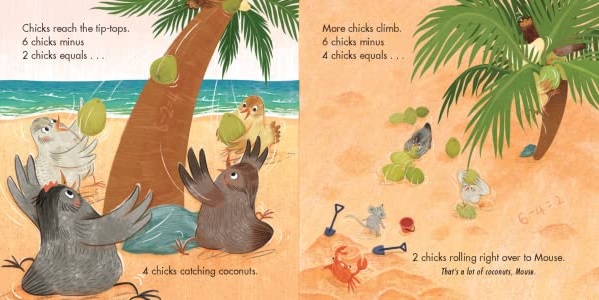

What I like about this book:
This is a great resource for teachers, homeschoolers, and parents who are looking for a fun way to introduce equations. Each page shows a different way to add – or subtract – the number of chicks, whether it’s climbing a tree for coconuts or falling off a surfboard. Back matter explains how to combine three numbers into math fact families:  2 addition facts + 2 subtraction facts = 4 facts in a family. There are more books in the Arithmechicks series; check out my review here.

What's Branching?: A Birthday Adventure! 
by Kaitlyn Siu; illus. by Marcelo Badari 
32 pages; ages 3+
‎Kane Miller Books / EDC Publishing, 2022

What’s branching? Let’s find out! We’ll help super robot Pixel plan a perfect party for Jet, and learn cool coding skills while we do. 

Jet loves being outside, so a party in the park sounds perfect. But what if it rains? Pixel makes backup plans: if it rains, then we’ll …..  In coding, writing backup plans using if/then statements  is called branching. We do this a lot in everyday life. Like planning a hike – and if it looks like rain, packing a poncho.


What I like about this book:
The graphics make it easy to understand the coding concepts introduced: branching, debugging a program. Back matter includes a simple matching game for if/then statements, a glossary, and a guide for teachers and parents. I also like that this book is part of a series (First Steps in CODING) and other books present algorithms, sequencing, loops, and more.

Beyond the Books:

Incorporate some math into your daily life. Use math language to talk about things like hanging the laundry: two socks on the line plus one more sock is ….. or stack blocks in a pyramid. 3 blocks on the bottom plus 2 plus 1 on top equals… And what happens when 2 block leave?  Check out this post for more books that incorporate math literacy.

Create some simple coding games. With this one all you need is a deck of cards, some toys, tape…. or you can make a grid and ask your friend to code a path around the obstacles.

We’ll join Perfect Picture Book Friday once they resume. It’s a weekly event where bloggers share great picture books at Susanna Leonard Hill's website. Review copies provided by the publishers.

Friday, December 10, 2021

Go, Lee, GO!

 
A.I.: How Patterns Helped Artificial Intelligence Defeat World Champion Lee Sedol 
by Darcy Pattison; illus. by Peter Willis
32 pages; ages 7-10
Mims House, 2021

Some folks meet at high noon in the middle of the street between the sheriff’s office and Miss Kitty’s. But for Lee Sedol, the world’s best GO player, the showdown happened in a hotel. The date was March 9, 2016. The weapons: computer keyboards. The stakes: a rivalry between man and machine.

This book, the latest in Darcy Pattison’s “Moments in Science” series, chronicles the events leading up to and surrounding this high-stakes competition. After introducing the game of GO (the oldest game in the world), Darcy introduces the opponents, Lee and AlphaGo, a computer program. Lee gained his GO cred by placing stones on a grid, game after game. AlphaGo had an entire team of programmers teaching it how to play. Should they teach rules? Or teach it to learn from patterns?

What I like about this book: I like the way Darcy integrates the tension of competition into the story. Game day. Will man or machine win? Nope, score goes to machine. Day two – score goes to machine. Day three – score goes to machine. By day 4 we are down to the nail-biting end, and Lee steps up to his laptop… we know how this story ends. But still. 

I also like the back matter: a timeline of games pitting man against computers (everything from checkers to Texas Hold’em). There’s more info about the players, the programmers, and even a challenge to write your own rules to help an A.I. learn something. Want to watch AlphaGo in action

I emailed Darcy a couple weeks ago and she had time to answer One Question

Me: In your book you distinguish between learning by "rules" and learning by "patterns". How would you characterize the way you learn new things?

Darcy: I tend to learn by patterns because it’s easier. As the scientists found out, if you try to write rules, there are too many exceptions. It's hard to be specific enough to cover everything. Instead, if you look at patterns, it’s easier to learn almost anything.

Darcy is a member of #STEAMTeam2021. You can find out more about her and the books she writes at her website. You can also read a review of an earlier book in the series here. Review copy provided by the publisher.

Friday, September 27, 2019

STEAM Jobs in Cybersecurity

STEAM Jobs in Cybersecurity (Series: STEAM Jobs You'll Love)
by Cynthia Argentine
48 pages; ages 9 - 13
Rourke Educational Media, 2019

Just one month ago, the computer systems in 22 small Texas towns  were hacked and held for ransom. Hackers blocked access to data, effectively closing down town governments and court systems. Just a week earlier, hackers locked down computer systems for a small town library system and school system.

Like pirates, hackers held town and institutional data hostage until a ransom could be paid. Their demands: hundreds of thousands of dollars in bitcoin. Those who don’t pay don’t get their data back. Even those who do pay often don’t get all their data returned.

Cities aren’t the only victims. Hospitals, credit agencies, even individuals are increasingly facing cyber-threats. So there are plenty of opportunities for people seeking a job in cybersecurity. Author Cynthia Argentine writes about those jobs, and the importance of a STEAM education for young people hoping to go into the field.

STEAM stands for Science, Technology, Engineering, Art, and Math. Cybersecurity involves many of these subjects, from information technology to psychology and cryptography – that’s the math and science of secret codes. Art is included because musical patterns and visual art help develop creativity and problem-solving skills.

Argentine shows how hackers can get into a computer system, and shares their “toolkit of tricks”: viruses, malware, and bots. She devotes an entire chapter to designing a defense against cyber-intrusion, another to ethics

Fast Fact boxes add information about specific cyber-attacks, how computers influence our lives, and which passwords are the worst. Hint: don’t use starwars! Throughout the book Argentine highlights STEAM jobs in cybersecurity: cybersecurity analyst, cybersecurity consultant, malware analyst, cyber-forensic investigator, security software developer, information security administrator, cybersecurity engineer and architect, and cybersecurity lawyer.

Another cool thing about this book: it’s part of the STEAM Jobs You'll Love series. Other books in the series focus on jobs in Agriculture, Architecture, Forensic science, Game development, Robotics, Wildlife Conservation … and the list goes on.

Today we're joining other book bloggers over at STEM Friday, where you can discover other cool STEM books. Review copy provided by the publisher.

Friday, September 7, 2018

Science Girls! Rachel Carson and Ada Lovelace

I love reading stories about real people - especially when those people use science to solve problems. Here are two women who have made big contributions to our understanding of the world around us.

Themes for the day: ecology, computers, biography

Spring After Spring, How Rachel Carson Inspired the Environmental Movement
by Stephanie Roth Sisson
40 pages; ages 4-8
Roaring Brook Press, 2018

It was dawn when the chorus began.
cheerily! fee bee! jurit jeroo!
Rachel didn't want to miss a note.

 Rachel Carson grew up surrounded by the sounds of nature. She paid attention to them season after season. So when spring sounded a little too quiet, she knew something was wrong. What was happening to the birds and insects who filled the air with song?

What I like LOVE about this book: I love that in the first few pages Stephanie R. Sisson has put the calls of birds and other creatures into speech bubbles. It's fun, and helps me hear the symphony of music Rachel heard around her. There's also a vertical illustration, so you have to hold the book a different way - which makes me take a closer look at the illustration and where the story is going.

I like the way Sisson portrays Rachel Carson - as a scientist who studied sea creatures but, when she noticed something was wrong, she used all her science skills to figure out what the problem was. She observed closely. She listened carefully. And she learned as much as she could by reading reports and articles - and then pulled the facts together into a narrative that explained how chemicals used to control insect pests were getting into the food chain and killing birds and other animals. The chemicals were making egg shells so thin that eagle eggs broke in the nest. And then Rachel did a brave thing. She wrote about it. She went to Congress and talked about it. Most of all, she inspired people to take better care of the earth.

I also like that there's back matter. (but frequent readers already knew that!)

Who Says Women Can't be Computer Programmers? The Story of Ada Lovelace
by Tanya Lee Stone; illus. by Marjorie Priceman
40 pages; ages 6-9
Henry Holt & Co (BYR), 2018

On the outskirts of a lovely village in County Kent, England, down a long driveway lined with lime trees, lived a young girl with a wild and wonderful imagination. As Ada was often left alone, she grew quite good at entertaining herself with interesting ideas.

Ada's mom, Lady Byron, worried about Ada's imagination, so she trained Ada to think like a mathematician. No poetry for her! And when Ada wanted to design a flying machine, Lady Byron gave her more hours of math studies instead of the bird -drawing books that Ada had asked for.

What I like about this book: We get a sneak peek into the life and times of the woman who created computer programming. Bored with high society and not terribly interested in the traditional role assigned to women in the early 1800s Ada preferred to hang out with thinkers - men like Charles Babbage who was inventing a calculating machine.

I love how author Tanya Stone brings in the math and computing power of the Jacquard loom, and how that served as an inspiration for ways to program a calculating machine. And, of course, there's ... Back Matter! Plus, consider this: if Charles Babbage and Ada Lovelace had funding to build their machine, we would have had computers 100 years sooner! Think about how that might have changed history!

Beyond the Books:
Learn More about Rachel Carson. Here's one website that talks about Silent Spring. And drop by Stephanie Sisson's website to learn more about how she wrote the book.

What does your neighborhood sound like in the fall? Go outside and listen. Can you identify all the calls and sounds made by birds, insects, and other animals? Write the sounds down, and then go out again next month and see how the sound scape has changed.

Watch a Jacquard Loom in action. This video was filmed at the Paisley Museum, in Scotland. Check out the punchcards! As early as 1801 people were programming machines to do work.

Write a program (directions) telling someone how to draw a design you have drawn.

Today we're joining the STEM Friday roundup - and we're also joining others over at Perfect Picture Book Friday, an event in which bloggers share great picture books at Susanna Leonard Hill's site. She keeps an ever-growing list of Perfect Picture Books. Review ARC's from publishers.

Friday, June 1, 2018

STEM Books for the Beach


theme: beaches, animals, STEM

On Gull Beach (On Bird Hill and Beyond series)
by Jane Yolen; illustrated by Bob Marstall
36 pages; ages 4 - 10
Cornell Lab Publishing Group, 2018

As I was walking on Gull Beach,

I saw a starfish within reach

While visiting a beach in Cape Cod, Massachusetts, a boy finds a starfish. But before he can pick it up a gull snatches the sea star and flies away. The boy gives chase… will he be able to rescue the sea star before it becomes gull lunch?

What I like about this book: Gulls toss the sea star from bill to bill to bill, leading the boy on a merry chase across the dunes. Along the way, illustrator Bob Marstall makes sure readers see the shells, dune grass, crabs, and other shore birds that the boy misses – because he is so focused on his rescue quest. I also like that the boy doesn’t want to keep the starfish, and shows respect for the life on the beach.

And there is back matter, which I always like! For curious naturalists, Jane Yolen provides information on gulls, sanderlings, and more shore birds. She also clarifies the use of “starfish” and “sea star” and introduces a cast of crabs as well as the horseshoe crab (which is not a crab). Best of all, there’s a list of ways you can help make our beaches a better place for people and wildlife.

How to Code a Sandcastle (a Girls Who Code book)
by Josh Funk; illustrated by Sara Palacios
44 pages; ages 4-8
Viking, 2018

It is the last day of summer vacation. Which means today is my very last chance to build a sandcastle!

Pearl has been trying to build a sandcastle all summer long, but things keep happening to them. Today, though, she’s got the perfect plan and the perfect building partner – her trusty, rust-proof robot buddy, Pascal. All she has to do is tell Pascal what to do, and how to do it.

What I like about this book: I like the fun way Josh Funk introduces coding. When Pearl tells Pascal to build a sandcastle, he doesn’t know what to do. Pearl realizes she needs to give her robot more specific instructions, so she figures out the steps needed for castle construction and, through trial and error, creates the code that tells Pascal what to do. Then, because she is tired of repeating the same instructions, she figures out how to create a loop of code so Pascal will continue doing the same thing over and over and over again.

I like the personality illustrator Sara Palacios imbues in Pascal. It? He? is delightful! And I love the clever way Josh codes “the end” and his dedication. This book will make you want to get a bucket and plastic scoop and head to the beach to code your very own sandcastle.

Beyond the Books:

Look for gulls. We think of them as living along the coast, but you can find gulls around lakes, ponds, even farmers’ fields. Cornell Lab or Ornithology lists 15 on their All About Birds site (hit “see more birds” to see them all. Check out this video of Laughing Gulls at the beach. And learn about more shorebirds here.

Learn more about ocean habitats. The National Park Service page allows you to explore many types of ocean habitat.

Visit the GROG Blog for an interview with JoshFunk about coding and castles.

Write your own instruction for building a sandcastle. Then go build it. It doesn’t matter whether you’re building your castle in a sandbox or at the beach, just have some fun. No sand? Then code a castle for natural construction materials in your habitat: stones, hay, pinecones, twigs….

Today we're joining the STEM Friday roundup - and we're also joining others over at Perfect Picture Book Friday, an event in which bloggers share great picture books at Susanna Leonard Hill's site. She keeps an ever-growing list of Perfect Picture Books. Review copy from publisher.

Friday, December 8, 2017

Coder Academy

Coder Academy
by Steve McManus; illus. by Rosan Magar
64 pages; ages 7 & up
Kane Miller, 2017

This week is Computer Science Education Week, a perfect time to dive into some computer coding. Part activity book, part "training manual", Coder Academy introduces young readers to the basics of computer code. You won't be a programmer by the end of the book, but you will have a good idea of what kinds of jobs are available in computer technology. And you'll get some hands-on practical coding experience.

I like how Steve McManus introduces the topic:
Imagine an alien came to visit. If you wanted to tell it what to do, you's have to learn its language first. It's similar with computers.

 The first section challenges kids (and any adults reading the book) to think like a coder. There's a great activity on binary basics - learning it is as easy as 1, 10, 11 - and a quick introduction to different kinds of programming languages.

One way to use this book is to read through, doing paper-and-pencil (aka "offscreen") activities. Another is to get started with Scratch - a programming language available free from MIT. Following along in the book (and with a laptop or computer of some sort) you explore animation, character design, music, and even dabble around with HTML and building a website. There are some punch-out-and-build robots on the end flaps and a game at the end.

Like the other Academy books from Kane Miller, this one is a lot of fun - even if it is a bit more complex. Today we're joining the STEM Friday roundup - Review copy from the publisher

If you're looking for online coding activities, head back to Wednesday's post and check out the links.


Wednesday, December 6, 2017

Wednesday Explorers Club ~ Explore computer code

This week is Computer Science Education Week, so flex your coder muscles and try some fun coding activities. Why this particular week? To honor two women who helped pioneer computer programming.

 Ada Lovelace was born on December 10, 1815. She had a talent for mathematics and is often considered to be the first computer programmers. She introduced the concept of repeating processes, or "looping". The programming language, Ada, is named after her.


Admiral Grace Murray Hopper was born December 9, 1906. She developed the first compiler for a programming language. She also popularized the term "debugging" - using the phrase when she had to remove a moth from her computer.

While computers are found in so many things we use, from cell phones to our cars (not to mention laptops!) - most of us have no idea what coding is. Here's the secret: "coding" is just another way of saying "telling a computer what to do".

Here's another secret: it's fun! The best way to learn about computer coding is to give it a try. So head over to the Hour of Code and check out all the coding activities. You can create a program in Minecraft, or Star Wars. You can write code to send Frozen princesses Anna and Elsa skating in a snowflake design, or create a Flappy Bird game.

There are coding activities for people from age 6 to 60 (or even older). Here's your chance to Boldly Go where you have not gone before! Give coding a chance - at least for an hour this week. And have fun!


Friday, December 1, 2017

Hello Ruby, Journey inside the Computer

Hello Ruby, Journey Inside the Computer
by Linda Liukas
96 pages; ages 4-8
Feiwel and Friends, 2017

theme: computers, technology

Ruby is a small girl with a huge imagination. Anything is possible if Ruby puts her mind to it. But today Ruby is bored.

Dad had promised that he would play with Ruby on the computer - but he isn't home. So Ruby decides she'll play with the computer by herself. But... the computer isn't working!

What I like about this book: Ruby falls into the computer like Alice falls into Wonderland. But Ruby's wonderland is full of bits and bytes, and she has to maneuver herself through a series of logic gates. She does have a trusty companion - a mouse - and meets many interesting characters along the way, such as CPU. And when things go wrong, Ruby has to do some troubleshooting.

Like the first book (Hello Ruby), the second half of this volume is an activity book jam-packed with things to do.

Beyond the book:
Crawl into a computer. In this video, author Linda Liukas explains how stories can help us understand the mechanics of a computer. That's why she made each component into a character in her story, to show how they interact with each other.

Play games with Ruby - Just head over to her website.

Read my interview with Linda (a couple years ago) over at Sally's Bookshelf.

And - Come back on Wednesday for some more coding and computer fun with the Wednesday Explorers Club! 

Today we're joining others over at Perfect Picture Book Friday, an event in which bloggers share great picture books at Susanna Leonard Hill's site. She keeps an ever-growing list of Perfect Picture Books. Review copy from the publisher.

Monday, December 7, 2015

It's "Play Around with Computer Code" Week

It's Monday.... so why am I here? Because this week - December 7 through 13 - is Computer Science Education Week, and there are all kinds of fun things to do. 


It's also a great week to celebrate Grace Hopper and Ada Lovelace, two pioneers in computer science. 

Ada Lovelace was born in London on December 10, 1815. She had a talent for mathematics, and is often considered to be the first computer programmer. She also introduced the concept of repeating processes, or “looping,” using a computing engine. The programming language, Ada, is named after her.

Grace Hopper developed the first compiler for a programming language. She also popularized the term “debugging” - using used the phrase when she had to remove an actual moth from the computer.

What better way to celebrate than to learn how to write computer code? If you've never written any code before, don't worry. There are plenty of books and online resources to help you learn how.

One new book that I really like is Hello Ruby: Adventures in Coding. It's written and illustrated by Linda Liukas, a computer programmer herself. You can find a review of the book and interview with Linda over at Sally's Bookshelf - plus a link to Ruby's game page where you can play around with coding.

A really great resource is the Hour of Code site where you'll find some videos and puzzles to get you started. Use blocks of code to take two characters on a Minecraft adventure, build a Star Wars galaxy, ice skate with Anna and Elsa, and make flappy bird games and more. 

Go. Play. Have fun. In the process you'll learn a little bit about logic and spacial orientation and maybe even computer coding. Plus... I'm betting you'll spend way more than an hour.

Monday, December 9, 2013

Anyone can Learn some Computer Code...


This week - December 9 through 13 - is Computer Science Education Week. It's also a great week to celebrate Grace Hopper, an American pioneer in computer science.

What better way to celebrate than to learn how to write computer code? If you've never written any code before, don't worry. The folks at the Hour of Code site have some videos and puzzles to get you started. All you've got to do is click on the GO button in the "write your first computer program" button.

And it's FUN! There are puzzles with angry birds and zombies ...and lots of opportunities to run into walls or flesh-eating plants. These are great puzzles to get your brain thinking about logic (if ___, then ___) and spatial orientation (how many spaces/ turn right or left?)

Go. Have fun. Play with computer code for an hour... even if you think you'll never use it again.