Showing posts with label women in STEM. Show all posts

Friday, June 6, 2025

Falling in Love with Pond Scum

 
Magic in a Drop of Water: How Ruth Patrick Taught the World about Water Pollution 
by Julie Winterbottom; illus. by Susan Reagan 
48 pages; ages 6-9
‎Rocky Pond Books, 2025

theme: biography, water, STEM

When Ruth Patrick was five years old, she fell in love with pond scum.

How can you not want to keep reading with a line like that? The story: she and her dad were out on a nature hike and brought home a number of things to study and (if they could) identify. Among those things: a bottle of slimy brown pond water. When Ruth looked at a drop of that water under the microscope she found glassy gem-like things. Diatoms. She was entranced and wanted to learn more!

But back in the early 1900s girls didn’t study scummy pond water. And they weren’t encouraged to study science. But with her dad’s support, Ruth went to college to study diatoms, and ended up teaching us about water pollution.


What I like about this book: The language is luscious. Here’s how Julie describes diatoms: “jewel-like shapes… ovals made of beads, circles filled with pearls, shimmering stars, lacy triangles…” It’s enough to make you want to collect your own pond water and look for these algae treasures. There are other similes and metaphors tucked into the text. I like how the story expands as Ruth discovers that studying diatoms can tell bigger stories. Stories of floods, and even about the presence of chemical pollution. Stories on a larger scale, from pond to rivers to the ocean. And I like that there is back matter – more about Ruth Patrick and a timeline to put her life and discoveries into a context we can relate to. Also, the end papers are amazing – kudos to Susan Reagan, the illustrator, who captured the magic of diatoms on the page.

I was amazed the first time I saw pond water under a microscope. So I had to ask Julie One Question

Me: What made you want to write about Ruth and her pond scum (and diatoms)?

Julie: When I first read about her in a book of essays about women in science, three things leapt out at me that made me want to do a book about her. The first was the story of how her father introduced her to the world of microscopic life in ponds and streams when she was only five years old. I thought that was a wonderful way into a scientist's life for young kids. The second was the incredible beauty of diatoms: what wonderful illustrations they would make, I thought. And the third was the important work that Patrick did to get government and industry to do something about water pollution, long before it was a public concern. Pollution is still such a pressing issue, and one that I think many young readers care about.

Both Julie and I were struck by the parallels between Ruth Patrick and Rachel Carson. They were contemporaries, both women in science and studying creatures in water, as well as the impacts of pollution. 

Beyond the Books:

Investigate pond water. Collect some and pour it into a clean white bowl (a plastic take-out container works well). Do you see pond scum (algae)? Do you see any insects? Use a hand lens to get a closer look. You might find fairy shrimp!

What happens when water is polluted? Pour some water in a bin and add some plastic ocean animals. Now pollute the water – great instructions here! Can you clean it up?

Go on a Pond Scum Safari with Sally Warring from the American Museum of Natural History. Remember to take your sketch pad so you can draw the cool micro-life you discover! Link here.

Julie is a member of #STEAMTeam2025. You can find out more about her at her website, julie-winterbottom.com

Today we’re joining Perfect Picture Book Friday. It’s a wonderful gathering where bloggers share great picture books at Susanna Leonard Hill's website. Review copy provided by the publisher.

Friday, May 30, 2025

These Spiders Served Their Country

 
The Spider Lady: Nan Songer and Her Arachnid World War II Army    
by Penny Parker Klostermann; illus. by Anne Lambelet 
48 pages; ages 7-10
Calkins Creek, 2025 

This book had me with the title: The Spider Lady. I mean… who wouldn’t want to know more? Especially with the subtitle mentioning an “arachnid WWII army.” 

Like other entomologists, Nan Songer loved nature. In her case, it was butterflies and moths, beetles and caterpillars – even spiders. She loved learning about them, but didn’t love the idea of killing them and mounting them in collection boxes. Instead, Nan wanted to watch them move about, and she wrote down notes about what she discovered.

Her living insect collection grew, and soon she had jars of bugs all over her house. One day a friend told her that he had used spider’s silk to replace the crosshairs in his surveying scope. And that got Nan wondering… could she harvest spider silk and sell it?

Penny Parker Klostermann takes us right into Nan’s lab – ok, it was probably her dining room – where Nan is experimenting with different ways to collect silk. Nan has lots of questions: Which spiders produce the most silk? What size of silk is best? And most importantly, what’s the best way to raise spiders in captivity? Because some of them would definitely eat their roommates!

These were important questions, because World War II had broken out and the US needed silk for crosshairs in gunsights, periscopes, and range finders. And Nan wanted to furnish that silk.

We watch as Nan realizes that raising thousands of spiders means feeding them. And they like to eat crickets and flies, grubs and moths… and that means MORE jars of bugs! Her seemingly simple idea – to collect spider silk for crosshairs in scopes – began to grow into a huge project. 

I love how Penny shows Nan thinking through the research she needs to do. How can she test whether noise affects the quality of silk produced? Does the age of a spider affect the thickness of the silk strand? And how could she obtain threads that were thinner or thicker than what a spider spun?  Fortunately, she figured out how and by the time the US entered the war, Nan and her spiders were busy helping the troops. 

You can find out more about Penny and her book by dropping over to the GROG where, last month I hosted the 5th Annual Arthropod Roundtable. 

Thanks for dropping by today. On Monday we'll be hanging out at Marvelous Middle Grade Monday with other  bloggers. It's over at Greg Pattridge's blog, Always in the Middle, so hop over to see what other people are reading. Review copy provided by the publishers.

Friday, April 25, 2025

A bowl full of jellies

 
Jellyfish Scientist: Maude Delap and Her Mesmerizing Medusas 
by Michelle Cusolito; illus. by Ellen Rooney
32 pages; ages 7-10
Charlesbridge, 2025 

theme: biography, nonfiction, jellyfish  

Welcome to the craggy coast of Ireland. The lady rowing her currach into the surf is Maude Delap. She’s a scientist collecting specimens.

And with that introduction, we’re headed out to sea with Maude to collect compass jellyfish. Why? Because no one has ever watched a jellyfish go through a complete lifecycle. So Maude intends to raise one in captivity. Sounds easy: fill a tank with sea water and watch. But the water has to be freshened frequently, and then there’s the issue of feeding the jellies – what do they even eat?


What I like about this book: So much! Starting with the end pages, which show the life cycle of a jellyfish. Then there's the title with marvelous alliteration: mesmerizing medusas. I like the journal headings, like on the first page where it says June 21, 1899 ~ Day 1. And the almost-last page where it says July 8, 1900 ~ Day 383. I love the language of the jellyfish observations: Pump, sway. Pump, sway. I admire Maude’s determination and dedication. And there is back matter! Author Michelle Cusolito includes additional information about jellyfish and Maude Delap, plus an author’s note about how she came to write this book. Illustrator, Ellen Rooney pens her own notes about the research she did to inform her artwork – including a trip to the New England Aquarium in Boston so she could watch (and sketch) jellyfish swimming. 

I had so much fun reading about the jellies that I just had to ask Michelle one question.

Me: How did you come to land on the journal style for your book?

Photo credit: Alison Noyce
Michelle: This book went through many iterations with varied approaches. Landing on the voice and structure took a long time. From April of 2020 until February of 2021, there were no headings like you see in the final book. Then, in February of 2021, I started trying out headings to help emphasize the passage of time. My initial headings were JUNE, THE NEXT DAY, SIX DAYS LATER, NINE AND A HALF MONTHS LATER, etc. They weren’t quite working, but I didn’t have a solution yet.

And then there was a large gap until I was able to get back to the manuscript. I got the news that I’d be going to sea with Woods Hole Oceanographic Institution. I had to prepare for two weeks of quarantine (in April of 2021—still during Covid) followed by our time on the ship, so all of my attention turned to prepping for the voyage and researching for the book I would write for middle schoolers about the expedition. I was gone for five and a half weeks. When I returned, I needed to actually write that book, so Maude still had to wait.  I didn’t return to Maude’s story until 11 months later, in January of 2022. By then, I had submitted the manuscript for A Window into the Ocean Twilight Zone: Twenty-Four Days of Science at Sea to my editor, so I had time to spend with Maude.

I added the journal style headings on March 4, 2022. I don't recall the exact moment when I thought to add them, but I'm certain my work on A Window into the Ocean Twilight Zone impacted my thinking. That book documents our time at sea and uses the same kind of headings. I’m sure that made the idea click for me.

Here’s something that might be helpful to other writers: Some of my headings in that March 4, 2022 version looked like this:  April 3-4, 1900 (Day XX). I didn’t want to derail my revision process by stopping to calculate the days, so I simply put XX to remind myself to do it later. I use this strategy often when I don’t have an exact number or fact I need, but I don’t want to stop to research or calculate. I know that uses a different part of my brain and getting back to the creative writing brain takes too long.

Thank you, Michelle, for sharing that bit of wisdom for us! Michelle is a member of #STEAMTeam2025. You can find out more about her at her website,  www.michellecusolito.com You’ll find reviews of her other books right here on the blog – just put her name into the search bar on the right.

Beyond the Books:

Find some jellyfish to watch. Ideally, you could watch some at an aquarium, but if you can’t travel to one, check out these videos at National Geographic and the Monterey Bay Aquarium.

Illustrator Ellen Rooney says that sketching is a great way to study nature. “Once you draw something, you understand it in a new way…” whether it’s a jellyfish at an aquarium or a bird outside your window. So grab some paper and pencils and do some sketching. 

Make some jellyfish crafts – you’ll find plenty of ideas here, including how to create a jellyfish costume!

Today we’re joining Perfect Picture Book Friday. It’s a wonderful gathering where bloggers share great picture books at Susanna Leonard Hill's website. Thanks for dropping by today. On Monday we'll be hanging out at Marvelous Middle Grade Monday with other  bloggers. It's over at Greg Pattridge's blog, Always in the Middle, so hop over to see what other people are reading. Review copy provided by the publisher.


Friday, October 11, 2024

Books to Celebrate Dinosaur Month

 October is National Dinosaur Month and I’ve got three great books that are perfect for young paleontologists!

Themes: dinosaurs, nonfiction, biography

Dinosaurs Can Be Small 
by Darrin Lunde; illus. by Ariel Landy 
32 pages; ages 3-7
Charlesbridge, 2024

 A Brontosaurus raises its head above a ginkgo tree. It is a long-necked dinosaur. But not all long-necked dinosaurs are big.

Many dinosaurs, it turns out, were small. Some as tall as you, others no taller than a Barbie doll. And that’s okay, because sometimes smaller is better. Smaller dinos needed less food to fill their bellies. They could survive eating insects. They could climb trees. And when the large dinosaurs were wiped out by a giant meteor, it was the small dinos that survive.

What I like about this book: I like the compare and contrast structure. On one spread Darrin Lunde introduces a large dinosaur – Tyrannosaurus, Tricerotops, Pterodactyl (not really a dinosaur but a close relative). The next spread highlights a tiny dino-relative. Back matter shows each dino with an explanation about their name.

She Sells Seashells: Mary Anning, an Unlikely Paleontologist 
by Heidi E. Y. Stemple; illus. by Emily Paik 
40 pages; ages 5-9
Charlesbridge, 2024

Mary Anning was an unlikely paleontologist. Especially unlikely for England in the early 1800s.

Because she wasn’t really a paleontologist at all. She was just a girl who collected fossilized seashells to sell in her family’s seaside shop. Back then, girls could collect things – they just couldn’t study them. Girls didn’t go to school, and they certainly didn’t become scientists. But Mary did.

What I like about this book: I like how Heidi Stemple shows the patience and persistence of Mary Anning as she chipped and dug fossils and bones from cliffs and stones. I like the use of repetition of some phrases such as, “Chip! Scrape! Chip!” I particularly like how she portrays Mary: unconcerned about those “rich boys” and “educated men” because she had fossils to find, and was too busy educating herself. Back matter dives a bit deeper into Mary’s life and the fossils she discovered. Plus, we learn about another Mary who lived just 150 miles away who was also digging up fossils! (And who, like Mary Anning, never got the credit for her discoveries.)


Mary Anning and Paleontology for Kids: Her Life and Discoveries, with 21 Activities 
by Stephanie Bearce 
134 pages; ages 8-12
‎Chicago Review Press, 2024

It is only fitting that Stephanie Bearce, a fossil-collecting, award-winning author, write about a girl who loved fossils. She begins with Mary Anning’s early life, fossil-hunting with her father, to Mary’s discovery of her first skeleton. Stephanie shows hoe Mary painstakingly removed the fossilized bones from the shale and how those bones, bought by a wealthy man, wound up in a museum. Mary did more than dig up bones, though. She cleaned them, figured out how to put them together in a complete skeleton, and creates detailed scientific illustrations about her finds. 

What I like about this book: Scattered throughout the book are sidebars that dive into details about aspects of life in the 1800s as well as the hands-on activities. Young readers can try their hand at making a fossil imprint, creating their own scientific illustration, and doing their own fossil extraction. I especially like that there’s an entire chapter devoted to female fossil finders and one on modern paleontology. 

Beyond the Books:

Make some dinosaur footprint cookies. You’ll need a plastic dinosaur or two… here’s the recipe.

Make a paper bag dinosaur puppet. All you need is a paper lunch bag, some construction paper, scissors, glue, and imagination. But here’s how one person made their puppets.

What kind of dinosaur are you? Gentle giant or fierce meat-eater? Here’s a quiz from the London Museum of Natural History that will reveal your true dino-heart.

Check out TrowelBlazers, a site that highlights the contributions of women in the ‘digging’ sciences: archaeology, geology, and palaeontology. 

Today we’re joining Perfect Picture Book Friday. It’s a wonderful gathering where bloggers share great picture books at Susanna Leonard Hill's website

On Monday we'll be hanging out at Marvelous Middle Grade Monday with other  bloggers. It's over at Greg Pattridge's blog, Always in the Middle, so hop over to see what other people are reading.
Review copies provided by the publishers.


Friday, April 12, 2024

Wilma's Words to Save the Water

 
Of Words and Water: The Story of Wilma Dykeman--Writer, Historian, Environmentalist
by Shannon Hitchcock; illus. by Sophie Page
32 pages; ages 6-9
‎ Reycraft Books, 2024

theme: Rivers, environment, biography

Born in the Blue Ridge Mountains near the French Broad River, Wilma Dykeman was an only child. Her first words were – “Water coming down.”

Using lyrical language, Shannon Hitchcock tells the tale of an environmentalist who deserves to be better known. An only child, Wilma spent her days exploring ponds and meadows and the creek that ran nearby. She earned a scholarship to college, and after marrying she returned to the Blue Ridge Mountains and the river of her home. She traveled up and down the river, collecting stories about the people who lived there and noticed the pollution that killed the trout and threatened peoples’ livelihoods. Wilma wrote a book about the people living along the river, and a publisher accepted the book. On one condition: she remove what she wrote about water pollution. Wilma refused. She wanted to inspire people to clean up the water and believed that  factories and businesses could coexist with clean water.

When her book was published – about seven years before Rachel Carson’s Silent Spring – people paid attention. 
 
What I like about this book: I always love a good story about someone working to make this world a better place to live, whether you’re a fish or a person. Her motto was “Be good to the earth, fair to other people, and use words to fight injustice.” Good words to live by whether you live near a stream or in the middle of a city.

I also adore Sophie Page’s artwork. She uses clay, paper, fabric, and wire in her pictures which give them a three-dimensional quality. Blues and greens run through nearly all of the double-page spreads … almost like a river connecting them.

Shannon graciously answered Two Questions:

Me: Why Wilma? What drew you to her story?
 
Shannon: This book is part of the storytellers’ series I've been writing for Reycraft. In that series we're looking at all the different ways human beings have shared stories. We started with oral storytelling, moved on to sharing stories through music, then story quilts. After that I started searching for an Appalachian author, somebody who shared stories through the written word. Wilma was born in Asheville where I now live, and after seeing an exhibition about her in my local library I thought she would be a good subject. So I started my research.

Me: There is something special about canoeing or rafting down a river: the smell, the sounds, the way the air feels different than on shore. Have you traveled down the French Broad (or maybe another) river? 

Shannon: No, I haven't traveled down the French Broad. The closest I have come is traveling down the Yadkin River on an inner tube! 
 
Me: Tubing down a river sounds like a relaxing way to spend a hot summer day! Thanks for joining us here on the blog. And for folks who are interested, I had a longer conversation with Shannon a couple years ago about "writing from a sense of place." You can read that over at the GROG blog.

Beyond the Books:

Spend some time near a river – or even in a boat on a river. What do you see? Listen: what sounds do you hear? Does the air smell or feel different the closer you get to a river? Write or draw your observations.

If you have a stream or creek or river nearby, visit it at different times of the year. How does it change? Besides you, what other animals hang out at the river?

Create a mixed-media picture that shows something of the world around you. Some materials to use: different kinds of paper (store bags, giftwrap, origami, construction); fabric; natural materials; clay or play-dough; paint, pencil charcoal, or ink.

Today we’re joining Perfect Picture Book Friday. It’s a wonderful gathering where bloggers share great picture books at Susanna Leonard Hill's website

Friday, September 15, 2023

Game-Changer

 I’m always looking for books about math. Here’s one that came out just recently.

The Queen of Chess: How Judit Polgár Changed the Game
by Laurie Wallmark; illus by Stevie Lewis 
32 pages; ages 6-9
‎little bee books, 2023 

Themes: biography, women in STEM, math

Judit Polgár peeked through the door of the “chess room.” Her oldest sister Susan was playing, and Judit wanted to be part of the fun.

She gets her wish when she turns five, and joins her older sisters for five to six hours a day studying chess. Judit loved playing, and even more loved competing. Soon she was winning tournaments, and at the age of 15 became a grandmaster.

What I like about this book: I like how Laurie shows Judit as a ferocious and fearless chess player – and also as a young girl who does other things, too. Chess doesn’t look as exciting as soccer or skating, but for the players it’s an electrifying game of strategy. As a non-chess player, I appreciated that back matter includes a section on the mathematics of chess. Not only do young players learn to recognize patterns and develop spatial reasoning, playing chess helps critical thinking – because players need to think several moves ahead and be able to quickly change their strategy.


We’ve got a couple chess boards on the game shelf, but for some reason I never got the hang of chess. So I had to ask Laurie One Question:

Me: Did you play chess as a child?

Laurie: I did, but only for fun – I never competed. Playing the game didn't inspire my writing, but my knowledge of chess definitely helped me get into the mind of Judit Polgar. 
 
I think the best way to learn to play is by doing chess puzzles. These are not entire chess games but rather the board is set up with only a few pieces. The goal is to figure out how to get to checkmate by using a limited number of moves. Chess puzzles offer the opportunity to practice the rules of the game and to improve pattern recognition skills.  

Beyond the Books:

Read more about the life of Judit Polgar at her website here.

Learn the rules of Chess and how to move the pieces. Here’s one site. ChessKid is another place that’s set up for kids to learn how to play (requires that you sign up)

You can play other, non-chess games to increase your powers of pattern recognition. Here are a few: Uno, Clue, Memory Minesweeper, Tetris, and Connect Four. If all you’ve got is pencil and paper, try tic-tac-toe.

Laurie is a member of #STEAMTeam2023. She has written tons of biographies about women in STEM, many of which I have reviewed on this blog. You can find out more about Laurie at her website.

Today we’re joining Perfect Picture Book Friday. It’s a wonderful gathering where bloggers share great picture books at Susanna Leonard Hill's website. On Monday we'll be hanging out at Marvelous Middle Grade Monday with other  bloggers. It's over at Greg Pattridge's blog, Always in the Middle, so hop over to see what other people are reading. Review copy provided by Blue Slip Media.

Friday, June 2, 2023

Sky-Watching with Maria


Her Eyes on the Stars: Maria Mitchell, Astronomer 
by Laurie Wallmark; illus. by Liz Wong 
40 pages; ages 8-12
‎Creston Books, 2023

theme: biography, Women in STEM, comets

Night after night, Maria and her father climbed the stairs to her magical world – their rooftop observatory.

This is a story about Maria Mitchell and how she fell in love with astronomy. At the age of 18 she took a job as a librarian – one of the few jobs open to women, writes Laurie. Eleven years later, Maria is the first American to discover a comet.

What I like about this book: I like the narrative style; Laurie seamlessly slides facts into the story, like details of how Maria determined that what she saw was really a comet. I like how the story shows Maria’s work opening up possibilities for women to study astronomy. And I love that back matter includes Maria’s Rules of Astronomical Observation – which are good rules for applying to any endeavor. There’s also a timeline, glossary, and handy information for observing solar eclipses.

After reading, I had One Question for Laurie:

Me: What made you want to write a book about Maria? 

Laurie: When I first started to research and write my book about Maria Mitchell, there was only one trade book published about her. And that book was closer to historical fiction based on her life rather than a true biography. I felt the need to tell a factual story about her life. Even forgetting her many achievements as an astronomer, maybe her biggest accomplishment was encouraging future generations of women to enter the field.

Sky-Watching Beyond the Books:

Watch a solar eclipse. An annular eclipse happens Oct. 14, 2023, and will be visible in the US from Oregon to Texas. Check out information here. The next total eclipse visible in the US will be April 8, 2024. You can read more about it and find maps for what cities lie in the path here

Planning to view an eclipse? Do it safely. Here’s how you can make a viewer from a cereal box.

Go comet hunting! You may have a chance to see a brand-new comet in October 2024. Check out this article from Earth Sky.

Laurie is a member of #STEAMTeam2023. She has written tons of biographies about women in STEM including these two which I have reviewed on this blog: Numbers in Motion and Code Breaker, Spy Hunter.

You can find out more about Laurie at her website, http://www.lauriewallmark.com/

Today we’re joining Perfect Picture Book Friday. It’s a wonderful gathering where bloggers share great picture books at Susanna Leonard Hill's website. Because this book appeals to older kids, on Monday we'll be hanging out at Marvelous Middle Grade Monday. It's over at Greg Pattridge's blog, Always in the Middle, so hop over to see what other people are reading. Review copy provided by the author.

Friday, March 31, 2023

Women scientists for space and sea

 March is Women’s History Month and today I’m reviewing books that highlight the contributions of women in rocket science and marine biology.

Theme: women’s history, space, ocean

Blast Off!: How Mary Sherman Morgan Fueled America into Space 
by Suzanne Slade; illus. by Sally W. Comport 
48 pages; ages 7-10
‎Calkins Creek, 2022   

Mary Sherman grew up on a farm in North Dakota with four older brothers and sisters. 

When she finally goes to school, she has a lot to learn. She didn’t even know the alphabet! But before long, Mary is reading stacks of books and exploring science. In high school, she fell in love with chemistry. She eventually worked in a lab studying rocket fuels, and figuring how much mixture would make a rocket fly.

But when it came time to send a satellite into space, would Mary’s fuel work? After trial and error and recalculations and retesting, it did! That’s what I like about this book: it shows the near successes, the misses, the dedicated scientists going back to the lab to work out more tests. I also like the back matter: some important dates, more about Mary, and about the rockets she sent up, up, up into the atmosphere.

The Lady and the Octopus: How Jeanne Villepreux-Power Invented Aquariums and Revolutionized Marine Biology 
by Danna Staaf
136 pages; ages 10-18
Carolrhoda Books, 2022

Jeanne Villepreux was born in a small village in France in 1794. While France was torn with uprisings and revolution, Jeanne grew up in relative peace in the French countryside. She learned to read as well as care for the sheep, cattle, and other farm livestock. At the age of seventeen, she set off to Paris to make her way in the world. On foot. Walking 280 miles – which took more than two weeks!

Once in Paris, she found work as an assistant to a milliner, who made hats for the Paris elite. She put her sewing skills to work and began stitching dresses and had a good business making fine dresses for the wealthy Parisians. When she married, she moved to a new land – Sicily – and remade her life again. Without children, she had time and freedom to study nature. Soon she had caterpillars, turtles, and more living in her home. She wondered: could she bring sea creatures into her house, too?

Jeanne invented aquariums for holding sea animals, and began to study some of the small octopuses called argonauts that lived in the local waters. Although the term “scientist” had not yet come into use, that’s what Jeanne was: a scientist. She observed, asked questions, kept notes, conducted experiments, and shared what she learned.

What I like about this book: This is a story about Jeanne, and also about the tiny octopuses she observed. It’s also about how science happens, and invention – for Jeanne was an inventor: she created observation tanks for doing her work. Back matter includes “how to be a naturalist” as well as timeline and source notes.

Beyond the Books:

Check out this book trailer for Blast Off here.   

The US wanted to get a satellite into space because of the "space race" - check out this video about the space race  

You have "rocket fuel" in your kitchen cupboard! Here's how to make a baking soda rocket

Today we’re joining Perfect Picture Book Friday. It’s a wonderful gathering where bloggers share great picture books at Susanna Leonard Hill's website. On Monday we'll be hanging out at Marvelous Middle Grade Monday with other  bloggers. It's over at Greg Pattridge's blog, Always in the Middle, so hop over to see what other people are reading. Review copies provided by the publishers.

Friday, March 24, 2023

Women Find the Cure!

March is Women’s History Month and today I’m reviewing books that highlight the contributions of women in STEM. I paired these books because they both deal with medical discoveries that were vital to understanding the COVID-19 pandemic.

theme: women’s history, medicine, nonfiction

Never Give Up: Dr. Kati Karikó and the Race for the Future of Vaccines 
by Debbie Dadey; illus. by Juliana Oakley 
40 pages; ages 5-10
‎Millbrook Press, 2023  

By the time the morning sun shone on the reed roof of Kati’s one-room home in Hungary, she had already fed the chickens, collected eggs, and been chased by a rooster.

Kati learned about animals at home – but at school she learned about science. And when the teacher showed the class how to use a microscope to see cells, Katie was hooked. She wanted to be a scientist! She attends science camps, competes in the Science Olympics, conducts research in mRNA, and begins asking whether (and how) mRNA might be used to help fight disease. Her experiments fail, and people question whether her idea is going anywhere. But Dr. Kati doesn’t give up and eventually has a breakthrough that leads to…
  • The founding of Moderna
  • A job at BioNTech
  • And the work that went into creating the COVID vaccine

What I like about this book: it is timely! It shows the additional hurdles women in STEM fields face in their research. And, we learn that Dr. Kati isn’t finished. Now she wants to find out if mRNA can cure or prevent other diseases! Back matter includes timeline of Kati’s life, steps to making a vaccine, glossary, source notes, and suggestions for further study.

June Almeida, Virus Detective!: The Woman Who Discovered the First Human Coronavirus 
by Suzanne Slade; illus. by Elisa Paganelli 
40 pages; ages 6-9
Sleeping Bear Press, 2021

June’s favorite days were school days.

She couldn’t wait to get to class – especially science, which she loved. But with no savings, she had to get a job instead of attend college. So she applied to work at a hospital, where she used a microscope to examine cells from sick people.

Using an electron microscope, she created pictures of viruses and their antibodies. One of those viruses looked like a blob with tiny dots circling it like a crown – she had discovered coronavirus.

Back matter includes more biographical information about June, and some photos of her working with an electron microscope, as well as a timeline of her life. Turns out that discovery of human coronavirus was published in 1967! Seems like ancient history, and yet so important to recent medical science.

Beyond the Books:

Do you know any women who are doctors or are doing research in medicine

If you could find a cure for a disease, what would you cure? 

Learn more about Dr. Kati Karikó. Here’s one article

Find out more about June Almeida. Here’s an article.

Today we’re joining Perfect Picture Book Friday. It’s a wonderful gathering where bloggers share great picture books at Susanna Leonard Hill's website

Because these books appeal to older readers as well, we’ll be over at Marvelous Middle Grade Monday, too. That happens at Greg Pattridge's blog, Always in the Middle, so hop over to see what other people are reading. Review copies provided by the publishers.

Friday, March 17, 2023

Women Invent Solutions!

March is Women’s History Month and today I’m reviewing books that highlight the contributions of women in STEM. 

theme: women’s history, invention, math

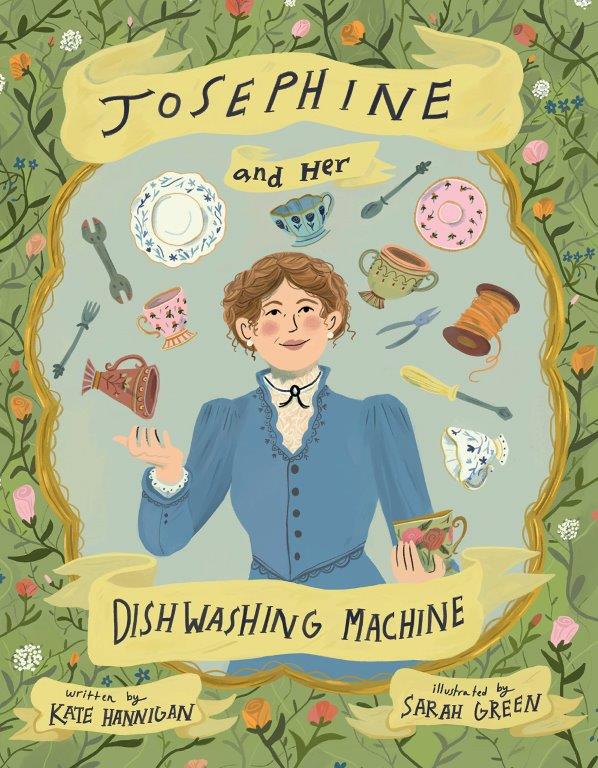
Josephine and Her Dishwashing Machine: Josephine Cochrane's Bright Invention Makes a Splash 
by Kate Hannigan; illus. by Sarah Green 
40 pages; ages 7-10
Calkins Creek, 2023

Josephine Garis Cochran was a modern woman who wasn’t afraid to get her hands dirty.

But, one night after a dinner party she’d had enough of dirty hands – and dirty dishes! There must be a better way, she mused. Inventors were busy at work, devising machines and tinkering with electricity and even making a telephone. So Josephine decided to invent a machine to wash dishes.

What I like about this book: I love the language. There’s alliteration: saucers and soup bowls, tested and tinkered, pushed and persevered. There’s rhyme: pliers and wires. And I like the emphasis on revising, reworking, and rethinking.

Josephine’s first machine doesn’t work well at all, but she learned from her mistakes. And each time she redesigned her machine, she fixed a problem until at last – she had a working dishwashing machine!

I like that there is back matter: an author’s note about dishwashers and Josephine, and an introduction to more than a dozen notable women inventors. There’s also a timeline of “fascinating inventions” and a whole bunch of resources for kids who want to learn more.

The Brilliant Calculator: How Mathematician Edith Clarke Helped Electrify America 
by Jan Lower; illus. by Susan Reagan
40 pages; ages 7-10
Calkins Creek, 2023


Edith Clarke devoured numbers. Conquered calculations. Cracked puzzles.

She loves math, and dreams of building dams and bridges. Instead, she is sent to boarding school to learn manners and music and finished her schooling at the dawn of the twentieth century. Cars are on the road, inventors are testing flying machines – and Edith sees a place for her and her math in these new modern times.

She teaches physics, and eventually begins work as a human “computer” with engineers who are stringing the first phone wires across America. Why do voices fade on wires as distances grow? Edith finds out. In her free time she tackles problems related to electrical transmission lines, invents a tool that helps engineers solve problems faster, and sets the stage for our modern “smart electric grid.”

What I like about this book: One of my favorite spreads is the city street, with wires crossing every which way and a biplane above. Equations are integrated into the buildings to show how Edith saw the world. 

I also like the illustrations that show how she invented her calculating device and the pages that highlight quotes from Edith’s own writing. And there is back matter: an author’s note about Edith and more about her contributions to engineering; a timeline of Edith’s life; glossary; and short bios about more women mathematicians, inventors, and engineers.

Beyond the Books:

Learn more about women inventors. Need a place to start? Check out this post on A Mighty Girl blog.

Find out how modern dishwashers work. If you have one, take a good look inside – maybe the owner’s manual has some drawings. Or you can check out this video.

Be an inventor. What job do you do that you would like to see done mechanically? Invent a way! Think about what needs to be done, and how it could be done. Then draw up your invention designs.

Today we’re joining Perfect Picture Book Friday. It’s a wonderful gathering where bloggers share great picture books at Susanna Leonard Hill's website

Because these books appeal to older readers as well, we’ll be over at Marvelous Middle Grade Monday, too. That happens at Greg Pattridge's blog, Always in the Middle, so hop over to see what other people are reading. Review copies provided by the publishers.


Monday, March 13, 2023

It's Women's History Month!


When you think of inventors, chances are the names that come first to mind are Alexander Graham Bell, Thomas Edison, the Wright Brothers. What names are on the tip of your tongue when you think about great scientists? Darwin? Einstein? Maybe Marie Curie (she did, after all, receive two Nobel prizes for her outstanding work in chemistry and physics).

But here’s the thing: even as the guys were inventing flying machines and phones, women were building airplanes and bridges. And seriously, would a man ever even think of inventing a dishwashing machine?

Women have long contributed to our history as rulers, pirate queens, explorers, political leaders, artists, composers, musicians, scientists, engineers, doctors …  Too often their contributions were overlooked, overshadowed, or simply erased from the history books.

So for the rest of this month I will be posting reviews of books about women who have contributed to the STEM fields. If you are looking for books to share in a classroom or to read at home with your kids, check out my “Women in STEM” page – the link is at the top of the blog. I’ve curated a list of books that I’ve reviewed here on Archimedes or elsewhere, along with some reviews by colleagues. There are picture books and books for older readers.

And, hey – if you come across a great book about a STEM woman, let me know so I can add it to the list.

Friday, February 10, 2023

These Books Put Stars in my Eyes!

One of the things I’ve noticed about winter is the stars. They seem to shine brighter, and look bigger than they do other times of the year. Why? I don’t know – but I do know that people have been asking questions about stars since forever. So today I’m sharing two books for the young stargazers in your life.

theme: stars, women in science, biography

The Fire of Stars: The Life and Brilliance of the Woman Who Discovered What Stars Are Made Of 
by Kirsten W. Larson; illus. by Katherine Roy
48 pages; ages 5-8
‎Chronicle Books, 2023

I usually begin my picture book reviews with the first line or two of the story. But in this case, that’s a bit tricky. Because there are two stories happening at the same time in this book. One story is about the life of Cecilia Payne, the astrophysicist who discovered what stars are made of. The other story is about the life of a star. 

Just how does one tell two stories at once? Kirsten does it using a parallel structure, showing the lives of Cecilia and the star side-by-side. She compares the baby Cecilia to an unformed star, waiting for its future to begin. She shows Cecilia growing and discovering her world, as the star grows into its world. It’s easier to understand if you can see a picture of one of the pages (thanks to Chronicle for permission to share this). 

The star’s story: In a cloud of dust and dirt …

Cecelia’s story: Cecilia spends hours watching slimy slugs glide through the garden…

Definitely my favorite spread because: garden, slug, getting down in the dirt. As the star grows, things shift and separate. So, too, in Cecilia’s life. She is uprooted from her cozy home when her family moves to London. Cecilia wants to learn about science, in a world where men are scientists. She is the only woman in her physics class, she often doesn’t get recognition for her work. But she discovers something amazing: what stars are made of!

What I love about this book: I love the clever parallel story structure! I love the illustrations! The paintings of nebulae and galaxies look as though they could be photos from one of the space telescopes. They are sweeping, grand, colorful – out of this world! And I love the back matter. Kirsten provides more information about Cecilia Payne, a true “science superstar”, and gives a detailed look at how a celestial star is born.

I had heard that we are made of stardust, and I wondered just how true that was. Fortunately, there is a book coming out next month that can help answer that question – and a whole bunch more. 

Am I Made of Stardust?: Dr. Maggie Answers the Big Questions for Young Scientists
by Maggie Aderin-Pocock; illus. by Chelen Écija 
128 pages; ages 8 and up
Kane/Miller Book Publishers, 2023

This is a great book for curious future space explorers. There are activities to try, tons of “Astro facts,” and a robot named IQ (which stand for Interesting Question). There’s lots of information about stars and our solar system and humans in space. For example, the author talks about whether we can grow plants on other planets. 

But back to the question at hand: are we made of stardust? Yes! You, me, and nearly everything in the universe first came from a star. Stars are made of hydrogen and helium on the outside – that’s what Cecilia discovered. But at the center, new elements are formed, including iron, carbon, and silica. Those elements at the heart of a star are let loose when that star dies in a Big Bang called a supernova. The bits of stardust are flung through the universe and … who knows? Maybe some tiny bits are falling through our atmosphere as we read about them.

Beyond the Books:

Learn more about Cecilia Payne in this video from The Lawrence Hall of Science

Create some Star Art! Drop by illustrator Katherine Roy’s studio where you can watch a book trailer, and learn about how she uses a toothbrush to help create star art. Then grab some paints and paper (and maybe a toothbrush) to create your own star art! Need inspiration? Here’s some great photos of nebulae taken by the Hubble Space Telescope.

Stardust is falling all around us! Collecting dust from actual stars is hard – even for scientists with the right equipment. But you can collect dust from meteorites, sometimes called “falling stars.” Here’s how. 

Today we’re joining Perfect Picture Book Friday. It’s a wonderful gathering where bloggers share great picture books at Susanna Leonard Hill's website. On Monday we'll be hanging out at Marvelous Middle Grade Monday with other  bloggers. It's over at Greg Pattridge's blog, Always in the Middle, so hop over to see what other people are reading. Review copies provided by the publishers.


Friday, January 13, 2023

The Mother of Nuclear Fission

Over the past year, scientists got closer to making nuclear fusion (the combining of two atoms to produce energy) a reality. Meanwhile, let's check out the story of ...

The Woman Who Split the Atom: The Life of Lise Meitner 
by Marissa Moss 
264 pages; ages 10-14
Abrams BFYR, 2022

Lise Meitner was a curious girl who slept with a math book under her pillow. She grew up in Vienna where Jews had more opportunities than in other countries. Still, going to college, becoming a scientist – that was for sons, not daughters. Even going to high school wasn’t something girls did in most of Europe in the late 1800s.

But Lise persisted, eventually earning a doctorate in physics. She was ready to do research even if no one wanted to work with a woman. So Lisa made her own instruments and got to work. Eventually she partnered with other physicists and chemists and discovered how uranium decayed. She built a cloud chamber so she could see trails of radioactive particles, wrote papers, and gained acceptance in the scientific community. 

But just when it no longer mattered that she was a woman, it mattered very much that she was Jewish! Now all employees of the institute where she conducted research were required to be members of the Nazi party. Lise was no longer welcome as a scientific collaborator, and her name was stripped from her published scientific papers.

As German scientists turned their attention to chemical weapons and the race to build an atomic bomb, Lise turned her efforts to getting out of Germany. Alive. She wanted no association with the potential doomsday weapon and called for peace, not war.


What I like about this book: I like the way author Marissa Moss shows how hard it was for Lise to make her mark on science – and how easy it was for her contributions to be erased.  I like the comic panels that open each chapter, showing slices of Lise’s life – especially the drawing of her cloud chamber. And I like the back matter, which includes a timeline and profiles of  scientists mentioned throughout the book. There’s even a short physics glossary for those of us who still count electron shells on our fingers.

Thanks for dropping by today. On Monday we'll be hanging out at Marvelous Middle Grade Monday with other  bloggers. It's over at Greg Pattridge's blog, Always in the Middle, so hop over to see what other people are reading. Review copy provided by the publisher.


This month, STEM Tuesday is featuring books about nuclear science and the scientists who discovered radioactivity. If you're looking for more books about atomic energy, please join us there!

Monday, October 17, 2022

Make the World a Better Place for Wild Things ~ by Lisa Kahn Schnell

I write and make art to make the world a better place. To me, that means protecting wild creatures and wild places, connecting people with the non-human natural world, and deepening and sharing those connections. That’s part of what made me curious to learn more about Rosalie Edge. 
Lisa's sketch of tree at Hawk Mountain

Mabel Rosalie Barrow Edge founded Hawk Mountain Sanctuary in 1934 as a response to the annual shooting of migrating raptors that passed along the main ridge that runs through southeastern Pennsylvania. Because hawks, eagles, falcons, and other birds of prey were considered vermin at the time, whole families gathered on rocky outcrops on Sundays each autumn to shoot the birds as they flew by. Rosalie, who by that point had dedicated her life to protecting wildlife of all sorts (not just the cute and cuddly kind), was horrified. After many ups and downs and a whole lot of work, she raised enough money to purchase the land and create the world’s first sanctuary for migrating raptors. 

I had worked and volunteered at Hawk Mountain Sanctuary for over ten years before I dove into the details of Rosalie’s story. Big posters of her greeted me every time I walked into the visitor center, and I had given presentations about her to tour groups and sanctuary visitors. But with her tidy suit, fancy hat, and heels, I always found her a bit intimidating. Her face did not just look out from those posters. It implored, with the fierceness of one of the raptors she so loved.

Red-tailed hawk sketch by Lisa
I have come to understand that fierceness as devotion to the causes she cared about. Hawk Mountain Sanctuary was definitely one of those causes! But her reach was broad, and whatever the topic, Rosalie took every opportunity to speak up—and encouraged others to do the same. By creating Hawk Mountain Sanctuary, she also made it possible to start collecting data about migrating raptors. This data set has continued to build to this day, and has been used by scientists far and wide (including Rachel Carson) to monitor raptor population trends. Rosalie listened to her heart, and her actions sparked great changes.  

But Rosalie hasn’t gotten as much attention as other environmentalists. I’m excited to share her story, both as a way to give back to Hawk Mountain Sanctuary—a place that has meant so much to me—and also to inspire others. By learning about her struggles and creative solutions, I hope that more people will use their own skills and ideas to make the world a better place for wild things and the humans who love them, too.     

Lisa at Hawk Mountain
One way you can help make the world a better place for wild things is to ask someone to tell you about an experience they had with nature. A lot can happen if you listen. However big or small the story—or the teller!—listening is a great reminder that these experiences and relationships with wild things are important. And who knows what good things will come of that. 

Lisa Kahn Schnell is the author of High Tide For Horseshoe Crabs and other books for young readers. She has worked and volunteered at Hawk Mountain Sanctuary for over 20 years. This year, Lisa has been sketching a tree every day. She’d love to hear your stories about a special tree you know, or other moments in the natural world. You can find her online at lisakschnell.com and @lisakschnell. 

Friday, September 16, 2022

Amazing Women in Wildlife Science

Animal Allies: 15 Amazing Women in Wildlife Research 
by Elizabeth Pagel-Hogan 
‎224 pages; ages 12-up
‎Chicago Review Press, 2022

Do you feed the birds in winter? Help salamanders cross the road? Safely escort spiders from your kitchen back to the great outdoors so they won’t get squashed? If so, you are an Animal Ally, just like the wildlife researchers highlighted in this book.

Elizabeth Pagel-Hogan features stories about fifteen women scientists from around the world who study animals. And since Elizabeth is a birder, it makes sense that the first women we meet work with birds. That’s okay, though, because she’s got the book divided into sections for women who study arthropods, sea creatures, amphibians and reptiles, and mammals. So if you’re a bug-lover (like me) you can dive right into your favorite section first, and read the rest later.
Having said that, I confess that I did, indeed open up to the section about arthropod researchers. Back in the last century I was the “ant lady” at a camping area on the Sonoran Desert. I studied the foraging behavior of harvester ants, so I wanted to read all about Dr. Corrie Moreau and her ant studies. Her first studies involved scattering crumbs and watching ants gather and carry them back to their nest. Now she uses DNA to learn more about the evolution of ants. Then, Elizabeth interviews the Bug Chicks – who, if you don’t know about them, you need to. They make learning about bugs fun and have scads of videos at their website. And there was a wonderful chapter about an ecologist who studies spiders in the city.

Each chapter highlights not only the wildlife science the researcher is engaged with, but also puts it into context. Sure, the bird scientists are studying birds, but their research intersects with biodiversity and conservation and, too often, the challenges of a changing climate. The scientists in this book are passionate about sharing their knowledge with others, often young people. And there’s one more thing that comes through, as we read our way from one chapter to the next: these women challenge the assumptions of who can be a scientist and what a scientist looks like.

And then there’s back matter! Elizabeth includes resources for young naturalists – apps such as Merlin and iNaturalist, tips about camera trapping, encouragement for becoming a community scientist, and how to take action on climate change. Chapter notes provide opportunities to learn more about specific points she makes throughout the book. If I rated books, I’d give it 4 wings.

I caught up with Elizabeth by email a couple weeks ago, and just had to ask her One Question:

Me: What inspired you to write this book? And was it a "pandemic project"? (okay, two questions)

Elizabeth: Yes, I wrote the book during the pandemic. So many scientists were unable to be out in the field doing work, I was able to interview them. 

I love animals and wildlife and cared for a wide variety of pets when I was young. I love reading science biographies and I was a science educator for many years. I think those things combined inspired me to write this book. I had so much fun interviewing the scientists and I’m happy I was able to share their stories. 

Elizabeth is a member of #STEAMTeam2022. You can find out more about her at her website
 
Thanks for dropping by today. On Monday we'll be hanging out at Marvelous Middle Grade Monday with other  bloggers. It's over at Greg Pattridge's blog, Always in the Middle, so hop over to see what other people are reading. Review copy provided by the publisher.