Showing posts with label winter. Show all posts

Wednesday, February 25, 2026

Explore Outdoors ~ Squirrel Snacks


I've read that rosehips make great winter snacks for rabbits and squirrels. Bears, too, though I don't expect we'll see any down at the County Courthouse gardens!

Rosehips are full of vitamin C, and they may be a great source of food when other stuff is scarce. But getting to them ... that's a prickly proposition.

If there are any rosehips in your neighborhood, do you ever see squirrels or birds eating them?

Wednesday, February 18, 2026

Explore Outdoors ~ Going on a Flea hunt ...

 ... snow fleas, that is. Monday it was so warm (40oF) that I decided to check out the old oak log behind my garden. It’s covered with moss and lichens, and on Monday the snow below it was covered with snow fleas!


Seen from a couple feet away, snow fleas look like specks of pepper. 

Up close, they look like bigger specks of pepper! Unless you have a hand lens, and then you can see their legs. They have six, but they aren’t insects. And they aren’t even fleas. They’re teensy arthropods called Collembola, or springtails. They’re a whopping 1/8 inch long and have two tail-like structures that are tucked under their belly – until they release and catapult the snow flea into the air, flinging them up to 100 body lengths away. It’s a great ride with one problem – the snow fleas have no control over where they land. 

Turns out snow fleas have been around a long time, at least 400 million years. By comparison, the first dinosaur didn’t show up until 240 million years ago, writes Judy Rosovsky. Check out her article at VT Agency of Agriculture, Food & Markets.

Snow fleas have been found on Mt. Everest, so finding them in my backyard isn’t unusual. They’ve got a protein that acts as an anti-freeze to keep their cells from freezing, says Judy. And they don’t bite people – or pets. Instead, these tiny-but-mighty jumpers subsist on leaf litter, decaying plants, and fungi. 

This week, if you’ve got snow and a warm day, go on a snow flea hunt!

Wednesday, February 11, 2026

Explore Outdoors ~ Three Ways of Looking at a Tree

 This week take your camera or a sketch pad outdoors with you and spend a few moments looking at trees. It should be a bit warmer, so you can actually spend some time observing things in nature!


Look at a tree from a distance.
What do you notice about its shape?
What do you notice about the way its branches come off the trunk?


Get closer.
What do you notice about the bark?
About the twigs?
About buds?


What do you notice about tree shadows?

Wednesday, February 4, 2026

Explore Outdoors ~ almost a leaf skeleton

 Beech trees are notorious for hanging on to some of their dead leaves all winter. That trait is called marcescence (mar-SES-ents) . Beech trees do it; so do oaks. When I walk along the road on a windy day, I can hear the beech leaves rattle and shake. The other day I took a closer look at one of the beech leaves. It looked a bit like a stained glass window, but without colored glass.


Next time you're out walking 
look for leaves lingering on limbs. Notice their shape and color, whether they have jaggedy edges, and what kind of tree they are on.


Wednesday, January 21, 2026

Explore Outdoors ~ Lichens!

 Lichens are small and easy to overlook, but they are amazing. These tiny symbiotic communities of fungi and algae and cyanobacteria can weather the cold temperatures and dry air of winter. How do they do it?
 
 
They go dormant. Some have anti-freeze chemicals in their cells to keep from - well, freezing and bursting open. Their superpower: they can pick up with photosynthesis once the weather warms up and the moisture returns. Find out more about lichens here. 
 
Go Lichen Looking around your neighborhood. 
Check tree trunks and branches, rocks, stone walls - I've even found lichens growing on park benches! 


Wednesday, January 14, 2026

Explore Outdoors ~leaving seeds for the birds

 I love my garden - but let's face it: I am a lazy gardener. I let my flowers go to seed and leave them all winter. One reason is that some of the seeds will germinate and grow into beautiful blooms next summer.
 
So who nibbles the seeds of my purple coneflowers and bee balm? Blue jays do. So do cardinals, goldfinches, chickadees, nuthatches, titmice, juncos and sparrows. These are the same birds that show up at my feeder ... but on those days I'm slow to refill the feeder, I'm happy there are plenty of seeds out in the garden for them.

 Birds, and other wildlife, glean seeds from grasses and other plants as well. 
 
You can find out more at this article, "Native Plants Provide Winter Food Sources for Birds" here.
 
This week, look for birds visiting seedy heads of flowers and grasses in your neighborhood.
 
Who do you see? 


Friday, December 5, 2025

Let it Snow!

We still have a couple weeks before the official “first day of winter” but it can snow any time, so I want to share these fun books today.

theme: snow, snowflakes, STEM

Flurry, Float, and Fly!: The Story of a Snowstorm 
by Laura Purdie Salas; illus by Chiara Fedele 
40 pages; ages 4-7
Bloomsbury Children’s Books, 2025

Clouds lie heavy, gray, and low. From down below, just one wish: Snow!

The kids are waiting, and waiting… they pull out the sled and sit on it and wait some more. Above, the sky is dark with clouds that look like they might bring snow. And above those clouds, the air currents, cold from the north and damp from the south, mix and swirl. “Water vapor clings to dust, begins to build a slushy crust.” From the endpages – autumn leaves at the front, snow at the back – to the rhythmic, rhyming language, this is one fun read-aloud!

What I like about this book: there’s a ton of science in this book, beginning with cloud formation. Readers will learn how a drop freezes and how water vapor clings, forming branches, and how those crystals begin to fall and collect into flakes. Back matter all about The Science of Snow, from the ingredients you need for a snowstorm to flake formation, accompanied by snowflake photos. 

Hello Snow (Board Book)
by Katherine Pryor; illus. by Rose Soini 
24 pages; ages 0-3
Schiffer Kids, 2025

Flakes flutter. Wind swirls.

Parents help two youngsters zip up into their outdoor clothes so they can greet the snow. They slip and slide, make snow angels, and roll snow into a friend. There is so much to explore outside in the cold.

What I like about this book: The rhymes are short and focus on sounds and action. Boots crunch, ice cracks. Activities are perfect for toddlers (and their adults!), and the bright colors bring life to a snowy page.


Beyond the Books:

Go snowflake watching. Make sure you’re dressed warmly and then go outside to watch snowflakes fall. What do they look like when you watch them looking straight ahead? What do they look like when you look up into the sky? Come up with words that show what you see.

Catch snowflakes. You’ll need to put some dark colored paper in the freezer a couple hours before. Then head outside and let flakes land. Some things to do: look at flakes through a magnifying glass; catch flakes at the beginning of the storm and later on to see if they have changed shape and size; try to count how many land on your paper in 10 seconds. 

Build a snowflake using materials at hand: legos, twigs, straws, or cut one out of paper. Remember the two rules of snowflakes: they have six rays and they are symmetrical. Here’s a video showing one way to cut a paper snowflake.

Make a list of five more things you can do to play with snow! Then go do them.

We'll be joining Perfect Picture Book Friday when it resumes after the holidays. It’s a wonderful gathering where bloggers share great picture books at Susanna Leonard Hill's website. Review copies provided by the publishers.

Friday, September 12, 2025

Crows Come Together

 
I Am We: How Crows Come Together to Survive 
by Leslie Barnard Booth; illus. by Alexandra Finkeldey 
44 pages; ages 5-8
Chronicle Books, 2025 

theme: birds, behavior, community, winter

I spill across the sky like ink—
fill the night with jagged cries.
I have one thousand eyes.

With the opening of the book we are invited into a winter flock of crows – a flock where one crow is part of the many because, as Leslie writes, “one set of eyes isn’t nearly enough.” With lyrical language she shows how the flock works together for survival. 

What I like about this book: The lovely, poetic language pulled me right in to the crow’s reality of winter survival. I love how Leslie explains that “we” is stronger than “I” – even if it is just for a night’s roost. There is a wonderful nod to the witches in Macbeth, and the recurring theme that night casts the spell that binds the birds together. The illustrations are perfect: dark, but not dreary! And there is Back Matter where curious readers can learn more about crow families, bird intelligence, social learning, and winter survival.


Every time I read a book by Leslie, I feel like she’s found a new way to tell a story. So I had to ask her One Question.

Me: How did you come to this way of telling a story about crows? And did you explore other ways of telling the story?

Photo by Kristal Passy Photography
Leslie: This story began with the concept of crows as social creatures that cooperate and collaborate to survive. I was particularly struck by the fact that crows benefit from the vigilance of other crows--by moving and resting as a flock, they can in a sense "see" with a thousand eyes. I had also been thinking, at the time I wrote this piece, about the power of cooperation more generally. We humans are inextricably bound to one another--our happiness, health, and survival depend on the actions of families, communities, and nations. Because the collective is the focus of this story, when I wrote the first draft I chose first-person plural point of view. While other aspects changed from draft to draft (I worked to add tension and create more of a narrative arc), the point of view remained consistent.

Beyond the Books:

Check out the video and activities at Leslie’s page for educators. There’s a lot to do there!

Get to know a crow. The best way is to find a place to watch them in your neighborhood, or at a park. If you want to know how to identify a crow, check out this page from Cornell’s All About Birds

Fold a paper crow. Instructions here.

Leslie is a member of #STEAMTeam2025. You can find out more about her at her website, lesliebarnardbooth.com
https://www.lesliebarnardbooth.com/

Today we’re joining Perfect Picture Book Friday. It’s a wonderful gathering where bloggers share great picture books at Susanna Leonard Hill's website. Review copy provided by the publisher.

Wednesday, February 26, 2025

Explore Outdoors ~ Almost Snowcones

 When the beech leaves dry up over winter, they curl into cones - perfect for catching snow. Some years I find perfect snowcones. This year, not so much. But still, they're fun to find on a winter walk.

How do the leaves in your neighborhood catch the snow?


Wednesday, February 19, 2025

Explore Outdoors ~ Lichens


 One of my favorite winter activities is Lichen Looking. That's because trees don't have leaves during this season - or if they do, the leaves are dried and rattly. And they don't have flowers. But they do sport lichens and other fungi. And, in this case, it was neat to observe how the snow gathered on the curls of lichen and bark.

I found this tree at a city park. What sort of lichen can you find in your neighborhood?

Wednesday, February 5, 2025

Explore Outdoors ~ Wintery Flowers

 Welcome Back! Shadow or no, and regardless of what the Groundhog thinks, it's time for me to come out of hibernation, shake the snow out of my brain, and share cool science and books for the spring.


I spent part of the winter months in south Boston area, near the ocean. The air seemed to be warmer, the climate milder, and the flowers bloomed into December...

Here are a couple I captured at first snowfall, right before the Solstice.


You can tell the air was warm(ish) because the flakes are so big - large enough to distinguish them on flowers and leaves. Within a couple weeks all the flowers had lost their petals and leaves were dried and crinkly.


What do the flowers look like in your neighborhood this week?

Wednesday, February 14, 2024

Explore Outdoors ~ the way snow collects

 A couple of weeks ago I took my camera out into the snowstorm. It was one of those "snow globe shook and flakes are flying" days. The snowflakes were fat and heavy and ... wet! Noisy, too - I could hear them SPLOT on the ground as they fell. A good day for watching how snow collects on branches, twigs, and pine needles.

Next time it snows, watch how - and where - the flakes collect.


Wednesday, January 24, 2024

Explore Outdoors ~ Birds playing in the snow

 This week we've had some snow ... which means when squirrels zip over to the feeder, I can see their tell-tale tracks in the snow. Deer and squirrels aren't the only ones leaving tracks. My friend, Trish Engelhard, and I have been enjoying evidence of some bird fun outside our back doors.

photo by Trish Engelhard

Over on Trish's side of the hill, the birds have been making Snow Angels!


Meanwhile, on my hill the juncos are holding square dances.


What kinds of stories do the birds leave in the snow where you live?


Wednesday, December 13, 2023

Explore Outdoors ~ in a new place

 Most of my exploring outdoors happens right outside my back door: in the garden or along roadsides I ramble. Usually within a three-mile radius of my home. My goal is to find something of beauty each day. Then last month I had the opportunity to travel somewhere new...

I boarded a train and headed out west. On the trip out, it was fall. A couple weeks later, on my return trip, we were treated to a dusting of snow on the red rocked landscape of southern Utah. 

If you have the opportunity to travel this winter, take some time to sit with the landscape. And look for some of the earth's beauty surrounding you.

Friday, October 27, 2023

Winter is Coming...


On a Flake-Flying Day: Watching Winter's Wonders
by Buffy Silverman
32 pages; ages 4-9
Millbrook Press, 2023

theme: winter, nature, animals

On a feather-fluffing, seed-stuffing, cloud-puffing day…

… leaves rustle and frost glistens. Winter is coming and the animals and plants are getting ready for it. Some change color, some snuggle together, and some take loooong naps.

What I like about this book: The language is spare and lyrical, sometimes rhyming and always evocative of the season. If the words aren’t enough to get you up off the couch and into your jacket and boots (don’t forget a hat!) then the photos will! They are so bold and enticing. And there is back matter with more information about each plant and animal featured in the pages. There’s a few books suggested for further reading, and a glossary so folks reading the book aloud can answer such questions as, “what does molt mean?”

I love Buffy’s books about seasons SO much that I just had to ask her One Question

Me: What do you like best about winter?

Buffy:  My favorite experience in winter is waking up to fresh snow and trekking down to our lake. On a cold, cold morning, the snow squeaks beneath my boots and the air tingles in my nose. At first glance, the snow is an unbroken blanket of white. But soon I start to notice tracks--the heart-shaped hoof prints of a deer, the tail-dragging trail of a deer mouse, a straight line of fox prints across the snow-covered ice, and occasionally the bounding track of a weasel. Although I love the winter stillness, I'm excited to see that some wildlife is out and about. And that's the connection to ON A FLAKE-FLYING DAY--winter is a great time to explore and see what's happening in the natural world!

Beyond the Books:


Before winter comes, what do you notice about the natural world right now? Go outside with a notebook and write down things you notice about trees and plants and birds and animals.

The first day of winter in the northern hemisphere is usually December 21st, though the wintry season often starts long before that. How will you know when winter gets to you?

Be a Winter Explorer. Go outside and give yourself time to notice what you see, hear, smell, feel. Does winter have a taste? 

Check out Buffy's other seasonal books here (fall) and here (spring)

Buffy is a member of #STEAMTeam2023. You can find out more about her at her website. Today we’re joining Perfect Picture Book Friday. It’s a wonderful gathering where bloggers share great picture books at Susanna Leonard Hill's website. Review copy provided by the publisher.

Wednesday, February 1, 2023

Explore Outdoors ~ Looking for Beauty

Last month I headed outside with a challenge to find five bits of beauty in the nature around me. It was cold, so I didn't go far - just up the road a bit - but there was plenty to see: snowflakes trapped in the curve of a beech leaf; the prickles and stickles of dried plants; the spiral of a desiccated goldenrod leaf; seeds whose parachutes never opened...

What beauty do you find
 outside your door?


Wednesday, January 25, 2023

Explore Outdoors ~ Frost Flowers


Out for a walk in the woods last month, we discovered these needle-sharp, spiky frost flowers decorating the thin ice of puddles. These frost flowers have nothing to do with plants. Instead, they are ice crystals that grow on tops of newly formed ice on ponds and lakes - and even on the Arctic Ocean. It has to do with how warm the air is compared to the water, and the granules of ice trapped on the puddle surface. Those nubby granules form perfect spots for nucleation and growth of these porcupine-like "frost flowers."

What's happening to puddles and ice in your backyard?

Wednesday, January 18, 2023

Explore Outdoors ~ Rosehips in the Snow


Rosehips provide nutritious lunches for birds and squirrels. But - look at those spiky stems! You've gotta be tough to harvest these tasty vitamin-packed berries.

This week, look for roses in your neighborhood. If you find some rosehips, look for bite marks or other evidence that they're being nibbled by local wildlife.

Wednesday, January 11, 2023

Explore Outdoors ~ Fungi & a January Thaw


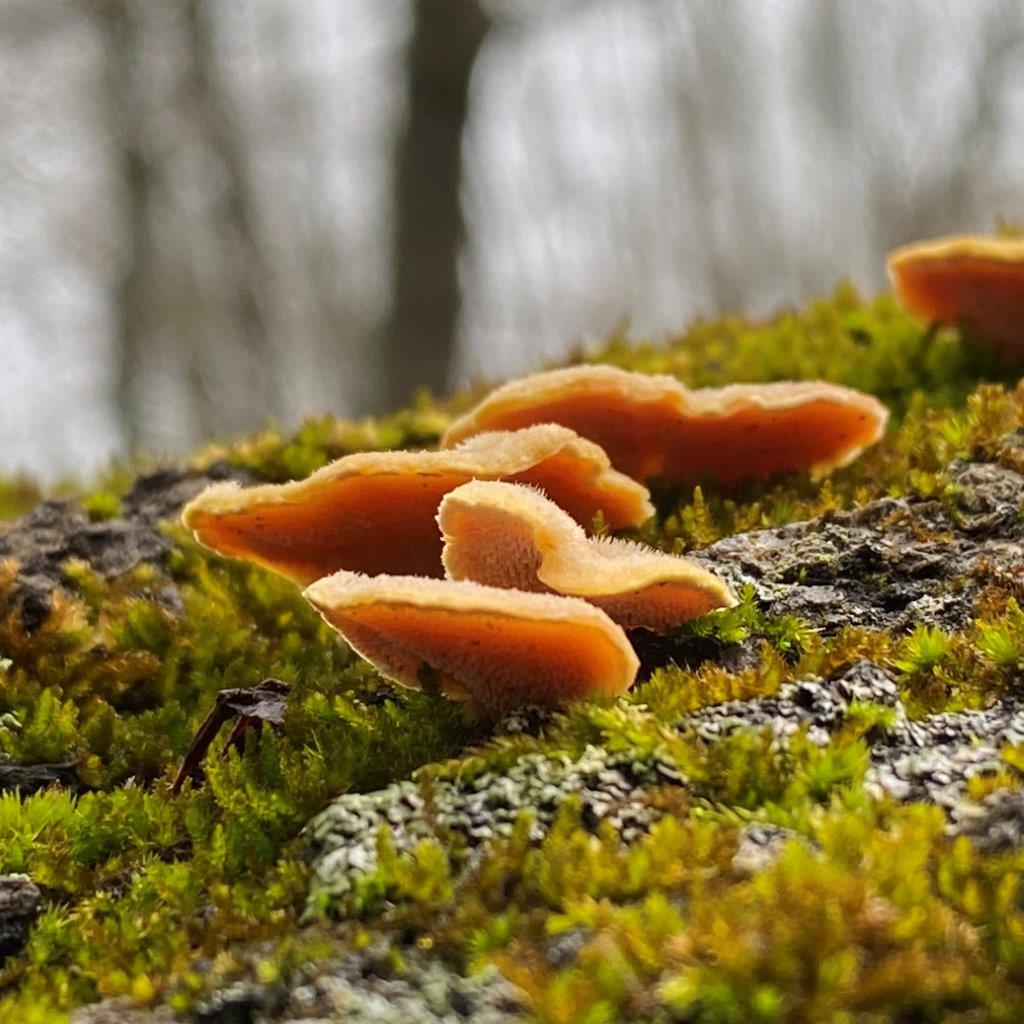
We got our January thaw a bit earlier than usual. Temperatures shot up from the previously polar zero-to-one all the way into the 50s. And yes, we had rain. The downed oak at the back of the garden was a wonder of brilliant moss greens, punctuated by small patches of these tiny fungi with spiky haircuts.

This week, keep an eye out for fungi. You might find them on old logs, tree trunks, branches that blow down, or even thick layers of woodchip mulch. Look at their colors and textures. Take a fungi photo or draw a picture of what you find.

Wednesday, December 28, 2022

Explore Outdoors ~ Winter ferns


In winter, even the palest green stands out against ice and snow, frozen rock. It never fails to amaze me at how a plant can find a root-hold between rocks. I wonder if living on the edge of a stonewall feels as breezy as it looks?

This week check out where plants are taking a toehold, planting down roots, clinging to the edge.