Showing posts with label monarch butterfly. Show all posts

Wednesday, July 27, 2022

Be a Scientist ~ International Monarch Monitoring Blitz, July 29 - August 7


Got an eye for monarchs? The Xerces Society among other partners invites you to join a weeklong International Monarch Monitoring Blitz beginning this Friday, July 29. 


Volunteers help track milkweed, monarch eggs, caterpillars, and/or adults as part of a trinational effort to better understand the monarch butterfly’s breeding productivity, range, and timing in North America. 

Learn how you can participate in this community science project. Give yourself some extra time to watch training videos and read up on the projects. Then head out and do science!


Friday, August 24, 2018

Books about Bugs!

There are so many fun books about butterflies, beetles, and all other six-leggeds that I have a hard time keeping up! Here are three that crawled, climbed, and fluttered to the top of the book basket last week. Just in time for monarch butterfly migration...

The Monarchs are Missing: A Butterfly Mystery
by Rebecca Hirsch
56 pages; ages 8-12
Millbrook Press, 2018

One of the things we used to do with our kids was tag monarch butterflies as they began their southbound journey. In our neck of the woods that means heading out to the hayfields with net and tags in the first weeks of September.

Rebecca Hirsch begins her book with kids in the field, capturing monarchs to tag for the Monarch Watch citizen science project. The monarch butterflies they tag will head south on a journey of nearly 3,000 miles from across the eastern US and Canada to Mexico. How they do that is a mystery. What's not a mystery: that monarchs are in danger. Every hear fewer butterflies reach the forests in Mexico where they spend the winter.

Why are the monarchs disappearing? That's what scientists want to know, so Hirsch profiles scientists in the field. We learn how field scientists count butterflies, and how human land use affects monarch populations. Habitat loss, climate change, parasites ... these are just some of the issues that monarchs face. Fortunately, there are things people can do to make the world a better - and safer - place for monarch butterflies, from creating milkweed corridors to planting native flowers in our back yards.

Yay for back matter! Hirsch provides further reading, seed sources for butterfly plants, and plenty of ways kids (and adults) can get involved as citizen scientists.Want to get started watching monarchs? Check out her website here.

Bug Hotel
by Clover Robin
16 pages; ages 5+
Kane Miller, 2018

Bug Hotel is a lift-the-flap board book filled with discoveries. Maybe you're thinking bug hotels are made-up - but no, they really do exist. People build structures from natural materials such as straw, plant stems, wood, and stones. They provide places for insects to stay. Some people build hotels for native bees. Some people create hotels for toads. And some folks build fancy condos with rooms for many different critters to move into.

As you turn each page, you learn more about the bugs (bees, beetles, butterflies, even snails) and you see what sort of accommodations they appreciate. The back spread provides a list of materials and encourages kids to build their own hotel to help create a sustainable and safe place for backyard bugs to live.

Sure, it's written for the board-book audience, but this "older kid" had fun exploring the pages! Check out these cool bug hotels!

1,000 Facts about Insects
 by Nancy Honovich
96 pages; ages 8-12
National Geographic Children's Books, 2018

Insects are the most diverse, widespread, and fascinating animals on planet Earth, writes entomologist Bill Lamp, in the foreward. So it stands to reason that we should get to know them. Every spread focuses on some incredible aspect of the insect world: life cycles, stingers, migration, conservation. Want to know more about butterflies? Pages 78-79 contain 50 fluttering facts about them.

Information is presented in fact-boxes, with photos interspersed, making this a perfect browse for waiting for an appointment or riding in the car. I can only imagine the kinds of trivia contests it might engender!  

Today we're joining the STEM Friday roundupOn any other Friday we'd be joining others over at Perfect Picture Book Friday, but it's summer vacation. PPBF will resume in September, but you can always head over to Susanna Hill's ever-growing list of Perfect Picture Books. Review copies from publishers


Friday, September 21, 2012

A Book to Celebrate Fall: Butterfly Tree


Butterfly Tree
By Sandra Markle; illustrated by Leslie Wu
32 pages, ages 4 – 8
Peachtree Publishers, 2011


This weekend marks the beginning of fall. From here on the days grow shorter – at least on this half of the earth. Down under, days are getting longer. Down under is where Sandra Markle lives, a wonderful writer and author of Butterfly Tree.

Perhaps you’ve noticed the Monarch butterflies – they’ve been all over my garden sipping nectar from the flowers and getting ready to hit the road… the skyway of migration. Too soon they’ll be gone, heading south to Mexico. It’s a long journey, too far to fly at one stretch. So they’ll have to make a few rest stops on the way.

And that’s what Markle writes about…. A magical moment when a young girl and her mother discover Monarchs just hanging out. The story begins one afternoon in early September, when Jilly sees something way out over Lake Erie. It looks like it’s raining black pepper from a clear blue sky, but as it comes closer it becomes a shimmery orange cloud. Is it smoke from a faraway fire, she wonders? Or the breath of a dragon?

Jilly and her mom follow the mysterious cloud into the woods, dark and deep. They find a tree covered with orange leaves that, when disturbed, explode in a flutter of wings. It’s Monarch butterflies; hundreds of them.

Markle writes a warm memory of a mother and daughter  - and a dog named Fudge - exploring nature. For us nature geeks she includes a map and resources at the back. This is a great book to share for the season.

The illustrations are every bit as wonderful as the story. Leslie Wu’s paintings have a soft, dream-like quality that evokes “memories”. 
Check out other "Fall" science books and resources at STEM Friday. Review copy provided by publisher. And check out Sandra Markle's fun science blog.

Friday, August 10, 2012

Summer Reading... Butterflies, Weather and More

If you're looking for some books that encourage young children to get out and explore nature, you might want to check out some of these new series from Bearport Publishing. They're all aimed at a second-grade reading level, but preschool nature detectives will love the bright photos and backyard activities. 

How do You Know it's Summer is part of a series about the seasons by Ruth Owen. She encourages children to keep track of the temperature from week to week and make notes about the kinds - and colors - of flowers blooming around the yard. Look at how leaves change over the season, she says, and what sorts of insects hang out. And there's a summer scavenger hunt in the back.  Yes, I could have posted this review last month - but there are still six more weeks of summer - plenty of time to head outside and fill a nature journal with cool (or hot) observations.

Speaking of "cool and hot", there's a new Weatherwise series, with books on climate and weather. They're full of photos and facts, a great introduction to help sort out what is the difference between snow, ice, hail or between weather and climate (something adults have difficulty remembering).

Having devoted an entire week to moths last month, I need to at least mention the new butterfly book, A Butterfly's Life by Ellen Lawrence. It's part of the "Animal Diaries" series. Each spread features a diary entry (written by a kid, not a caterpillar) and great photos of a Monarch butterfly's life cycle, from egg to adult. Lawrence includes lots of activities, from going on a caterpillar hunt to creating a butterfly fruit breakfast club. And she lists a few favorite butterfly plants you can grow in your garden - jot them down on your calendar so you remember to plant them next spring!

For science adventure into  places you normally can't go, check out the "Hole Truth" series. Want to know what a fox den or chipmunk's home is really like? Dee Phillips takes you there with an underground home tour: here's the bedroom, there's the pantry, and yonder are a couple extra doors in case you need to get home in a hurry.
Check out other resources at STEM Friday. Also check out the book reviews at the Nonfiction Monday round-up. Review copies provided by publisher.


Saturday, September 10, 2011

Heading South: Monarchs on Migration


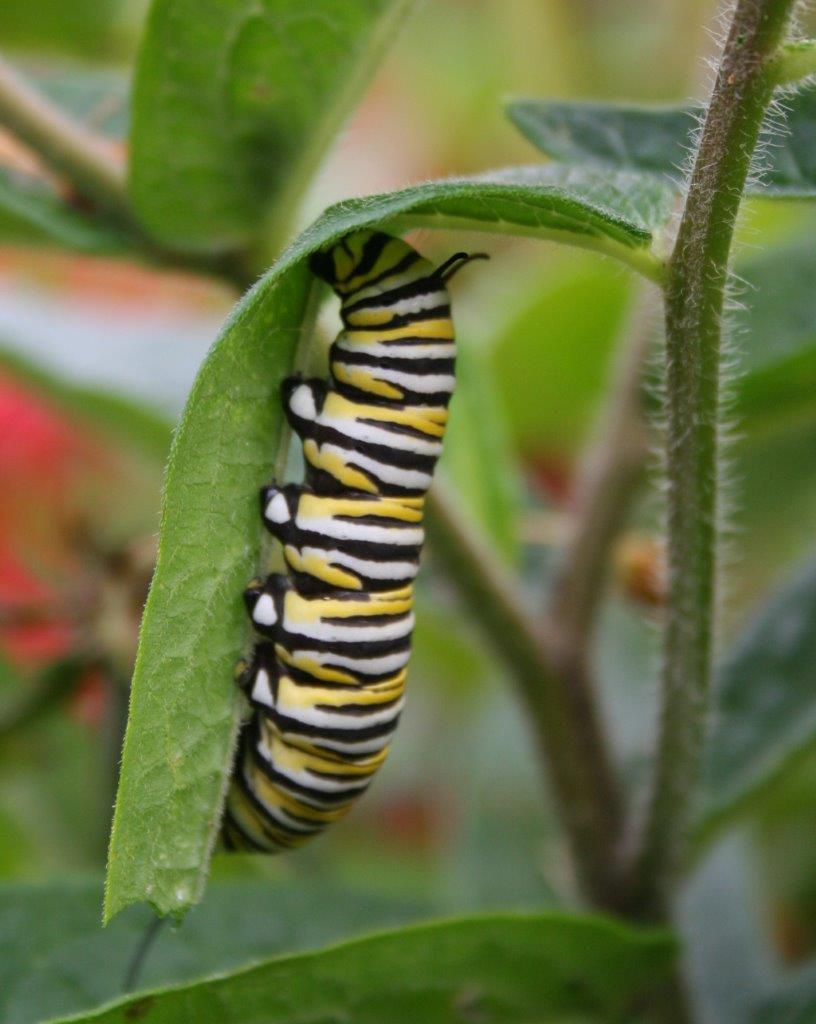
Last month a monarch caterpillar found a nice cozy spot under a cabbage leaf and decided to pupate there. It walked a fair distance before finding shelter, because the nearest patch of milkweed is a football field's length away.


After 24 hours it had changed into a chrysalis.It was well protected from wind and weather and, apparently, anything interested in munching on chrysalides. Not to mention that the chrysalis blended well with the color of the cabbage leaf...


Now it’s waiting to join the vast Monarch migration southward, to Mexico – which, given where we live (42nd parallel) should peak over the next two weeks. 

If you live south of the 45th parallel, now’s the time to start paying attention to Monarch butterflies. Scientists are interested in them and you can help by gluing tags on Monarchs you catch in your neighborhood. It’s a great way to spend sunny autumn days with your children and helps scientists learn more about these butterflies. You can learn more at Monarch Watch.

Sunday, June 12, 2011

How Many Eggs Can a Monarch Lay?

Monarch laying an egg (photo by Rick Bunting)
Back in 2007  Jim Edson, from the University of Arkansas counted and came up with 326. Of course, he says, the butterfly could have laid some eggs on her journey north from Mexico….

Last week Rick Bunting, a butterfly watcher in Upstate NY happened to have his camera handy when a female Monarch was laying eggs. Monarch eggs are tiny – about 1/8 inch long – and the butterfly glues each one individually to the underside of a milkweed leaf with a quick-drying substance she secretes along with the egg.  

It takes about a handful of days (from 3 to 5) for the egg to hatch. The tiny larva (caterpillar) eats what’s left of the egg, then begins munching milkweed leaves. As it eats, it grows. When it gets too big for its skin, the caterpillar molts and then eats its old skin. After it molts about four times, the larva is ready to turn into an adult butterfly. It stops eating and finds a protected branch where it can pupate.

The caterpillar spins a bit of silk and attaches its hind end to a branch. Then it hangs head down and turns into a jade green chrysalis. The chrysalis is hard, and protects the caterpillar-changing-into-butterfly for nearly two weeks. During that time the caterpillar dissolves and reorganizes its body into an adult butterfly.

Karen Oberhauser a professor at the University of Minnesota, answers lots of questions about the butterflies. One person asked how to increase the number of eggs and caterpillars that survive to maturity (the butterfly stage). Should she try to control predators?

Not really, said Oberhauser. The most important thing to do she said, is to create and preserve habitat – and avoid the use of pesticides that can harm them. Global warming may make this more challenging. According to the models, Oberhauser said that monarch overwintering sites are likely to become much wetter than they are now. That’s because of more frequent storms, she says. The model indicates current summer habitat will become too hot, so the Monarchs may need to move farther north for breeding.