Monday, May 30, 2022

A Link between Moving and Creativity

Do we get our most creative ideas when walking? Some scientists think so. Since the time of the ancient Greek poets, people have known that moving helps us to think creatively. Which begs the question: why do I tend to sit at my desk to do my writing?


The fact is, I come up with some wonderfully creative ideas when I’m walking. But is it the movement or the change of scenery around me that stimulates my mind? And it’s not just walking. I have come up with some of my best ideas while turning the compost pile, planting seeds, spading my garden beds, and raking leaves. Sometimes it’s a matter of just having time away from a project, and letting my mind go into neutral while I do something physical. 

Recently, Barbara Händel, a neuroscientist at the University of Würzburg, wanted to know more about how movement is connected to creativity. What happens in our brain when we walk? she wondered. And are people who don’t move less creative?

What she learned is that movement isn’t necessarily the thing that helps us think more flexibly. Rather, she says, it’s the freedom to make movements without having those movements forced into regular patterns…  which is too often what happens when you focus on a small screen for long periods of time.

She’s not the only one who has looked into this in a scientific way. A few years ago a Stanford study showed that creative thinking improves while a person is walking – and even afterwards.

I'd love to elaborate, but I'm heading outside for a walk!

Friday, May 27, 2022

Spend a Day at a Pond

At the Pond     
by David Elliott; illus. by Amy Schimler-Safford 
40 pages; ages 3-7
Candlewick, 2022

theme: nature, water, animals

The red-winged blackbird spreads his tail and sings his hello morning song…

This book is like a day-long field trip to a pond. Each spread features an animal, or a plant, described in a poem. We meet a family of mallards, a legendary catfish, turtles, and a busy beaver. There are also two insects that most kids will enjoy looking for on their pond visits: dragonflies and water striders. Each poem reveals a bit of the daily life of pond dwellers.

What I like about this book: I admit a bias toward insect poems, but also anything frog. So I truly loved the very short poem about metamorphosis from tadpole to adult. Told in seven words! Also, the fun play on words in the heron poem. And I love how the book ends with the evening song of the blackbird.


I also love the illustrations. The artwork is multimedia, finished digitally, but they are so full of texture I can almost feel the feathers and cattail fluff. And then there is Back Matter! Even the notes about the animals and plants in the book are fun to read. Take his entry on cattails. Most kids think cattails look like hot dogs (they do!) but that hot dog head, writes David, “is a collection of tiny female flowers. Not very tasty, I’m afraid.” Fun, right?

Beyond the Books:

Go on a pond field trip. Look, and listen, and smell the air, and feel the ground beneath your feet. You can do this any time of the year. I visited a local pond in mid-March and Canada geese were jumping from the ice into the water and flapping up a ruckus!

Write a poem or story about an animal that lives in or around a pond. Or write about pond life from the point of view of a plant along the shore.

Today we're joining Perfect Picture Book Friday, an event where bloggers share great picture books at Susanna Leonard Hill's website. Review copy provided by the publisher.

Wednesday, May 25, 2022

Explore Outdoors ~ My Weedy Garden


In May,  my garden was THE place to be if you were a carpenter bee or a bumble bee or any number of small wild bees to numerous for me to name. You see, I let my beds go to "weed." Or rather, I let the wild-growing plants flower while the soil warmed and dried out enough to spade. 

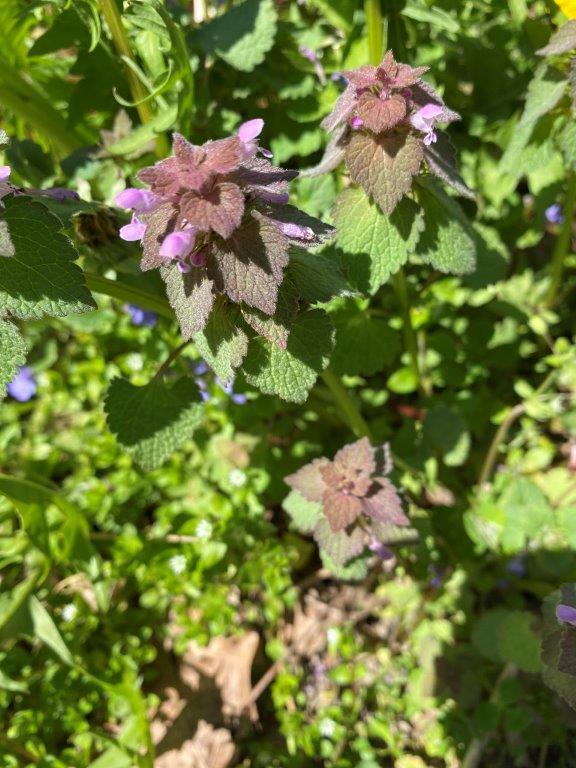
The bees particularly liked the deadnettle blooming in the aisles between the beds and, in some cases, growing up the sides and across the top. Some folks call this a "weed" but I've got a problem with labeling plants that way. You see, deadnettles (in the mint family) are an early-blooming favorite of the local bumble bees.
 
The only problem I have with weeds is that they grow where I want to plant something else. The problem with labeling them "weeds" is that people forget they are simply growing where you don't want them to be, and take drastic actions to get rid of them.


Still, I did have to reclaim my beds for tomatoes and beans, but even as I pulled out dandelions and other weeds, I left a few for the bees.
 
This pretty little blue flower is Speedwell (Veronica sp) ~ it seems to attract small bees and flies. I have read that rabbits like to eat it, but there better not be rabbits in my garden!


One pretty little invader (from the British Isles about 200 years ago) is Creeping Charlie, also known as Gill-over-the-Ground. It's been used as a medicinal herb and, as Christy Mihaly and I note in Diet for a Changing Climate, you can add it to soup. But in our area it grows a little too well, escaping into the lawn and taking over gardens without so much as a how-do-you-do. 


Fortunately, bumble bees and sweat bees seem to like the tiny purple blossoms, so I tolerate it  - but only as long as it takes for me to get to that spot and ... weed it out. 


Chickweed is so green and vibrant you almost want to toss it in a salad. Good news! You can. It's tender and mild and a perfect substitute for sprouts on a sandwich. Birds like it, too. Mourning doves and a diverse crew of sparrows snack on chickweed seeds. Sweat bees and syrphid flies can be found on the flowers as well.


This week take a Weed Walk . What flowers do you find growing in your yard? Are there any bees or flies visiting them? Check a field guide to see if they are edible... and take a bite of the wild side.