Wednesday, March 30, 2022

Explore Outdoors ~ the Other evergreen


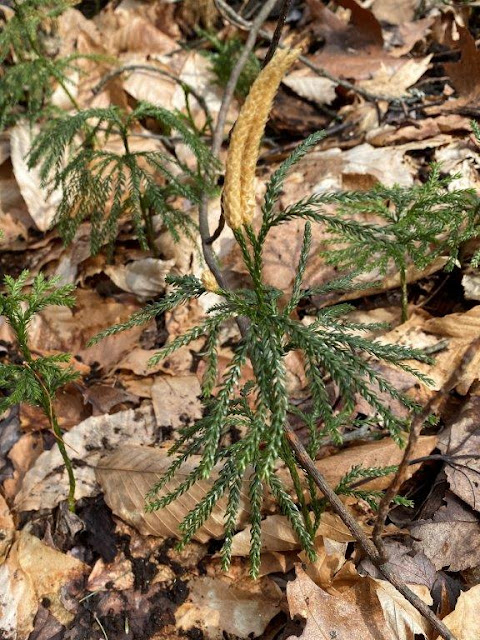
Evergreen trees get their name because they stay green all year round. In our woods we've got these tiny evergreen plants that look like miniature pine trees. Usually, we can see them poking their tops up out of the snow. 

They aren't tiny pine trees, though. They are Club Mosses - which is a funny name for them because they aren't mosses either. Club mosses have stems (which true mosses don't) and shallow roots. Those cone-like structures at the top? They're called strobili. That's where spores are produced... and in late summer they'll open and release the spores.
 
You can learn more about tree club mosses here. Next time you go for a walk in the woods, look for some of these tiny tree club mosses.


Monday, March 28, 2022

Squashing Plants for Fun and Science

The first plant I pressed was a violet. I think I wanted to glue it on a card. My “plant press” consisted of a piece of newspaper and Webster’s Dictionary. I laid the flower between a folded sheet of newspaper and put it inside the dictionary. I may have piled on my dad’s geology textbook for good measure.

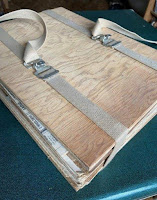
The thing about plants is that they sometimes leak and, as I’ve discovered, books don’t like damp pages. Eventually I made a heavy-duty plant press with straps to squish it closed. It’s heavy and big, so I made another one that I can fit into my backpack and take with me on walks.

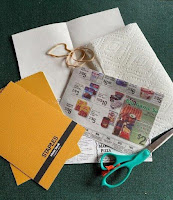
Here’s what you need to make a simple plant press using materials you can find around the house (maybe even in the recycling bin):
  • cardboard (I used the covers of an old steno notebook)
  • paper towels
  • newspaper
  • watercolor paper
  • some printer paper
  • two thick rubber bands or twine
To press a plant, place it between two pieces of paper or newspaper. Take a few minutes to position it so that you can see the petals, leaves, and other plant parts.

Then layer paper towel and heavy watercolor paper, or more newspaper. If you want to press another plant, place it between paper and layer in the newspaper and other sheets.

Put the top cardboard layer on.

Stretch rubber bands around each end, and let it dry. You can stack a heavy book or two on it as well.


After a week, check to see if your plant is completely dry. If not, leave it in the press longer.

Once your plant is dry, use it to make cards or for art projects. Or make an herbarium mount and add it to a plant collection. Here’s what you need:
  • card stock
  • scotch tape
  • labels
  • page protectors
  • 3-ring binder
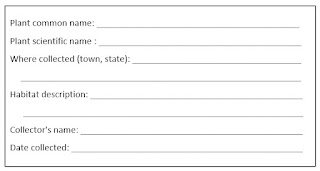
Before you mount your plant, fill out a label. Tape it to the bottom right corner of a piece of cardstock.

Gently remove the dried plant from your press and arrange it on the cardstock. Use thin strips of tape to hold the plant to the page. You’ll want to tape the stem, leaves, tops of petals.

Slide the cardstock into a page protector, and put it in the binder. 

Friday, March 25, 2022

In Defense of Dead Plants

Last spring was a tough time for new book releases, what with libraries, schools, and book stores unable to host public events. So this spring I’m sharing some STEAM books that I didn’t get time to review, and I feel are worth another look. And since spring is here and plants are beginning to grow, I thought today would be perfect for looking at…

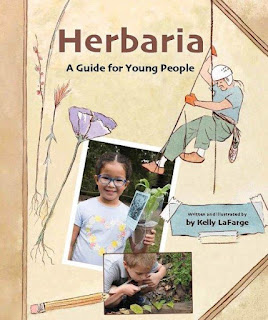
Herbaria: A Guide for Young People 
by Kelly LaFarge 
34 pages; ages 8-12
Missouri Botanical Garden Press, 2021

The first thing I noticed about this book is that it’s almost as big as my plant press! 

The second thing I noticed was the question on the back cover: What good is a dead plant? It’s a good question, for sure.

Live plants give us oxygen. They capture carbon. They provide fruits and leafy greens for us to eat, and food for animals. They clean pollutants from the air, provide shade, moderate temperature, and beautify the world.

Dead plants, says Kelly LaFarge, “can be as useful to us as living ones.” Especially when they are collected in plant museums, called Herbaria. Just as scientists use museum collections to study birds and mammals and insects, they use herbarium collections to study plants. Medical researchers can use samples of plants to aid in their inventions of new medicines. Farmers can learn about weeds, and ecologists can study plant diversity and their geographical range.

Remember the Lewis and Clark expedition? Back in 1803 President Thomas Jefferson directed them to bring back information about the plants and animals found west of the Mississippi. They observed, recorded, drew pictures of, and collected plants from the west – information that helped leaders understand more about the new world. Those samples are preserved in an herbarium, available for researchers interested in learning how the plant populations have changed in the past 200-plus years.

In addition to introducing the why of Herbaria, LaFarge shows how plants are collected and preserved. Her text illustrations are augmented with lift-up flaps (what’s inside a plant press?), field notebook pages, envelopes, and other interactive things to explore. There’s a glossary and a list of herbaria to visit, should you be so inclined. There’s even a side bar about a kid who discovered a new species in his backyard.

This weekend, pay attention to the plants growing around you. On Monday, come back to find out how to make a simple plant press so you can create an herbarium of your own.

Thanks for dropping by today. On Monday we'll be hanging out at Marvelous Middle Grade Monday with other  bloggers. It's over at Greg Pattridge's blog, Always in the Middle, so hop over to see what other people are reading. Review copy provided by the author.