Monday, February 7, 2022

I have Birds on my Brain

 We've got some feeders hanging from the lilac tree outside the kitchen window. Every morning I watch the chickadees and juncos, blue jays and woodpeckers ~  red-bellied, hairy, downy ~ feast upon sunflower seeds and suet. The juncos gather on the mess of intertwined lilac and forsythia twigs, a safe place to wait for the open spot at the feeder. The blue jays wait for no one. And the red-bellied woodpecker has discovered a stout limb below the suet where he can perch and peck away at his heart's content.

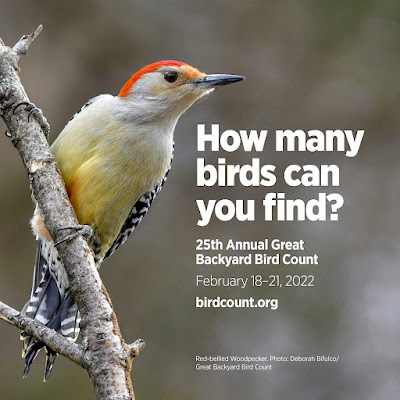
Though I've watched birds for many years, this will be the first time I officially count them for the Great Backyard Bird Count. 

 You might be wondering: hey, Sue, you count pollinators every summer - so why have you been ignoring the birds? Well, the truth is that a number of years ago a bear took down our feeder. After this happened a few times, we sort of gave up. But this year we decided to try again, because we really miss watching our feathery neighbors. And now the birds have told their friends where the buffet is and we anticipate seeing a good number.

Not only that, the Great Backyard Bird Count sounds like fun. All I need to do is: 

  • watch birds for 15 minutes or more at least once over the President's Birthday long weekend. That's next week, Friday, Feb. 18 - Monday, Feb, 21.
  • count all the birds I see or hear during those observation times
  • report them using one of the tools listed on the GBBC website.

Since I've got the Merlin app on my phone, I'll probably use that. But you don't need a smartphone - you can jot down your observations in a notebook and report them using a computer. In fact, you don't need much of anything except a bird guide and some warm clothes. Binoculars are great, but if you don't have them, rely on your eyes and ears. You don't even need a backyard. You can count birds on your balcony, at a park, at the bus stop, at the school yard, or anywhere you are. Heck! You can sit at your kitchen table where it's toasty warm, and count birds while you enjoy your cup of coffee.

I'm planning to go outside, though. Partly because I want to listen to the birds and partly because I need to rack up some #1000hoursoutside time. And who knows, maybe I'll head down the road and check for birds hanging out by the creek. 

The real reason I want to participate is that I know the data we collect will help scientists learn more about where birds are wintering here in the northern hemisphere, and summering in the southern hemisphere. Yup, it's a global event. Find out more at  https://www.birdcount.org/.


Friday, February 4, 2022

Krill: mmm-mmm good!


Good Eating: The Short Life of Krill 
by Matt Lilley; illus. by Dan Tavis 
36 pages; ages 6-8
Tilbury House Publishers, 2022

theme: nature, ocean, food chain

Hey, egg. What are you doing?

The egg, it turns out, is sinking. Down, down … and then it hatches into a weird six-armed larva that begins to swim up, up, up. Over time, this larva goes through changes, developing eyes, a mouth, and an appetite for small things. Really small things – plankton! From here on out it’s an eat-grow-swim world for the krill … until something big and hungry comes along. 

What I like about this book: I like how the book is written as a conversation with a krill. Author Matt Lilley asks krill questions throughout. At the beginning: how can you do all this growing and changing without eating anything? I like how he warns them about predators. “Watch out! Penguins!” And the cheesy jokes: how many is a million million?  A  krillion!

There is back matter- more information about how krill are part of the ocean food web, and more krill facts. Did you know that krill can create their own light, like fireflies? Even the krill-covered end pages are fun.

I was intrigued by the voice in this book, so I asked Matt One Question 

Me: How did you decide to address the book to the krill? You begin with "Hey, egg." And throughout you give them warnings about penguins and other predators.

Matt: The first draft of Good Eating was in the third person, but it didn't feel right to me. It felt like the audience would be too distant from the subject of the story. As soon as I changed it to second-person/"you", it felt right. I think addressing it to "you" makes the reader feel closer to the story. The narrator is addressing the krill as "you," but it also feels like the narrator is talking directly to the reader. It's a way of inviting the reader to imagine life through the eyes of that one krill.

Beyond the Books:

A single Antarctic krill can grow to be as long as your pinky (about 6 cm) and weigh up to 1 gram. A penny (US) weighs 2.5 grams. So how many krill is 10 pennies worth?

Play a round or two of Krill Smackdown. In this game you try to move your swarm of krill while collecting krill eggs and avoiding predators. Here's the link.

Learn more about Krill at the Antarctic. You can watch a "cool" video here

Matt is a member of #STEAMTeam2022. You can find out more about him at his website.

Today we're joining Perfect Picture Book Friday, an event where bloggers share great picture books at Susanna Leonard Hill's website. Review copy provided by Myrick Marketing & Media

Wednesday, February 2, 2022

Explore Outdoors ~ Springtails in the Tracks


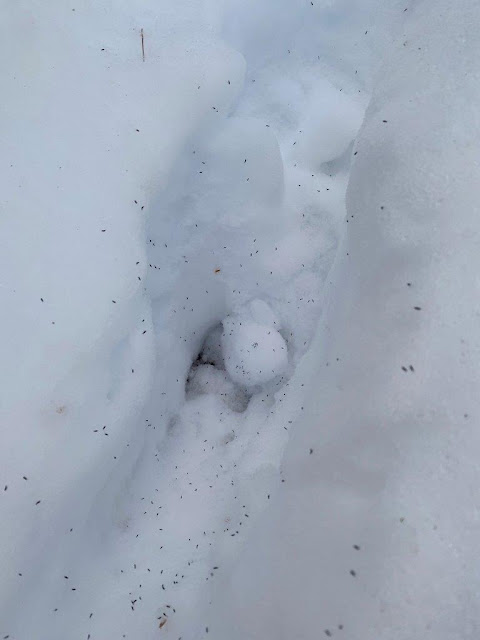
A couple weeks ago I went out snowshoeing. It was a warm day for January – with temperatures all the way into the high 30’s (Fahrenheit). As I tromped along the road between hayfields, I noticed black specks sprinkled around tracks like pepper. They weren’t pepper flakes. They were tiny arthropods called springtails, or snow fleas.

So what were they doing in the tracks? Springtails live in the top layer of the soil, right under the snow. They spend their winter nibbling on fungi and decaying leaves, and on warm days they catapult themselves up, up, up to the surface. As winter turns to spring, these tiny springtails become spider snacks. You can watch a cool video about them here.

On warm days this month, look for a sprinkling of springtails on the snow around trees in your neighborhood. If you have a magnifying lens, take a close look. They won’t leap too far away.