Showing posts with label rainforest. Show all posts

Friday, October 31, 2025

A Rainforest Expedition!


3 Weeks in the Rainforest: A Rapid Inventory in the Amazon 
by Jennifer Swanson 
80 pages; ages 8-12
‎Charlesbridge, 2025

Imagine a place where you’re surrounded by trees that soar to the sky, writes Jennifer Swanson. A place where large, glossy leaves block sunlight, and heavy, damp air is filled with the aroma of flowers. Where the chatter of monkeys and toucans drifts down from the canopy.

That place exists – it is the rainforest of the Andes-Amazon, home to an incredible diversity of plants and animals. In this book, Jen takes us on a three week field expedition into the rainforest, with a “rapid inventory” team of scientists from the Field Museum of Chicago. Together, with their partners from the Andes-Amazon region, they survey the wildlife and learn as much as they can about the people who live there. The goal: to develop a plan that will protect the rainforest and the inhabitants.


Individual chapters take readers into the field with the fish team, the bird watchers, plant collectors, or the night crew surveying snakes and frogs. Put on your boots and make sure your headlamp has fresh batteries because you’re not returning to camp until you’ve counted and recorded everything that slithers, hops, flies, or crawls.  Meanwhile, other teams are tracking elusive mammals and talking with the locals about how they use and care for the land.

What I like about this book: It feels like an adventure. We travel to the first camp by canoe, and set up tents. Each team gets a chapter that takes readers deep into the field with the scientists. Sidebars add details – sometimes about science technology. Did you know that there’s a fish DNA database called the Fish-Barcode of Life? Another explains why birds don’t like to fly when it’s raining. And the photos! Did I mention them? They are gorgeous! I have to admit that I am smitten by the sweet face of the Southern tamandua. 

photo from the Smithsonian
Turns out, it's an arboreal anteater!

The last two chapters focus on the human connection and making a plan for the future. There’s a brief report – 790 species of plants and 706 species of vertebrates, included some species that may be new to science – and what happens next. You can find out more about this expedition at their website: https://www.rapidinventories.fieldmuseum.org/ri-30

In her author’s note, Jen says that she was inspired by an exhibit at Chicago’s Field Museum seven years ago. I wanted to know more!

Me: When did you know you had to write a book about the Inventory Project?

Jen: I spent about an hour or more walking through the rest of the very informative and descriptive exhibit – and during that entire time I just kept thinking, why haven't I heard about this? This needs to be a book for kids! Then I was hit by an overwhelming feeling of excitement, I knew then that I wanted to be the one to tell this story. Less than a week later, I reached out to Dr. Corine Vriesendorp, the head of the Rapid Inventory Project at the time, to request a meeting. 

A few months later, I went back to the museum and met with four of the scientists for interviews and also the PR person to ask if they would support me writing this book. Thankfully, the PR team was very excited about the book.

Jennifer Swanson is an award-winning author of over 50 nonfiction books for children, and founding member of STEAMTeamBooks. You can find out more about her at her website, jenniferswansonbooks.com 


Thanks for dropping by today. On Monday we'll be hanging out at Marvelous Middle Grade Monday with other  bloggers. It's over at Greg Pattridge's blog, Always in the Middle, so hop over to see what other people are reading. Review copy provided by the publisher.

Friday, June 14, 2024

How to Build a Beak

 
Building a Beak: How a Toucan's Rescue Inspired the World  
by Becca McMurdie; illus. by Diana Hernández 
32 pages; ages 4-8
Page Street Kids, 2024  

theme: engineering, birds, kindness

High in the Costa Rican treetops, a toucan named Grecia soared from branch to branch…

She did the regular things toucans do: pick berries, preen her feathers, sing, and tuck her beak next to her wing at night to sleep. Until humans hurt her, breaking her beak. Fortunately some kind-hearted people found her and took her to a place where she could be protected. But a toucan can’t survive without a beak. Enter an engineer with a 3-D printer and people around the world who wanted to help save Grecia.

What I like about this book: I can’t resist a story of kindness overcoming adversity, especially when scientists use the technology they have to try a novel solution. In this case, printing an artificial beak. I love how author Becca McMurdie shows the community of engineers and scientists, bird experts, the rescue center staff, and children came together to help an injured toucan. And I like how illustrator Diana Hernandez included an engineering diagram of the new beak. In back matter, Becca discusses why stories like this are important. Reading and discussing these kinds of stories helps build awareness about the importance of protecting habitats (in this case the rainforest) and the animals that live there, she says.

Becca mentioned that she had gone to Costa Rica for a couple months and learned about Grecia while she was there. So of course I had Questions!

Me: Hi Becca. Can you tell us a bit about what you were doing while in Costa Rica?

Becca: I was working for a charter school network in New York City that allowed all staff members to take a two-month sabbatical after every 10 years of service to the organization. I decided to spend my two months living in a small cabin in the Monteverde Cloud Forest, volunteering at a local school there, going on nature walks daily, and doing lots of writing. Why not!? 

Me: Why not indeed! So how did you learn about Grecia?

Becca: While I was in Monteverde, I went on several bird watching tours. On my first tour, I saw a toucan for the first time. It was perched on top of a branch singing proudly. So beautiful! The guide then told me that a few years prior, there was a toucan in Costa Rica who was injured and lost its beak, but a prosthetic beak was made for it. I was intrigued! He couldn’t remember all of the details, but said that everyone in Costa Rica had heard about it at the time, and had been in the news. I went back to my cabin that night and did an internet search to learn about this toucan with the prosthetic beak. I learned her name was Grecia, that a 3D printer had been used to create the beak, and, even more impressively, that the event sparked a wildlife protection movement that successfully led to legal protection of the rainforest! Many of the articles I read were in Spanish, from local Costa Rican news sources. I found out that the name of the rescue center that saved Grecia was Rescate Wildlife Rescue Center. It was about three hours from where I was staying. Bravely, and humbly, I emailed them to tell them how I had learned of Grecia, and that I wrote children’s books (albeit no published books and no agent, at the time) and that I would love to speak with someone on the rescue team, either via email, Zoom or in-person, if they’d be interested and open to that. To my delight, they replied with enthusiasm and invited me to visit! 

Me: I have to know more about your visit to the rescue center to meet Grecia and their caretakers and scientists.

Becca: During my visit I was escorted by one of the veterinary technicians on Grecia’s team, and met several other caretakers and scientists as well. I got a behind-the-scenes tour of their emergency animal rescue department. I could look into the enclosures through one-way viewing glass. It’s important to minimize the animals’ contact with humans, so they maintain their natural instincts and be returned to the wild after they are rehabilitated. I saw lots of baby monkeys, a few grown-up monkeys, sloths, many beautiful birds and even an ocelot. Some of the animals had been hit by cars or injured on power lines. As one of the largest rescue centers in the country, Rescate receives several new injured or orphaned animals every single day, arriving from all around Costa Rica. Many of them require weeks, if not months, of care before they can be released. Animals that cannot be released, either because their injuries will require long-term treatment or because they no longer have natural instincts needed to survive in the wild, remain in the center’s lifetime animal sanctuary, which is open to the public. That’s where Grecia lived after she received her new beak. Unfortunately, I did not get to meet Grecia. She passed away of natural causes just a month before my visit. (She did live a full life-span, comparable to those of most wild toucans.) Rescate Wildlife Rescue Center is truly an amazing place. You can learn more about them at www.rescatewildlife.org. I donate a portion of the proceeds of Building a Beak, to the organization. 

Beyond the Books:
By Bernard Dupont - Flickr, CC BY-SA 2.0

Read about Grecia here at NPR

Make a paper plate toucan. Here's how.

Becca is a member of #STEAMTeam2024. You can find out more about her at her website,

Today we’re joining Perfect Picture Book Friday. It’s a wonderful gathering where bloggers share great picture books at Susanna Leonard Hill's website. Review copy provided by the author.

Friday, January 14, 2022

Life in the Very Slooooow Lane


The Secret Life of the Sloth
by Laurence Pringle; illus. by Kate Garchinsky 
32 pages; ages 6-9
‎Boyds Mills Press, 2021

theme: animal families, rainforest, nonfiction

Perezoso swims. She swims across a narrow river to reach a place in the rainforest where she knows there are tree leaves she likes to eat.

Perezoso is a three-fingered sloth who spends her life in the trees. Readers will travel with her as she searches for food, escapes the clutches of a harpy eagle, and gives birth to a baby.

What I like about this book: Perezoso’s secret life high in the rainforest canopy fits in well with Pringle’s other books in the “secret life” series. He provides details that you might not otherwise ponder. For example: sloths have weak back legs. So when she is on the ground, she needs to have strong front arms that can pull her along on her belly. And algae grows on her hair. And moths and beetles and other tiny creatures make their home in her fur – some of them snacking on the algae.

I like that this book ends the same way it begins – with Perezoso swimming in the river. And there is Back Matter! (You know I love back matter) This is where we learn what the sloth’s name means, and about fossils of giant sloths, and how hanging upside down affects the internal anatomy of an animal. We also learn how the slow, secret life of sloths is threatened by humans.

Beyond the Books:

Find out more about the brown-throated three-toed sloth. Here’s an article, and here’s another.

Get to know a sloth. One way is to visit a zoo where sloths live. Observe the sloth for a while. What kind of sloth is it? What is it doing? If it’s moving, figure out how long it takes to travel a certain distance.

Move like a sloth. Need inspiration? Here’s a video to get you moving… very …. slowly.

Today we're joining Perfect Picture Book Friday, an event where bloggers share great picture books at Susanna Leonard Hill's website. Review copy provided by the publisher.

Friday, December 17, 2021

Two new National Geographic Readers

My kids loved listening to stories, and picture book read-alouds were our favorite time of the day. But there came a time when they wanted to find out stuff on their own – to read about bugs and animals that live nearby or far, far away. That’s one reason I love sharing books from the National Geographic Readers series. The other reason: they are filled with gorgeous photos that will have kids poring over the furry, fuzzy, or scaly details.

So here are two recently released titles.

In the Desert, by Michaela Weglinski is a short (24 page) book perfect for kids who are “ready to read.” The book features animals – and a few plants – from dry places around the world. It’s more than camels: there are fennec foxes, lizards, big cats, small birds. The text is large, with each sentence focusing on a specific fact. For example, “The cactus stores the water in its thick stems.” That photo features a diversity of cacti in the Sonoran Desert (USA), with an example pointing out where the stems are. This is helpful, since cactus stems look nothing like rose stems, despite them both being rather prickly.

What I like about this book: Did I mention the photos? Well, let me mention them again! They are filled with textures, from grainy sand to needle-sharp cactus spines to the fluffy coat of a snow leopard. Wait! What’s a snow leopard doing in the desert? That is one of the cool things kids will learn about. I also like the Vocabulary Tree at the beginning – with lists of words for Things in the Desert and How Deserts Feel.

Rainforests, by Andrea Silen is a 32-page book that is perfect for kids who are reading independently (but need occasional help with new words). Rainforests may cover only a small amount of the planet, but they have more unique plants and animals than anywhere else on Earth. And the photos in this book show some of those amazing flowers and frogs, birds and butterflies that inhabit the layers of a rainforest.

What I like about this book: There’s a table of contents, so kids can see what topics are included at a glance. And there’s a fun quiz at the back. There are those amazing, detailed photos full of color and texture. And there are plenty of text boxes that share information, show how to pronounce a word, or contain a joke. What do you call a clouded leopard on a rainy day?


Thank you to Tracey Daniels at Media Masters Publicity for review copies.

Friday, August 20, 2021

Books that explore Math

Warning: School days are closer than they look on the calendar! So today I’m sharing two books that brush up on math concepts in a fun way. The first takes us deep into the rainforest.

theme: math, biodiversity, comparisons

Tree of Wonder: The Many Marvelous Lives of a Rainforest Tree
by Kate Messner; illus by Simona Mulazzani
pages 36 ; ages 5-8
Chronicle Books, paperback edition, 2020

Deep in the forest, in the warm-wet green, ONE ALMENDRO TREE grows, stretching its branches toward sun.

Flip a page and it’s two macaws, then four toucans, then eight howler monkeys. Can you see a pattern here? There are snakes, frogs, butterflies, and ants! So many cool animals to look at and count.

What I like about this book: Three-quarters of the spread is given to lyrical text and detailed illustrations of the tree and the animals that live in and around it. Then a panel shows the number (four), the correct number of animals (four toucan icons), and an additional layer of text providing more facts about the animal. I love how the last page brings it all back together: 

Life multiplies again and again … in this ONE ALMENDRO TREE.

Back matter provides more information about the Almendro tree, more playing around with math, and resources to read, watch, and explore for kids who want to know more about the rainforest.

Comparisons Big and Small
by Clive Gifford; illus. by Ana Seixas
48 pages; ages 5 and up
Kane Miller, 2020

 Did you know that a spinner dolphin can jump higher than a double-decker bus?

If you’re looking for a fun way to introduce comparisons, this book is filled with ‘em. Each spread focuses on one type of comparison: length, speed, weight. What I like about this book is that it is browseable – perfect for the kid who wants to dive in at random and explore a page. Vertical spreads offer interactive ways to interact with the book. And there are plenty of “quick quizzes” scattered throughout. Some of my favorite sections are about bugs, comparing countries, being a dino detective, and space stuff. For sports buffs there’s a section about record-breaking throws, and lots of comparisons on how fast animals can run and how high they can jump.

Beyond the Books:

How fast can you run?
Mark a starting place on the sidewalk or playground, then have a friend with a watch time you for 10 seconds. Measure the distance you covered. Then compare how far you went in that time to how far other animals can go: a caterpillar? your cat or dog? a beetle?

Compare the heights of people in your home or classroom. Compare how far people can throw a tennis ball. What other things can you compare?

Try some doubling math. Get one hundred things to use as counters: dry beans, pennies, macaroni elbows, beads, legos. Then line up five or six bowls. Put two counters in the first bowl. Then put four in the next. Double that number for bowl # 3. When do you run out of counters? Bonus: if you got a penny on the first day of September, and every day after that you got double the number of pennies (day 2 = 2 pennies, day 3 = 4 and so on) how much money would you have by the end of the month?

We’ll join Perfect Picture Book Friday once they resume. It’s a wonderful gathering where bloggers share great picture books at Susanna Leonard Hill's website. Review copies provided by the publishers.


Friday, October 23, 2020

Exploring a Rainforest


Over and Under the Rainforest 
by Kate Messner; illus. by Christopher Silas Neal
48 pages; ages 5-8
Chronicle, 2020

theme: ecosystem, rainforest, exploring

Into the rainforest we hike, through slivers of sunlight and dripping-wet leaves.

Hundreds of plants and animals make their homes in the tropical rainforest. But up, up, up – high in the canopy there is another world. This book takes us on a hike through a Costa Rican rainforest – clambering up rocks, walking high on bridges through the canopy over the course of a day. We meet bats and agoutis, butterflies and sloths. Parrot snakes hunt frogs and howler monkeys fill the air with their exuberant hoots and hollers.

What I like about this book: For those of us who can’t get to a rainforest, this is a great way to explore it. Back matter contains more details about the animals along with some suggested books and resources to check out. And Kate tells a wonderful tale of how this book came to be.


Beyond the Books:
Find out more about Costa Rican rainforest animals here.

Go on a virtual rainforest tour (in the Amazonian rainforest in Peru) here. It’s 20 minutes of walking and climbing, so pack a snack.

If you could be a rainforest animal, what would you be? Use a paper plate and markers to create an animal mask. 

Imagine you live high in the trees. Write down some of the advantages of living high in the leafy canopy. Can you think of any problems?

Today we're joining Perfect Picture Book Friday, an event where bloggers share great picture books at Susanna Leonard Hill's website. Review copy provided by the publisher.

Friday, March 29, 2019

Books Celebrating Frogs and other Living Creatures

I love frogs almost as much as I love bugs. One time I even tried to learn the languages of our local frogs. Peeper, American toad, Wood frog - I got the basics. But never enough to ask them the important questions. Here are some recent books celebrating the lives of frogs - and other animals, too.

themes: frogs, animals, conservation

The Frog Book
by Steve Jenkins & Robin Page
40 pages; ages 6-9
HMH, 2019

Frogs are creatures of two worlds - they spend part of their lives in the water and part on land.

Spread by spread we meet frogs that hop, frogs that fly, frogs bigger than your hand, and frogs smaller than your thumb. Frogs have lived on earth for millions of year. "In fact," the authors write," a frog could have been stepped on by one of the first dinosaurs."

What I like love about this book: I love that each page features a particular froggy feature, from "what is a frog?" to frog adaptations. We discover what frogs eat (and it's not all flies), frog defenses, and life in the trees. Unfortunately, one-third of all frog species are in danger of extinction due to habitat loss, climate change, pollution, and disease. Back matter includes quick facts about every frog featured in the book: size, diet, home range.

I also love the torn- and cut-paper illustrations. The detail is amazing! And I really love the end papers! They are a luscious mix of bubbly pond shades of blues and greens. If you can't wait for spring to bring frogs, this book may tide you over the next few weeks.

Readers: Tadpole to Frog
by Shira Evans
48 pages; ages 2-5
National Geographic Children's Books, 2018

Subtitled "Animals Grow Up", this book is a co-reader. The text on one side of a spread, labeled You Read,  is meant for an older reader to read aloud. The text on the other side (I Read) is meant for the beginning reader. For example, chapter one introduces the concept that babies grow up. The text for older reader is in smaller font with three lines about animals and their babies. The "I read" text is larger, and contains a single idea:  Babies change as they grow.

This book has a table of contents, so you can find frogs or butterflies. The photos are amazing. And at the end of every chapter is an activity for a child and their reading partner to do together. It could be a matching game or a challenge to act out some life cycle phases.

Little Kids First Big Book of the Rain Forest
by Moira Rose Donohue
128 pages; ages 4-8
National Geographic Children's Books, 2018

Frogs abound in the rain forest. But they aren't the only animals living there. This book contains a diversity of animals - and plants - found in the rain forest. From the ground, to the understory, and on up to the canopy, this book introduces the birds, reptiles, and mammals that inhabit the rain forest. And yes, there are frogs! Blue poison dart frogs live on the forest floor, while red-eyed tree frogs live in the canopy.

Back matter includes "10 Cool Things to remember about Rain Forests" and a spread filled with tips for how parents can extend their child's experience beyond the book.

Beyond the Books:

Learn to speak frog. One way is to listen to the frogs that live in your neighborhood. But if snow and ice are covering the ground, head over here for some frog recordings.

Sing a silly frog song. Here's a link to Five Little Speckled Frogs (still one of my all time faves).

Visit a zoo that has a rain forest exhibit. How does the air feel on your skin? Look at the animals and plants on the forest floor. Can you see what's living in the understory and canopy? While there, visit the exhibit with frogs.

Can you jump like a frog? Try it. Some frogs jump 20 times the length of their body. How far would you have to jump to be that kind of frog?

Today we're joining other book bloggers over at STEM Friday, where you can discover other cool STEM books. And we're joining Perfect Picture Book Friday, an event where bloggers share great picture books at Susanna Leonard Hill's website . Review copies provided by the publishers.

Friday, July 20, 2018

Animal books!

 Today ~ three books about animals from National Geographic Children's Books (2017).  What I like about them all is the wealth of bright, crisp photos, close-up views into animal worlds, and the language is accessible to children.

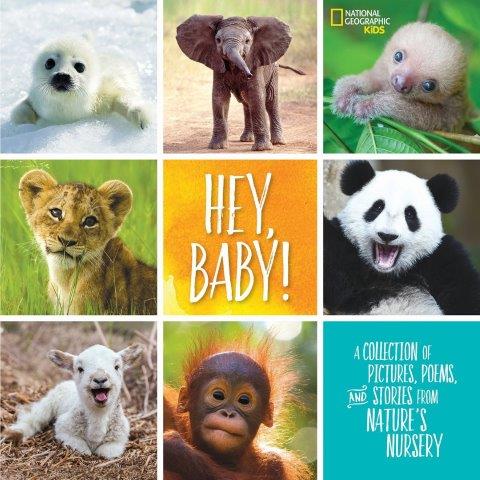
Hey Baby!
by Stephanie Drimmer
192 pages; ages 4-8

Who can resist photos of animal babies? With their too-long legs, waiting-to-grow-into feet, and cute round faces, they are irresistible!

This book is divided into sections based on habitats: mountain and plains babies, desert and coast babies, ocean and sea babies.... Each section features a dozen or more of the cutest, cuddliest babies ever. You get to know them through profiles, folk tales and fairy tales,  poems, and true-life stories. Plus there are fun facts scattered through the book.

 Explore My World Rain Forests
by Marfe Ferguson Delano
32 pages; ages 3-7

Another in this fun series for young readers. Short sections focus on different aspects of the rain forest, from colors to sounds. There are green leaves, electric blue butterflies, pink bugs. Another section focuses on the ways animals move. Snakes slither, tigers slink. And, of course, there is rain!

There's a map for kids who want to know where to find a rain forest, and a couple of activities that encourage kids to explore beyond the book.


Wild Cats
by Elizabeth Carney
32 pages; ages 4-6
This is aimed at kids who are beginning to read on their own, so I like that it begins with a table of contents. Each "chapter" is only a couple or so pages long and written in large-print, easy-to-understand language.

After an introduction to the cat family the reader gets a world tour of  wild cats; who lives where? A diagram of a cat "up close" shows how all cats are alike and there's a list of cool facts about wild cats. If you're into animal babies, there's an entire chapter devoted to "caring for cubs." The book ends with a chapter describing people who are working to protect cats and their habitats.

Review copies provided by publisher.

Friday, October 23, 2015

Kyle Goes Alone

Kyle Goes Alone
by Jan Thornhill; illus. by Ashley Barron
32 pages; ages 3-7
OwlKids, 2015

theme: nature, animals, nonfiction

"I have to go," said Kyle.

The problem is that Kyle is a three-toed sloth living high in the rainforest canopy. And he's a slowpoke. And the "bathroom" is wa-a-a-ay down on the forest floor. And on this day, of all days, mama sloth decides that Kyle is old enough to go on his own.

What I like about this book:  As Kyle descends down, down, down the tree, he is never alone. Not only does mom follow him (though she stays mostly hidden), he meets other inhabitants of the rainforest: a red-spectacled parrot, a whipsnake, a tree frog.

I also like the repetition of Kyle saying, "But I'm all alone!" followed by "No you're not" croaked or screeched or hissed by an animal living somewhere on or near Kyle's tree. I like that the illustrator uses the book, making us turn the book sideways for more vertical illustrations that help depict just how far down Kyle has to climb. And I like that Kyle makes it all the way down by himself... and "goes".

Plus there's back matter, which I love because it fills in the gaps of the story. And I love the cut-paper illustrations. A completely different take on your "Going to the Potty" book.

Beyond the book:

Find out more about life in the canopy. There are lots of animals that live in the canopy of the rainforest jungles. But what about the canopy of forests near you? Is there a nature center with a tree house where you can sit and watch animals?

Go on a field trip to a zoo. Take along a camera or your sketchbook so you can draw pictures of animals you see that live in the rainforest canopy.

Watch how illustrator Ashley Barron makes Kyle from cut paper.

Try your hand at creating some cut paper animals. Or maybe you'd like to use fabric or scraps of paper and feathers. For more ideas, check out this post over at Sally's Bookshelf.

Today's review is part of the STEM Friday roundup. Drop by STEM Friday blog for more science books and resources. We're also joining PPBF (perfect picture book Friday), an event in which bloggers share great picture books at Susanna Leonard Hill's site. She keeps an ever-growing list of Perfect Picture BooksReview copy from publisher.