Showing posts with label fungi. Show all posts

Wednesday, January 21, 2026

Explore Outdoors ~ Lichens!

 Lichens are small and easy to overlook, but they are amazing. These tiny symbiotic communities of fungi and algae and cyanobacteria can weather the cold temperatures and dry air of winter. How do they do it?
 
 
They go dormant. Some have anti-freeze chemicals in their cells to keep from - well, freezing and bursting open. Their superpower: they can pick up with photosynthesis once the weather warms up and the moisture returns. Find out more about lichens here. 
 
Go Lichen Looking around your neighborhood. 
Check tree trunks and branches, rocks, stone walls - I've even found lichens growing on park benches! 


Wednesday, October 29, 2025

Explore Outdoors ~ Fungi from the tree tops


Last month the wind blew lots of branches down from the trees. I'm always curious to see what's growing up in the sky... so I look at them all before tossing them into the brush pile. And one branch had this very bright and sunny lichen. It's got a bright and sunny name: sunburst lichen! I love the little cups. They are the fruiting bodies, and release spores.
 
What's growing on trees in your neighborhood? 

Wednesday, September 17, 2025

Explore Outdoors ~ After Rain

 I love exploring the world after rain has stopped. Drops still cling to blossoms and stems, sometimes reflecting light and glinting like jewels. Other times they act as lenses, reflecting the world they see.
 
 What do You discover After Rain?


Wednesday, August 13, 2025

Explore Outdoors ~ Funky Fungi!


 We had a lot of rain in June and early July, and the pile of wood chips hosted quite the convention of mushrooms. But one day when I walked over to check them out, I noticed that many of them seemed to be wearing "hats" atop their caps.
 
iNaturalist came to the rescue and identified the brain-like growth as another fungus, a parasite called Collybia Clouds (Syzygospora mycetophila).


I wondered: did it grow beneath the mushroom cap as well?
So I looked.
Yep!  
 
And then I found one of the collybia clouds all by itself... I guess it had finished off its host mushroom. A week later I checked the chip pile and all was gone!
 
With mushrooms, you've got to be looking when they fruit! 

 
What cool fungi will you find this week?


Wednesday, April 23, 2025

Explore Outdoors ~ Treetop Fungi

 During an early spring storm, a couple of small branches blew down from the oaks lining the driveway. I always enjoy looking at what's growing on them - usually a fun selection of lichens and other fungi that are too high to see. They resemble the sorts of things one might find clinging to driftwood at the ocean's edge. Sometimes the treetop fungi look just as surprised to see me as I am to see them.

Next time the wind blows down branches from a tree, check out what's growing on them!


Friday, March 14, 2025

More than Mushrooms: an author interview!

 Just a quick reminder that it's Pi Day (3.14) - and that Pie are round; cake are square. Now on to the wonderful book for today!

Fungi Are... More Than Mushrooms
by Alisha Gabriel; illus. by Vivien Sárkány 
36 pages; ages 4-8
Tielmour Press, 2025 

theme: nature, observation, fungi

Fungi are travelers.

Most people, when they think about fungi, think about the mushrooms on their pizza, or popping up in their lawn after a week of rain. But fungi are so much more. They recycle nutrients. They come in an amazing assortment of colors and shapes and sizes. And they don’t stay in one place! Sure, you’re not going to see a mushroom uproot itself and saunter over to the woodpile – but they do send their spores out into the world. And their hyphae are always spreading, spreading, spreading under our feet. In fact, its those hyphae that help hold the world together, author Alisha Gabriel points out.

What I like about this book: I like the structure: a main point followed by three specific examples. I like the layered text: simple concepts in large font with explanatory text below the illustrations. I like the soft feel to the illustrations. And I really like that there are a bunch of non-fungi things included in the illustrations – and a scavenger hunt-type list at the back challenging readers to find those items.

Full disclosure: Alisha and I co-authored a book for middle-grade readers called Funky Fungi: 30 Activities for Exploring Molds, Mushrooms, Lichens, and More (Chicago Review Press, 2022), and we are critique partners, so I’ve watched her new book grow from spore to fruiting body. 

Still, I had a few questions

Me: What inspired this book?

Alisha: Do you remember the first walk we took when we met at Highlights? I must have stopped a dozen times to take photos of mushrooms. Even way back then, I knew I wanted to write a picture book about fungi. 

Me: Yeah – that was back in 2013 maybe? I remember some very cool fungi.

Alisha: Then almost a dozen years passed before you and I co-authored the award-winning Funky Fungi: 30 Activities for Exploring Molds, Mushrooms, Lichens, and More. When that book came out, I started giving presentations at schools, libraries, museums, and festivals. The age of my audience varied from 2 to 92, but Funky Fungi is aimed at middle grade readers. As I adjusted my presentation on the fly, I explored ways to share the information with a younger audience. I realized that I still wanted to write a picture book about fungi. Since there were already several beautiful picture books about fungi available, I knew that it would require a unique approach to capture an agent or editor’s attention. 

Me: How did you come to the structure and categories? (fungi are travelers, fungi are homes…)

Alisha: In late May and early June 2023, I jotted some notes in my journal about writing an expository picture book about fungi. I also read many, many books on a variety of topics, keeping a close eye on structure. Some of my journal entries from this time frame included whole sentences, but there were lists and lists of words. Nouns. Adjectives. Synonyms. There were late night scrawls that meandered diagonally across the page. One that stood out was, “Fungi become homes to animals and insects. They soften, cradle, and protect.” 

After exploring and contemplating different directions the text might take, I came back to that snippet. With a bit of tweaking, it became Fungi are homes. They soften, cradle, and protect. I had landed on my first layer text structure; a statement and three specific examples. The second layer would become a short explanation with a specific type of fungi. The writing went incredibly fast, from idea to final draft in one month. That was unusual for me, but I had been immersed in fungi research since 2020, so perhaps these ideas had been marinating and were ready to come together.

Me: I think letting ideas marinate helps them become more robust. Now that your book is out (well, as of tomorrow) what do you hope kids (and maybe adults) take away from reading it?

Alisha: I hope they understand that fungi are an incredibly important part of our world. Mushrooms have been popping up on everything from clothing, art, and interior design for a few years now, and it’s exciting that they’re having a renaissance in our culture. However, there’s more to fungi than the mushrooms we see, and I hope people will also continue learning about the less noticeable fungal relatives. 

Me: You’re published with Tielmour Press, in Canada. Can you share a bit about working with them? 

Alisha: It has been a wonderful experience working with Tielmour Press! They’re still a fairly new publisher, but have several books in the pipeline. Although some people might hold out for an offer from a BIG 5 publisher, there are certainly advantages to working with smaller companies. Everyone at Tielmour Press replies to emails quickly, each book receives individualized attention, and the company has a strong environmental vision. 

Me: The illustrations are so soft and inviting. Did you get to meet Vivien Sárkány ?

Alisha: Yes, her work is amazing! We’ve never spoken, but she did a remarkable job bringing the book to life. It was important to me that the fungi in the book resemble the real thing, and if the text mentioned a type of fungi, that it should be used on the page. She did this, and much, much more! I’d love to work with her again. Her signature style is gorgeous.

Me: I know you have another book under contract, and I can’t wait to see it. 

Alisha: I do have another nonfiction picture book under contract, but it hasn’t been announced yet. I can’t give specifics, but I can say that it’s nature-themed, on a completely different topic, and also uses a layered, expository style. Thank you so much for inviting me over to your blog to talk about Fungi are… More Than Mushrooms! 

You can find out more about Alisha and her books at her website alishagabriel.com

Beyond the Books:

Use mushrooms to make stamp art. Here’s how.

Yeast makes bread rise, but can it blow up a balloon? Try this easy experiment – you could experiment with recycling empty water bottles instead of the squeeze bottles. I remember doing this one waaay back in elementary school. Here's how.

Another fun yeast experiment is to make elephant toothpaste. You’ll need 1/2 cup hydrogen peroxide, yeast, a recycled water bottle, and a drop of dish soap. Here’s how.

Today we’re joining Perfect Picture Book Friday. It’s a wonderful gathering where bloggers share great picture books at Susanna Leonard Hill's website. Review copy provided by the author.

Wednesday, February 19, 2025

Explore Outdoors ~ Lichens


 One of my favorite winter activities is Lichen Looking. That's because trees don't have leaves during this season - or if they do, the leaves are dried and rattly. And they don't have flowers. But they do sport lichens and other fungi. And, in this case, it was neat to observe how the snow gathered on the curls of lichen and bark.

I found this tree at a city park. What sort of lichen can you find in your neighborhood?

Wednesday, November 20, 2024

Explore Outdoors ~ Funky Fungi in the Garden!

Just last week or so I was clearing a patch of garden so I could plant garlic, when what should I spy - but these cool and funky fungi!
 

These are cup fungi - and they look just like cups, don't they!

What cool discoveries will you make this week?
 

Wednesday, August 7, 2024

Explore Outdoors ~ 5-minute field trip

 A few years ago lightning hit an oak tree behind my garden. Neighbors helped fell the tree and cut up most of it for firewood... but there remained a trunk too thick for any of our chainsaws. So we left it for part of my outdoor curiosity lab. Last month I wandered over to see what was going on. Turns out a lot is happening. Fungi, moss, and lichens have made their appearance over the years, and now small tree seedlings are gaining a foothold. Insects galore hang out on, in, and under the log. Here are a few photos from my Five Minute Field Trip.


Take a 5-Minute Field Trip in your neighborhood~
what do you discover?

Friday, July 26, 2024

Two Books for Exploring Summer

Greystone Kids has a couple books that are perfect for young nature explorers. 

Themes: fungi, nature, hands-on activities

Mushrooms Know: Wisdom From Our Friends the Fungi 
by Kallie George; illus. by Sara Gillingham 
40 pages; ages 4-8
‎Greystone Kids, 2024   

Mushrooms always wear their thinking caps. They know so many things.

For example, they know that there is more beneath the surface than what you see. That being unique is awesome. And that small can be mighty. They also know that it’s important to take care of your neighborhood, your friends, and yourself. Most of all, they know how important it is to stay connected.

What I like about this book: This is a wonderful book on so many levels. There’s the simple text about what mushrooms know, that ranges from ecological understanding to SEL. Sidebars provide another layer that dives deeper into the science of mushrooms. That’s where you’ll find cool info about how fungi send messages to plants, how they glow in the dark, and where you might find them growing. I also love the cute expressions on the mushroom caps. Plus there is back matter! That’s where you’ll find even more information about what mushrooms are, how they’re used to clean up oil spills, and the cool way bird’s nest mushrooms use raindrops to spread spores.

Be a Nature Explorer!: Outdoor Activities and Adventures 
by Peter Wohlleben; illus. by Belle Wuthrich & translated by Jane Billinghurst  
100 pages; ages 6-10
Greystone Kids, 2024 

This book is filled with 52 activities for the curious young naturalist. Peter Wohlleben invites kids to explore what’s outside around them. Record the plants and animals in your own nature notebook, he tells readers – that way you’ll have a book filled with your own discoveries. In addition to taking a pencil and notebook, he suggests a few other things to take along on your outdoors adventures: plastic containers to collect things for further study, a hand lens or magnifying glass, binoculars for observing animals and birds without bothering them, a cell phone to take photos – and maybe a nature app to help identify plants, insects, and other cool discoveries.

The activities are listed in a table of contents, in no particular order. The idea, Peter says, is to browse through and find something that interests you. They range from listening to a tree talk, to following slugs and snails, to mapping plants that move. It’s a great way to beat the “nothing to do” blahs of late summer

Beyond the Books:

Go on a fungus foray. Late summer and into the fall is the perfect time to look for mushrooms and other fungi. Draw what you see – feel free to give them faces, even entire personalities. What wisdom do they have for you?

You’ll find 30+ activities to explore fungi in my book, Funky Fungi: 30 Activities for Exploring Molds, Mushrooms, Lichens & More (co-authored with Alisha Gabriel). Plus there’s more over at Patricia Newman’s LitLinks.

Label some pages in your nature notebook and start some lists of all the birds, trees, wildflowers, insects, and mammals you see in your neighborhood. Share with a friend and ask what they have discovered in their neighborhood. Hint: the more you look, the more you’ll see.

We’ll join Perfect Picture Book Friday once they resume. It’s a wonderful gathering where bloggers share great picture books at Susanna Leonard Hill's website. Review copies provided by the publishers.

Monday, May 27, 2024

Explore Outdoors ~ Fungus Among Us!

Last week I had the marvelous opportunity to share science fun with a student at our local elementary school. She is passionate about mushrooms, and had checked out my book, FUNKY FUNGI (written with Alisha Gabriel). The school librarian asked whether I could spend half an hour with her exploring mushrooms. So of course, I said YES!

I shared around 50 photos of mushrooms and coral fungi and staghorns and lichen that I'd found in my garden, yard, and nearby woods. Then we dissected a portobello mushroom from the local grocery store, following the directions listed in the activity from FUNKY FUNGI. We had So Much Fun! 

Over the long Memorial Day weekend, I went walking through the woods again and I added a few new fungi photos to my collection - check them out. 

What Cool Fungi will You Find this Summer?


Friday, March 29, 2024

If a Tree Falls...

 
One Day This Tree Will Fall     
By Leslie Barnard Booth; illus. by Stephanie Fizer Coleman 
40 pages; ages 4-8 
Margaret K. McElderry Books, 2024

theme: trees, ecology, life

Look at it. Wounded, worn, twisted, torn. One day this tree will fall and this story will end.

But before that day, we should know how this tree began as a tiny seed, folded inside a cone. Using lyrical language, Leslie Barnard Booth shows how this tree grew, surviving the challenges of storm and wildfire. And she shows how, even as it dies, it provides life for the forest.

What I like about this book: I love how Leslie shows a Douglas fir tree as more than just a tree; it is a habitat for hummingbirds and squirrels, spiders and insects. Even after it falls it continues to provide a place for moss and fungi to grow, a home for ants and salamanders, and hollow spaces for larger animals to curl up and nap. This is a perfect life cycle story, accompanied with lovely art. You’ll never look at a tree the same way after this. And there is Back Matter! So if you want to learn more about life, death, and life after death in the world of the Douglas fir, Leslie’s got you covered.


I’ve got an oak trunk lying beyond my garden that I’ve been watching for the past handful of years. It was struck by lightning and threatened to fall, so we had to cut it. Most went to firewood, but the trunk was so big that we decided to leave it to nature. It’s one of my favorite places to explore (currently at the lichen, moss, fungi stage). So I knew I just had to ask Leslie a Couple Questions:

Me: How did you come to this structure, this way of telling the story? 

Leslie: The seed of this story came from a few places. At the preschool my children attended and where I worked for a time, a group of kids in another class were doing this amazing study of a rotting stump. They were dissecting it and learning about all the little critters that lived inside it. At the same time, I was reading Peter Wohlleben’s The Hidden Life of Trees. This book made me think of trees differently—as responsive organisms with dramatic life histories. The incredible drama of a tree’s life is often hidden from us because it occurs on a timescale too long for us to observe and appreciate. But in a book, we have all the time we want! We can spend 1,000 years watching a single tree! So, I knew I wanted this book to cover a tree’s whole life, and to be dramatic—to show the tree’s active struggle to live. I decided I wanted the reader to care about the tree, to love the tree, to identify with it, so that the idea of the tree eventually falling and dying is sad. But then, I wanted to prove to the reader that trees live on, even after they die. Which is true! A dead tree, as those preschoolers discovered, is absolutely chock full of life. So, knowing that’s what I wanted to accomplish, it occurred to me to set up the story of the tree almost like a cradle to grave biography, but one where the concept of “grave” is upended. Because, in the context of a forest ecosystem, a tree’s story has no end. 

Me: Did you explore other ways of telling the story?

Leslie: The initial version of the book was called GROW and it included more emphasis on the way the tree reacts and responds to its environment. My editor wanted to really focus in on the tree’s death and decay as the heart of the story, and she was so right! Which is all to say that the basic structure stayed the same, but that I had to chisel away some major pieces to make space for the book's central theme to really come through. 

Thank you, Leslie. And now, let’s do some activities that take us…

Beyond the Books:

Go log-looking. When you find a downed trunk or a stump, take some time to really look at it. Draw a picture of moss, lichens, fungi and other things growing on your log.

If you find a small log, look around it. Are there nooks and crannies for animals? If you can roll it a little bit, see what’s hiding under it – just remember to roll it back.

Collect tree seeds and plant them. Acorns, pine seeds, maple seeds, sycamore, buckeye … put a couple seeds in an old yogurt cup with some soil and see what grows! Just be mindful of where you plant it once it starts growing. 

Leslie is a member of #STEAMTeam2024. You can find out more about her at her website.

Today we’re joining Perfect Picture Book Friday. It’s a wonderful gathering where bloggers share great picture books at Susanna Leonard Hill's website. Review copy provided by the publisher.


Wednesday, February 28, 2024

Explore Outdoors ~ Tree-gazing

 With leaves gone, it's easier to see lichens and other fungi growing on trees. Here's one I found just a couple weeks ago, along our road. I've walked by this tree nearly every day, but on that day I stopped and spent time looking at it. Really getting to know it - lichen patches and all. 

What will you notice when you go tree-gazing?


Wednesday, January 17, 2024

Explore Outdoors ~ Funky Winter Fungi

 Welcome Back to a New Year of nature breaks, seasonal observations, and outdoor exploration. I now have a macro-lens that clips onto my mobile phone! And that allows me to see things "up close and personal"  - it's like having a hand-lens attached to the camera. So of course I took it out for a walk!

I love lichen, so of course I just had to take some photos! Some lichens look crusty and tough, but it's not until you look closer that they look a bit ... scaly, like tiny dragons raising their heads above the field of leafy fronds.


Others look sharp and dangerous - like deer antlers!

There are all kinds of soft fungi growing on old logs. These looked like someone had pushed a bunch of yellow trumpet-shaped tacks into the wood. Hey look! you can even see the mycelium network spreading across the log.


What tiny natural wonders will you discover this week?


Wednesday, November 8, 2023

Explore Outdoors ~ Fall Fungi

 Fall is a great time to look for mushrooms and other fungi. Some blend right in with the colors of the fallen leaves; others provide contrast. Here are a couple of fungi I came across this fall.


What funky fungi are you finding this fall?

Wednesday, August 23, 2023

Explore Outdoors ~ what pops up after rain

Last week when I walked over to the garden to check the rain gauge (9/10 of an inch) I noticed a couple mushrooms had popped up. So I decided to take a 5-minute nature break, which edged into 10 minutes, and then longer because I kept finding cool things under the pines and out behind the garage. 
 
It was a Great Day for Fungi! And for the things that nibble on them. Here's a few of the fungi, and one saprophytic plant that I discovered. Next time it rains, go on a fungus-looking walk in your neighborhood.


Lichens. Who doesn't like lichens? They grow on tree bark, old picnic tables, rocks... in and around moss. Some are crusty and some are like flat leaves.


Coral fungi look just like ... corals! Some come in fantastic colors. Those growing under our trees are white, sometimes yellow.


These are Pinesap (Monotropa hypopitys) - a plant that uses fungi to get its food from the surrounding pine trees. They have scaly stems and many nodding flowers. They range in colors (reddish to white) though ours look a lot like bleached pinesap!


Sometimes I'm just curious about what eats the mushrooms. I don't know, but it would be neat to catch fungus-nibbling squirrels, slugs, insects in the act of dining.


Even though I co-authored Funky Fungi: 30 Activities for Exploring Molds, Mushrooms, Lichens, and More with Alisha Gabriel, I am still learning about mushrooms and lichens and other things in the Kingdom!

What will you discover about the Fungi in your neighborhood?

Friday, May 12, 2023

These books will Light Up your Life!

Ooh! Two books about things that light up in the dark!

Theme: nature, animals, glow-in-the-dark

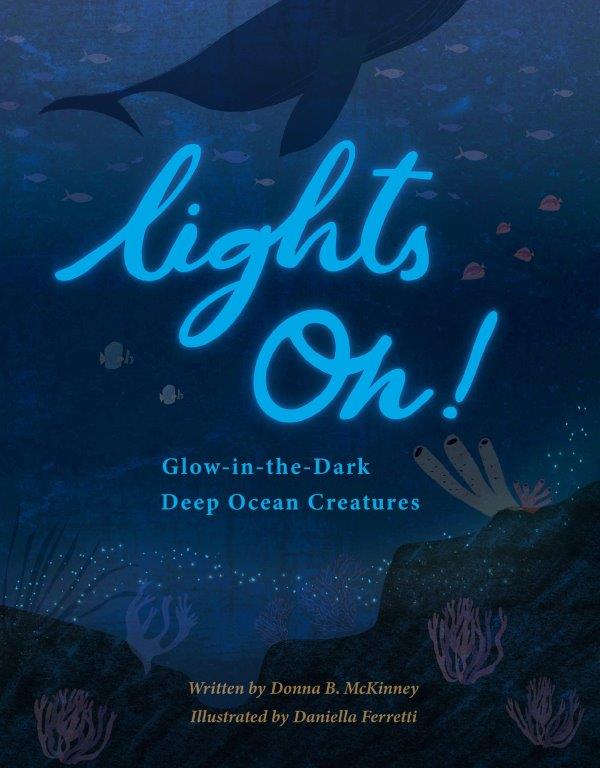
Lights On!: Glow-in-the-Dark Deep Ocean Creatures 
by Donna B. McKinney; illus. by Daniella Ferretti 
32 pages; ages 4-8
Yeehoo Press, 2023

Near the ocean’s surface, the first rays of sunrise bathe the waters. Here fish, seals, and turtles swim, splash, and eat in a world lit by sunlight.

But down below, where the sunlight doesn’t reach … where it’s always dark as night, what do the creatures do? Vampire squid and lantern fish carry their own light. Pocket sharks and jellies glow in the dark. Some animals use their bioluminescence to find a mate, others to trick prey, and others to escape from a predator. There’s a lot of action going on down in the deep, dark sea.

What I like about this book: There are flaps! Beneath each flap is a tidbit of information that adds to what is on the page. For example, the spread introducing pocket sharks: lift the flap to learn how this shark got its name. I like the contrast between what’s happening in the upper, surface layers of the ocean and the action in the darkest deep waters. To do that, the book was designed to be turned by the reader. This creates long, vertical spreads. And there’s back matter, where Donna introduces the term “bioluminescence” and gives some fun facts.
I wanted to know a bit more about Lights On! so I asked Donna a couple questions:

Me: Whose idea was it to create the flaps? 

Donna: My editor, Molly Shen Yao, suggested the flaps. I had submitted the story to Yeehoo with that additional informational text positioned as sidebars (text boxes). In the editing process, Molly suggested putting the sidebar material under flaps. I loved the idea and I hope my readers will enjoy the flaps!

Me: Upon opening the book, readers have to turn it so they can get a tall vertical look. How did this come about?

Donna: Editor Molly gets credit for that, too. Because each art spread in the book reflects what's happening above the ocean surface and at the ocean depths, she thought the vertical orientation would give the illustrator more freedom to reflect that ocean depth. I love how the illustrator, Daniella Ferretti, was able to use that vertical space, showing what was happening from sky to ocean depths in each spread. 

Luminous: Living Things That Light Up the Night 
by Julia Kuo 
44 pages; ages 4-8
‎Greystone Kids, 2022

When it’s dark out, we need light to see.

We might use a flashlight or a lantern to see at night. But some animals make their own light. That light, explains Julia, is called bioluminescence, and creatures make that light using special chemical reactions in their bodies. Throughout the book, she shows fungi, fish, and dinoflagellates that create light. Each spread includes an info-packed sidebar, so there is no need (or room) for back matter.

What I like about this book: The black pages with white print set the perfect stage for a book about dark, though I do wish the sidebar text was bigger. Of course I love that bioluminescent fungi are included! As are fireflies and glow worms (which she points out are neither flies nor worms). And I love the focus on the diversity of creatures that make their own light.

Beyond the Books:


Go on a night walk and look for luminous things. If you’re walking near the ocean, you might see plankton glowing on the water. If you’re walking in a woody area, you might find glow-in-the-dark mushrooms (here are a few), and if you’re in the eastern part of the US you might see fireflies blinking above the tall grass. I once found glow worms in my garden!

Make some glowing water with this simple experiment from PBS

Donna B. McKinney is a member of STEAM Team 2023. You can find out more about her at her website https://www.donnamckinneybooks.com/

Today we’re joining Perfect Picture Book Friday. It’s a wonderful gathering where bloggers share great picture books at Susanna Leonard Hill's website. Review copies provided by the publishers.

Wednesday, January 11, 2023

Explore Outdoors ~ Fungi & a January Thaw


We got our January thaw a bit earlier than usual. Temperatures shot up from the previously polar zero-to-one all the way into the 50s. And yes, we had rain. The downed oak at the back of the garden was a wonder of brilliant moss greens, punctuated by small patches of these tiny fungi with spiky haircuts.

This week, keep an eye out for fungi. You might find them on old logs, tree trunks, branches that blow down, or even thick layers of woodchip mulch. Look at their colors and textures. Take a fungi photo or draw a picture of what you find.

Monday, October 10, 2022

Finding Fungi in Alaska ~ by Alisha Gabriel

 In June, I was very fortunate to take an Alaskan cruise with my husband. We saw beautiful mountains, waterfalls, eagles, glaciers, and…fungi! On some of the hiking trails, I couldn’t seem to walk more than a few feet without stopping to photograph something – usually some type of fungus, of course. My husband was the same way, but his passion is sound. He’s an audio engineer and works on video games. He brought along a hand-held recorder and kept stopping to record nature’s ambience. Isn’t great to walk with someone who doesn’t rush you?

The fungi that I found along Alaskan trails were a far cry from the fungi in my backyard in central Texas. Since the trip, I’ve tried to identify a few of the things I photographed. One favorite includes Fomes fomentarius, also known as tinder fungus or amadou. Sue and I highlighted it in chapter 8 of Funky Fungi: 30 Activities for Exploring Molds, Mushrooms, Lichens, and More in a section titled “From the Fungus Files.” And do you know what kept going through my head as I photographed them? I wish I could have used these photos in our book! By then, though, our book was already printed and about to be released to the public. 

But I can share them with you now. Just a few feet away from the tinder fungus was another type of polypore. I think they might have been red-belt conks (Fomitopsis pinicola).


As I walked alongside a trail in the Sitka National Historical Park, a beautiful lichen caught my eye. Nicknamed the “fairy barf” lichen (Icmadophila ericetorum), it was growing on a fallen log stained a blue-green color. I called out to my husband, “Spalted wood!” There are several types of fungi that discolor wood (one type of spalting), but it was the first time I had found one. 

Speaking of lichens, there are many diverse species in Alaska and it’s possible that I saw a few without realizing they’re lichens. When I began sorting through my photos and trying to figure out their names, I came across this PDF of Lichens of Alaska’s South Coast provided by the USDA Forest Service. If only I had researched some of the fungi before the trip! 


One of the coolest lichens I photographed would normally be dangling from a branch, but I found it crumpled on the ground. This stringy, mossy-looking lichen is probably Usnea longissimi, nicknamed Methusula’s beard. 

You don’t have to travel halfway across the country to find fungi, though. You can find lichens and mushrooms and other funky fungi in your own backyard! The more you look, the more you’ll find. Back in May, Sue and I wrote about how and where we find fungi in our backyards, and (of course) you can always check out the activities in our book. If you’re looking for more books, I’ve created a list of “fun”-gi books at bookshop.org, so check it out! 

In addition to writing books, Alisha is an elementary music teacher and adjunct professor at Southwestern University. Not only has she used her writing skills to win four grants to benefit her students, but she’s played flute and piccolo for  video games – and even a TV commercial! You can find out more about her books here.


Wednesday, August 10, 2022

Explore Outdoors ~ Textures


There are so many things to see on trees: leaves, insects, bark, and lichens! The thing I like about lichens - aside from the fact that they are funky fungi - is the diversity of textures. You can touch them gently and feel that some are bumpy and crusty, some are bristly, and some are smooth and leafy.

This week take a closer peek at the trees in your neighborhood. Do they have lichens growing on their bark? If so:

  • What kinds of lichens do you see? Write notes or draw them in your nature notebook.
  • What colors are the lichens?
  • How would you describe their texture?
  • Are there two (or more) kinds growing together?
  • Take a closer look with a hand lens or magnifying glass.
  • What do you suppose ants think about as they walk through a lichen patch?