Showing posts with label end of winter. Show all posts

Wednesday, March 4, 2026

Explore Outdoors ~ Forsythia Galls

 Winter is a great time to take a closer look at shrubs and trees. You might find interesting fungi or lichens or... 


... knobby galls on your forsythia twigs. What makes these galls form? It's a mystery, says Amanda Bratcher at North Carolina State University. As cool-looking as they are, they harm the health of the forsythia. So I'll be pruning those twigs shortly!  

What interesting things do you find when you look closely at the twigs and stems of trees and bushes in your neighborhood?

Wednesday, March 19, 2025

Explore Outdoors ~ End of Winter

 Spring officially begins tomorrow!  So this is a great time to walk around and see what the dregs of winter look like, and what the beginning of spring brings. Down at a neighbor's yard I found some mummied cherries and a catkin just waking up from a long winter's nap.


 What end-of-winter changes do you see around your neighborhood?

Wednesday, March 5, 2025

Explore Outdoors~ Frozen

 In 15 days, spring will be here! I can't wait. It's been a cold winter, which makes it feel longer than normal. Even when the sun shines and melts snow off the roof, it freezes overnight! 

What does the world look like outside your door this week?


Wednesday, February 28, 2024

Explore Outdoors ~ Tree-gazing

 With leaves gone, it's easier to see lichens and other fungi growing on trees. Here's one I found just a couple weeks ago, along our road. I've walked by this tree nearly every day, but on that day I stopped and spent time looking at it. Really getting to know it - lichen patches and all. 

What will you notice when you go tree-gazing?


Wednesday, March 1, 2023

Explore Outdoors ~ A Listening Walk

 Three days ago I went for a Listening Walk. I hadn't intended to; initially I was heading out for a brisk walk to stretch my legs. But the wind blowing through distant trees sounded like the ocean waves upon rocks. Then it roared through, bending tree boughs above, leaving in its wake a breeze that rattled the desiccated beech leaves still clinging to twigs.


Other things I heard, as I stood still for a few minutes:
honking geese flying overhead
tree trunks creaking as they swayed
maple leaves skittering across snow crust
the dee-dee of chickadees
engine of ATV down the road

This week take a few moments to stop and listen to the sounds around you - distant noises and those nearby, natural sounds and those made by people, machine-generated noises and those made by living things.

Wednesday, February 15, 2023

Explore Outdoors ~ False Spring

 There is a joke in these parts about a mid-winter seasonal imposter called "False Spring." It's a day or two of sunshiny warmth where the mercury nudges above 45F and you head out for walks forgetting your hat. It's a trickster-interlude that fools some of the flowers which, given their lengthy residence at that end of the yard, should know better!
 
 
By Friday, lunchtime temps will be around freezing, and within a week it's likely that all those hopeful daffodils will be covered by a blanket of snow - if they're lucky. Ice, if they're not.
 
Before the next winter storm blows in, take a nature break. What's happening in the leaf-blown edges of the lawns and gardens in your neighborhood? Where are nubbins of greenery poking up? 

Wednesday, March 16, 2022

Explore Outdoors ~ End of Winter


This is how winter leaves:
bit by bit
one patch at a time
melting into a puddle
soaking into the soil
leaving mud on my boots
and the smell of spring in the air


Wednesday, March 17, 2021

Explore Outdoors ~ Signs of Spring


the music drops of sap make in a metal bucket
the burble of the creek, unfrozen
geese honking overhead
woodpeckers drumming on dead trees
we can see the grass
laundry hanging on clotheslines
 
What signs of Spring can you find?
 

Wednesday, March 3, 2021

Explore Outdoors ~ End of Winter


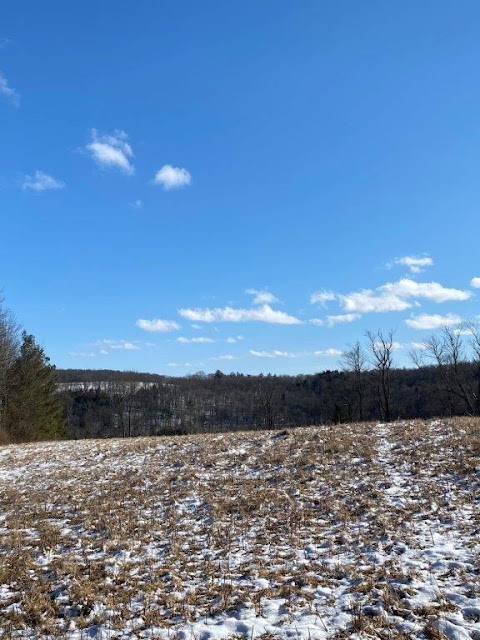
Warm days and cold nights, wind, rain, and everything in between ... all take a toll on the snow that has blanketed the fields. It's got dimples and waves, lumps and bumps. 

As Earth turns toward spring, what is happening to the landscape outside your front windows?

Wednesday, March 11, 2020

Wednesday, February 26, 2020

Explore Outdoors ~ What's left of the flowers?

Once the blooms have faded, petals dried and fallen, we forget about the flowers. As fall turned to winter, I watched birds land on the bare monarda and other flower heads. With a pick and a peck, they snagged a seed and flew off.

Later, the empty heads filled with snow. As sun warmed and melted the snow, the flowerheads trapped droplets, which froze overnight. Suddenly all the flowers were decked out in winter hats...

What's left of the flowers where you live?


This year I'm encouraging everyone to spend 1,000 hours outdoors. So on Wednesday I'll be posting ideas for nature breaks, field trips, and outdoor play. The goal: to have fun!

Teachers and homeschoolers who want to use nature breaks as field trips can grab a sketchbook or journal, something to draw and write with, and some watercolors, colored pencils, crayons, or markers. Think cross-curricular: art, language, science, math, engineering, movement, exercise! And come back Friday for some STEM book-talk.

Wednesday, February 12, 2020

Explore Outdoors ~ Snowflake Size

Last week we had a bunch of snow fall from the sky. At first, the flakes were large and fluffy. They looked like downy feathers about as long as my index finger. In the space of a half hour they were replaced by smaller flakes. Over that time, the temperature had fallen from near 30 degrees F to about 24 degrees.

If you get snow during these last few weeks of winter, pay attention to the flakes. What do they look like? How big are they? Do they float or are they intent on reaching the ground? And how do they change over the course of a storm?


This year I'm encouraging everyone to spend 1,000 hours outdoors. So on Wednesday I'll be posting ideas for nature breaks, field trips, and outdoor play. The goal: to have fun!

Teachers and homeschoolers who want to use nature breaks as field trips can grab a sketchbook or journal, something to draw and write with, and some watercolors, colored pencils, crayons, or markers. Think cross-curricular: art, language, science, math, engineering, movement, exercise! And come back Friday for some STEM book-talk.

Friday, February 7, 2020

Seeking Signs of Spring

On a Snow-Melting Day: Seeking Signs of Spring 
by Buffy Silverman
32 pages; ages 4-9
Millbrook Press, 2020

themes: changing seasons, spring, nonfiction, STEAM

On a drip-droppy, slip-sloppy, snow-melting day…

Opening this book is like stepping into a seasonal change. It begins with ice-encased twigs and salamanders on snow and ends with muddy splatters and buds growing.

What I like about this book: The language! It’s lyrical and fun to read. Lots of verbs: icicles drip; chickadees sip. I like the photos – they take us winter-bound readers out of our dreary gray day and into the woods where leaves and twigs cover the ground and snow only exists in patches. Where the sky is blue and grass is green beneath the melting snow. You can almost smell the mud!

And there is Back Matter! I am a big fan of back matter. Here, in the last pages, you can read more about the animals mentioned, the physical aspects of snow, mist, drifts, lake thaw… and where the snow goes when it melts. There is a brief glossary and some great titles for kids who want to find more fun books about spring emerging.

One Question for Buffy:

Archimedes: What inspired you to write about emerging spring? 

Buffy: The idea for Snow-Melting Day began as a response to a StoryStorm post in January, 2018 by Heidi Stemple. Heidi encouraged writers to pay attention to what is around them. It must have been a warm winter day for Michigan, because I wrote this sentence in my notebook:
It was a drip droppy
                slip sloppy
                snow melting day


And then I jotted down a few images: Mist rises in the air, boots sink in the slush, puddles grow on the lake, followed by some questions to myself: Is there a story here? Or just a poem? followed by more notes: dog wet from snout to tail (it really must have been a slushy day!) and writing on the snow (dog/deer tracks) turn to slippery sloppery.

Beyond the Books:

Pay attention to how the season is changing around you. Maybe you notice that there are more birds at the feeder, or different birds. Maybe the sky looks different than it did last month. What do you notice?

Take photos over the next six weeks and make a scrapbook showing how spring emerges where you live.

Make a map showing where snow melts first in your neighborhood, and where the first buds show.

Become a citizen scientist. Join Project Budburst to help scientists document when flowers bloom.

Buffy is a member of #STEAMTeam2020. You can find out more about her at her website.
Today we're joining Perfect Picture Book Friday, an event where bloggers share great picture books at Susanna Leonard Hill's website. Review copy provided by the publisher.

Wednesday, March 13, 2019

Wednesday Explorer's Club ~ changing seasons


We are nearing the equinox, when day length will equal dark length. Which means we can have ice and snow one day and 40 degrees the next. This week the snow is melting, turning slushy. Leaves and pine needles that fell during the big wind a week ago are coming to the surface, and some create local "hot spots", melting holes into the remaining few inches of snow. And then, overnight, snow melt freezes into a thick layer of ice and we start the melting anew at mid-morning the next day.

What does the end of winter look like where you live? (Or maybe in your neck of the woods it is the end of summer)

How does the texture of the snow change over the course of a day, a week?

What unexpected treasures are you discovering as the snow melts?

Friday, March 20, 2015

How does spring sound?

A couple weeks ago the sun burned through the clouds, and soon I could hear the drip-drip-drip of icicles melting. Faintly, from the other side of the ravine, I could hear the dull drumming of a woodpecker tapping out coded messages from a dead tree.

Spring is but a day away - what do you hear around your house as the season changes? Go outside for a listen. Find a dry place to sit, and close your eyes. Just listen. What do you hear?

Then take a minute to jot down some notes. If you can't determine what bird is calling, then describe how the call sounds. Does it slide up the scale, whistle, or chitter? Are there woodpeckers drumming on old trees or against the metal roof of a garage? Can you hear water moving? Snow melt? Sap drip?

Make sure you write the date on the page. Because every year is different. Two years ago it was 80 degrees in early March here in my neck of the woods. This year, on the same date, it was barely over freezing (32 degrees)... quite a difference.

If you're looking for more end-of-winter start-of-spring activities, check out this book review and related activities.