Wednesday, February 2, 2022

Explore Outdoors ~ Springtails in the Tracks


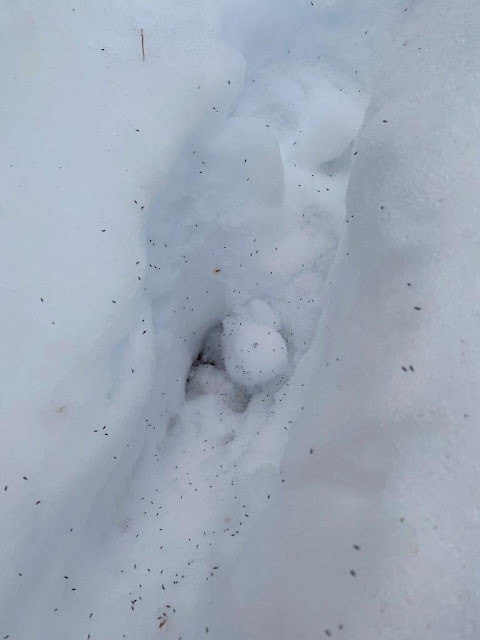
A couple weeks ago I went out snowshoeing. It was a warm day for January – with temperatures all the way into the high 30’s (Fahrenheit). As I tromped along the road between hayfields, I noticed black specks sprinkled around tracks like pepper. They weren’t pepper flakes. They were tiny arthropods called springtails, or snow fleas.

So what were they doing in the tracks? Springtails live in the top layer of the soil, right under the snow. They spend their winter nibbling on fungi and decaying leaves, and on warm days they catapult themselves up, up, up to the surface. As winter turns to spring, these tiny springtails become spider snacks. You can watch a cool video about them here.

On warm days this month, look for a sprinkling of springtails on the snow around trees in your neighborhood. If you have a magnifying lens, take a close look. They won’t leap too far away.

Monday, January 31, 2022

A voice for STEM from the foot of the Great Wall, by Songju Ma Daemicke

 
The freedom to read any books you want at any time is a privilege. I grew up in the small town of Jilin, China during the Cultural Revolution. At that time, China was a cultural desert. There wasn't a single library in our town. All Western and Chinese traditional arts and literature were considered without virtue and were forbidden. People read Mao's little red book at school and in their workplaces. We had no TV, only radio, and occasionally, Russian movies. Reading was my escape. I read not only Mao's book and text books, but every single book I could get my hands on. I was fascinated by the beauty and power of a good story and dreamed of being a writer when I grew up. 
I came to the United States in 1996 to advance my education. Even though I loved stories, I chose to major in Computer Science. After receiving my Masters degree in computer science from DePaul University, I worked as a Software Engineer for Motorola. When my twin daughters were born, I became a stay-at-home mom and read to my daughters every day. 

My curious nature and engineering background steered me towards STEM themed books. I chose nonfiction books along with fiction books on each library trip as I wanted my girls to learn something besides being entertained. Noticing how few children books about Chinese culture existed, and none of them being STEM related, I decided to write one myself. 

My first book, A Case of Sense, is about a greedy man who tries to make his neighbors pay for the delicious aromas that come from his yard. A clever judge uses his wise and convincing logic to close the case with another sense. It is a part of the Creative Mind Series of Arbordale Publishing. 

In my second book Cao Chong Weighs an Elephant, I tell the tale of seven-year-old Cao Chong, a famous Chinese child prodigy who lived around 2,000 years ago.  He used creative thinking and a science principle (buoyancy) to determine the weight of an elephant. My book was one of Best STEM book of NASA in 2018.

My newest book, Tu Youyou’s Discovery: Finding a cure for Malaria is a biography of the first Chinese woman Nobel laureate. Tu Youyou used her background in traditional Chinese medicine to develop a new medicine, saving millions of lives. 

I love to share my rich Chinese culture and my STEM interests with young readers. I am proud to be a voice for STEM from the foot of the Great Wall.

Thank you for joining us today, Songju. Last month I reviewed her newest book, Tu Youyou's Discovery. A couple years earlier, I read Cao Chong Weighs an Elephant. You can visit Songju's website here.
 

Friday, January 28, 2022

What's a Wombat?


Wombat 
by Christopher Cheng; illus. by Liz Duthie 
32 pages; ages 5-9
Candlewick, 2021  

theme: animals, nature, nonfiction

Far underground, where dirt and tree roots mesh, tunnels lead to a burrow.

That’s where wombat lives. Wombat is a nocturnal marsupial, so she becomes active as day fades into night. We follow her as she ambles along her well-worn path on a mission to find breakfast. We watch as she excavates a burrow. And we find where she has left her cube-shaped poop on a rock – it’s her way of marking her territory, so stay out if you’re another wombat!

Wombats may look soft and cuddly, but you don’t want to tangle with them. They have sharp teeth, strong limbs that they use to shovel dirt like bulldozers, and bony bottoms they use to defend their burrows.

What I like about this book: It’s fun to tag along with Wombat on her daily rounds – where we see the world through her point of view. Sidebars add additional information, and there’s additional information at the back. There’s a handy index at the back that makes it easy to look up information more quickly. 


Beyond the Books:

Learn more about Wombats. Here’s an article about wombats, and here’s a video, and here’s an article about how they can produce poop cubes. Because, yes – scientists wanted to know.

Make a Wombat mask. Use cereal box or paper plate to make a stiff face – add ears, draw on a nose, and remember to cut out holes for your eyes. Tie it on with yarn and go off on a wombat adventure.

Learn how to talk like a wombat. They are generally quiet, but make a variety of sounds such as the soft grunts and loud raspy calls you can hear on this video.

Today we're joining Perfect Picture Book Friday, an event where bloggers share great picture books at Susanna Leonard Hill's website. Review copy provided by the publisher.