Friday, November 25, 2016

Blades vs. Birds ~ offshore wind power

Birds vs. Blades? Offshore wind power and the race to protect seabirds
by Rebecca E. Hirsch
48 pages; ages 8-12
Millbrook Press (Lerner), 2016

 Up and down the Atlantic coast, between Virginia to Rhode Island, engineers are looking for places to build offshore wind farms - just like the wind farms that provide energy for other parts of the country.

But the Atlantic coast is a migration corridor for millions of birds  - birds that play an essential role in the ocean food chain. So the question arises: can we harvest clean wind energy without harming seabirds?

Rebecca Hirsch follows a research team describes their multi-year study of three seabirds:
  • the Northern gannet, a graceful diving bird
  • the Red-throated loon, who spend the winter along the mid-Atlantic coast
  • the Surf scoter, a black-and-white sea duck

Red-throated loons and Surf scoters seem to avoid areas where wind farms are located - making habitat loss a concern. The gannets fly at the same height as turbine blades, so they may be at risk of collisions. And doing the research isn't easy - and it involves a team of people, from the capture team to wildlife veterinarians, to a host of other scientists.

Hirsch not only follows the field adventures of scientists, but also the journeys of one of the tagged gannets. Complementing informative - and fun to read - text are plenty of photos, maps, diagrams, and lots of sidebars that help expand the story.

"Protecting the ocean is a big job," Hirsch writes. It's too big for scientists and politicians alone. "You can take action in your own home and community to help." She ends with things everyone can do. There's a handy index, source notes, and a glossary.

Today's review is part of the STEM Friday roundup. Drop by STEM Friday blog for more science books and resources. Review copy provided by publisher.

Wednesday, November 23, 2016

Wild Outdoor Wednesday


Find things in nature that curl or spiral. Record your observation in images, colors, words.

Remember to take your sketchbook or journal with unlined pages, something to draw and write with, and something to add color ~ watercolors, colored pencils, crayons, or markers.

Friday, November 18, 2016

Because of an Acorn

Because of an Acorn
by Lola Schaefer and Adam Schaefer; illus. by Frann Preston-Gannon
36 pages; ages 3-6
Chronicle Books, 2016

I love the simplicity of this book:
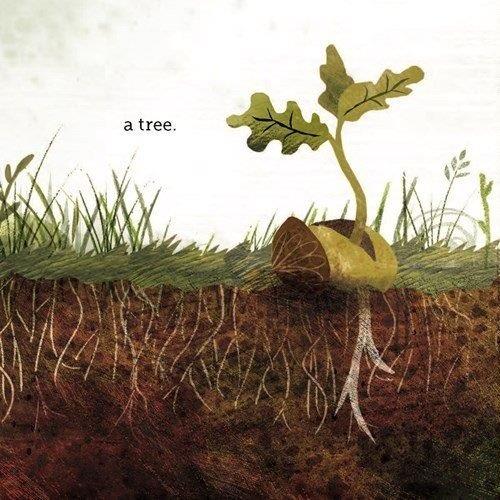
Because of an acorn, a tree.
Because of a tree, a bird.

I love the ecological layers in this book: food, shelter, seed, transport. Everything - everything - is connected.

I love the illustrations. Simple, soft, just enough detail. And cumulative. Plus there are some interesting die-cuts where the shape created the image on one page, but the coloring is from something different on the next.

See what I mean? Seedling and grass roots and soil particles... how cool is that!

I love the back matter. That's where you can learn more about the white oak tree - a "foundation species", and what an ecosystem is, and what role saplings play in the food chain. That's where you get the nitty-gritty details about forest inhabitants and why we need forests.

And that's where you'll find four things you can do to help forests.

By this time in November, most of our acorns are gone - eaten by turkeys or buried by squirrels. But I know that I'll find tiny oak sprouts in the spring... in my gardens and in the middle of the yard. And there's always plenty of acorn caps to use for art projects.

Today's review is part of the STEM Friday roundup. Drop by STEM Friday blog for more science books and resources. Review copy provided by publisher.