Why did the Woolly Bear Cross the Road? To find a good spot to sleep!
They may not predict how long, or how cold, winter will be, but woolly bear caterpillars can make their own antifreeze so they can survive the winter. We, on the other hand, have to rely on multiple layers of sweaters and copious amounts of hot cocoa!
Showing posts with label adapting to winter. Show all posts
Showing posts with label adapting to winter. Show all posts
Wednesday, November 6, 2019
Friday, November 1, 2019
Snack, Snooze, Skedaddle

by Laura Purdie Salas; illus by Claudine Gévry
32 pages; ages 5-9
Millbrook Press, 2019
theme: winter, animals, nature
Soak up the sun, breathe in the breeze, munch crunchy apples that fall from the trees.
Because nights are growing longer, days are getting colder, and soon snow and ice will cover the landscape. Laura Purdie Salas shows how different animals prepare to survive the winter. Some, such as hummingbirds and butterflies, migrate. Others store up nuts and seeds, or build layers of fat, and spend the winter napping. And others grow extra layers of hair so they can keep warm.
What I like about this book: Rhyming text reveals survival secrets of twelve different animals, from worms to mammals. And yes, humans are counted amongst those mammals. A line of smaller text, offset by squiggly lines, offers additional details. Claudine Gévry’s illustrations are filled with details inviting readers to explore the spreads that show animals across the two seasons of autumn and winter.
And there is back matter! Salas provides more information about the three basic winter survival strategies: migrate, hibernate, or tolerate. Following pages tell more about the migrators, hibernators, and tolerators, and end with a glossary.
Beyond the Books:
The Cornell Lab of Ornithology is a great resource for learning more about bird migration. Here’s an article about bird migration basics, and here’s the migration forecast map.
Spend a month watching the wild animals and birds in your yard, neighborhood, parks, or nearby fields and woods. Jot down the dates when you see (or hear) geese flying overhead, or other birds. Make a list of animals you see staying. Are the birds that hang out in winter the same ones you saw in the summer?
If you live in a place of winter snow and ice, what do you do to adapt to the colder temperatures? Put on extra layers? Build snow forts and glide on ice? Do you eat different kinds of food than you do in the summer?

Friday, August 23, 2019
Wait, Rest, Pause

by Marcie Flinchum Atkins
32 pages; ages 4-8
Millbrook Press, 2020 (released fall 2019)
theme: dormancy, nature, waiting
If you were dormant, you would pause—
waiting,
resting,
huddling,
curling,
napping.
When conditions get tough, some animals head elsewhere. But others – they tough it out by going into a dormant stage: estivation, hibernation, diapause, torpor. Plants go dormant as well. You’ve watched deciduous trees lose their leaves when days grow shorter and colder. The trees hunker down for the winter, waiting for the right condition to break dormancy and produce flowers and leaves.
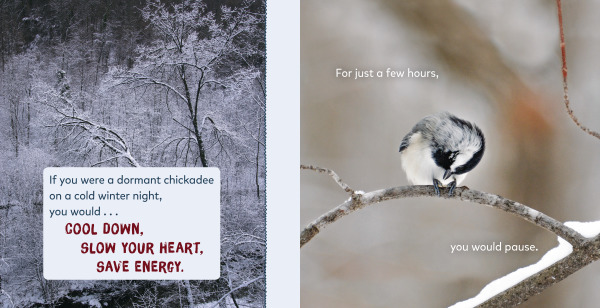
What I
Beyond the Books:
Have you ever wondered where worms go in winter? Here’s a place to learn more. And if you’re wondering about what happens to ladybugs, Dr. Laura Levine has the answers.
Download this free Winter Ecology Teacher’s Guide from Glacier National Park for great information about how plants and animals survive the winter. Get PDF.
Meet Marcie Atkins! Next Wednesday I’m interviewing Marcie over at the GROG blog. Please drop by and join us! You can find out more about her at her website.
Friday, January 18, 2019
Do Frogs Drink Hot Chocolate?
Keeping warm in winter is tough for those of us living in the colder parts of the world. I keep warm by pulling on an extra sweater, wearing fuzzy slippers, and drinking hot cocoa. So when I saw the cover of this book, I knew I had to review it! Because... hot chocolate and frogs! And because the cover is so inviting!
 themes: animals, winter, nature
Do Frogs Drink Hot Chocolate?
By Etta Kaner ; illus. by John Martz
32 pages; ages 4-8
Owlkids, 2018
When it gets cold out, do animals turn up the heat?
No!
Using a question-answer format, this book explores how animals survive chilly - and downright frigid - weather. Thankfully, the hot chocolate question gets answered right away. I'll save you the suspense: Frogs do not drink hot cocoa. They don't even try to keep warm. In fact, some of them turn into frogsicles during winter. Brrrrr!
What I like about this book: I love the diversity of strategies that are presented for keeping warm. Penguins snuggle, butterflies sunbathe, and some animals build snow dens (snow is a great insulator!). Things animals don't do: jump up and down, wear ear muffs, drink hot chocolate. Well, wild animals may not do those things, but I can think of one animal that does all three: humans.
Now that you know ways to keep warm in winter, it's time to head outside and explore the weather. This new book from National Geographic Kids introduces young children to all different sorts of weather, from Whoosh! of wind to the drip-drop of rain. There's a spread explaining how droplets can freeze in the clouds and fall to the ground as snow.
Given the variability we've seen in our winter thus far - freezing rain, snow, wind, rain, 26 degrees one day, 50 the next - this might be the perfect book to inspire the pre-K to first-grade crowd to observe weather around them. Back matter includes photos and short explanations of "wild weather" (floods, blizzards, hail) and the instruments that scientists use to study the weather.
Beyond the Books:
What do you do to stay warm in winter? Think about the clothes you wear, things you eat, activities, whether you hibernate...
Polar bears and penguins (and other cold-weather animals) have a layer of fat that helps them stay warm. How does that work? Try this: Fill a bowl partway with cold water and toss in a bunch of ice cubes. Put one of your fingers in the icy water. How long can you keep it there until it gets too cold?
Now, dry off your finger and coat it with a thick layer of shortening. Pop it back in the icy water. How long can you keep your finger in the water? Instructions here.
Keep a winter weather logbook. Some things you can keep track of in your book include: temperature outside, whether it's windy or calm, what the sky looks like, snow or rain or ice... and remember to write the date for each observation. You might also jot down any birds or animals you see outside.
 Today we're joining other book bloggers over at STEM Friday, where you can discover other cool STEM books. And we're joining Perfect Picture Book Friday, an event where bloggers share great picture books at Susanna Leonard Hill's website . Review copies provided by the publishers.

Do Frogs Drink Hot Chocolate?
By Etta Kaner ; illus. by John Martz
32 pages; ages 4-8
Owlkids, 2018
When it gets cold out, do animals turn up the heat?
No!
Using a question-answer format, this book explores how animals survive chilly - and downright frigid - weather. Thankfully, the hot chocolate question gets answered right away. I'll save you the suspense: Frogs do not drink hot cocoa. They don't even try to keep warm. In fact, some of them turn into frogsicles during winter. Brrrrr!
What I like about this book: I love the diversity of strategies that are presented for keeping warm. Penguins snuggle, butterflies sunbathe, and some animals build snow dens (snow is a great insulator!). Things animals don't do: jump up and down, wear ear muffs, drink hot chocolate. Well, wild animals may not do those things, but I can think of one animal that does all three: humans.
 |
| 32 pages; ages 3-7. NGK, 2018 |
Given the variability we've seen in our winter thus far - freezing rain, snow, wind, rain, 26 degrees one day, 50 the next - this might be the perfect book to inspire the pre-K to first-grade crowd to observe weather around them. Back matter includes photos and short explanations of "wild weather" (floods, blizzards, hail) and the instruments that scientists use to study the weather.
Beyond the Books:
What do you do to stay warm in winter? Think about the clothes you wear, things you eat, activities, whether you hibernate...
Polar bears and penguins (and other cold-weather animals) have a layer of fat that helps them stay warm. How does that work? Try this: Fill a bowl partway with cold water and toss in a bunch of ice cubes. Put one of your fingers in the icy water. How long can you keep it there until it gets too cold?
Now, dry off your finger and coat it with a thick layer of shortening. Pop it back in the icy water. How long can you keep your finger in the water? Instructions here.
Keep a winter weather logbook. Some things you can keep track of in your book include: temperature outside, whether it's windy or calm, what the sky looks like, snow or rain or ice... and remember to write the date for each observation. You might also jot down any birds or animals you see outside.
Wednesday, February 1, 2017
Wednesday Explorers Club ~ meet a bug

Meet the Mourning Cloak butterfly. It's one of the few insects that sticks around for the winter, hibernating in tree cavities, beneath loose bark, or in unheated buildings. They'll hide away anywhere they fit as long as the place protects them from winter winds and keeps then out of sight from predators - birds and squirrels.
Mourning Cloaks overwinter as adults. The spend the winter in "cryo-preservation", replacing water in their bodies with glycerol which acts as an antifreeze. You can read more about Mourning Cloaks and other critters that spend the winter as icicles here.
When the weather warms, the Mourning Cloaks will flit about, looking for mates. You might even see them out in the snow!
Friday, February 20, 2015
The Frogs of Winter

That's OK, though, because some of these frogs -wood frog, Cope's gray tree frog, eastern gray tree frog, spring peepers, and western chorus frog - can survive freezing. When things warm up, they thaw out and hop away.
Frogcicles. Cool. But a bit more complicated than just turning into a block of ice. There's a process involved to protect the frog. Once ice starts to form in the skin, the wood frog's liver starts converting stored sugars into glucose. That glucose is carried through the bloodstream to tissues where it helps keep cells from completely dehydrating and shrinking.
Over winter, as much as 70 percent of the water in a frog's body can be frozen. One ecologist says that if you opened up a frozen frog its organs would look like "beef jerky" and the frozen water around the organs would resemble a "snow cone".
What starts this freezing process? According to the scientists in this video, all it takes is exposure to ice crystals. They stay in their frogcicle state until the snow melts - which, for frogs in the northeast, could be a long time coming.
.jpg)
Today is STEM Friday - head over to the STEM Friday blog to see what other bloggers are talking about.
Friday, January 31, 2014
Life Beneath the Snow

When the
snow piles up, it’s tempting to believe that everything is hibernating – or at
least waiting for a warmer day. That may be the case for deer and other large
animals that have a harder time finding food in deep snow – but not for meadow
voles and shrews and other small creatures that live close to the ground. For
them, deep snow is an advantage.
That’s
because a thick blanket of snow serves a … blanket. Or at least a quilt. All
that snow insulates the tunneling-near-the-ground critters from icy winds and
freezing temperatures. A layer of snow 6 – 10 inches deep traps heat rising
from the ground. That heat melts the snow at the surface. Snowflakes change
shape and size, becoming grainy like sugar. They also become less sticky, so
small animals can move through that sugar-snow layer.
The
blanket of snow blocks the wind, so temperatures in the pukak remain pretty
close to freezing all winter long. That may sound cold, but it’s a lot warmer
than the air temperature on the surface. Some plants, protected by the thick
snow layer, remain green and actively growing – even though they’re getting
much less light. Those plants and their roots provide food for the insects and
animals that remain active under the snow.
Snow Study
Find a
deep, undisturbed snow drift. Using a ruler or a long stick, slice into the
drift to expose a cross-section. Examine the different layers you see: thick
layer, thin layer, icy, crusty, powdery, dirty. Make a sketch and label the
layers. Can you reconstruct the history of snowfalls using your drift-drawing?
Now dig
down until you reach the soil layer at the base of your drift. What do you see?
Are there any plants? If so, what color are they? Draw or write about signs of
animal life – do you see any evidence of tunnels or nests? Check the soil – is it soft or frozen?

Friday, January 11, 2013
Bugs & Bugsicles ~ Insects in Winter
Last week I wrote about the snow fleas hopping all over my
ski tracks. Turns out lots of insects have similar strategies for dealing with
winter weather.
Some go dormant, entering a state called “diapause”. That’s
a state of dormancy that might look like hibernation but isn’t. It’s used as a
way to survive temperature extremes, drought, or other unfavorable conditions. Insects
that spend the winter in diapause can withstand a temperatures as low as 94
degrees below zero Fahrenheit (-70 C).
How do they do it? Some have antifreeze compounds that
supercool their body fluids and tissues – sort of like ethylene glycol used in
antifreeze for cars. Other insects freeze, turning into bugsicles – like the
Arctic Woolly Bear caterpillar that Amy Hansen writes about in her book,
Bugs and Bugsicles.
 |
|
Bugs and Bugsicles: Insects in the Winter
By Amy Hansen; illustrated by Robert C. Kray
32 pages, ages 7-9; Boyds Mills Press
|
In Bugs and Bugsicles, Hansen shows the diversity of
strategies insects use to survive winter. Unlike the grasshopper of Aesop’s Fables fame, many insects begin their winter preparations while the weather is
still warm. In late summer Monarch butterflies get ready to fly to Mexico,
honeybees cap off their cells full of pollen and nectar, and ants stockpile seeds
of all sorts and sizes.
Dragonfly nymphs curl up in the mud. Not only does the mud
protect nymphs from cold, but it hides the nymphs from hungry fish. Ladybugs
are more gregarious – they snuggle in hidden ladybug clusters until spring
returns. And some insects go to sleep or, like the Arctic Woolly Bear, freeze
until spring thaw.
Bug antifreeze works because, as the temperature drops,
their cells produce glycerol (or other compounds). These compounds prevent water
crystals from forming within the cells – and that’s important, because water
freezes and any ice crystals would rupture the cells and kill the insects.
Hansen includes some hands-on investigations for curious bug-ologists-
but here’s one you can try. You’ll need 2 ice cube trays, a couple cups, a
measuring cup, some sugar and a freezer (or a really cold day).
Mix 1/2 cup of sugar with 1 quart of water. Fill up an ice
cube tray with this solution.
Put water in the other ice cube tray. Put both trays in the
freezer and check after an hour.
You can read more about insects in winter here - and check out more science resources at STEM Friday! Review copy provided
by publisher.
Subscribe to:
Posts (Atom)