Showing posts with label under the snow. Show all posts

Wednesday, February 2, 2022

Explore Outdoors ~ Springtails in the Tracks


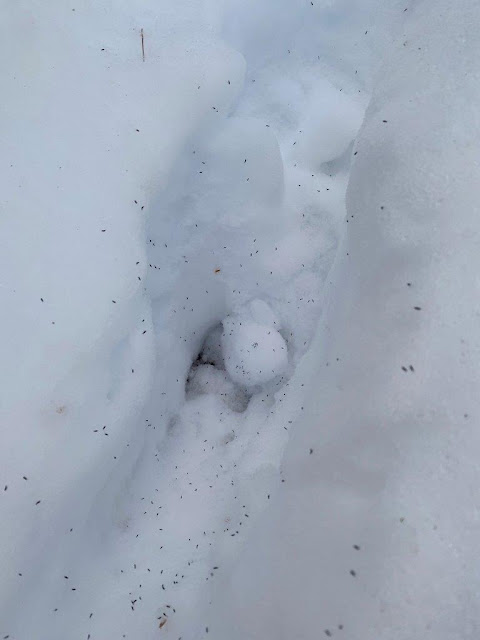
A couple weeks ago I went out snowshoeing. It was a warm day for January – with temperatures all the way into the high 30’s (Fahrenheit). As I tromped along the road between hayfields, I noticed black specks sprinkled around tracks like pepper. They weren’t pepper flakes. They were tiny arthropods called springtails, or snow fleas.

So what were they doing in the tracks? Springtails live in the top layer of the soil, right under the snow. They spend their winter nibbling on fungi and decaying leaves, and on warm days they catapult themselves up, up, up to the surface. As winter turns to spring, these tiny springtails become spider snacks. You can watch a cool video about them here.

On warm days this month, look for a sprinkling of springtails on the snow around trees in your neighborhood. If you have a magnifying lens, take a close look. They won’t leap too far away.

Wednesday, January 15, 2020

Explore Outdoors ~ Windows to What's Under the Snow

 Warm winds blew in for a week, and snow began to melt. What was underneath? Bright green mosses, soggy leaves in shades of brown, rust-colored pine needles. It smelled like a garden after rain, but colder.

What's poking through snow-windows in your neck of the woods? Or if you don't have snow, what's starting to grow? Scribble words, brush paint, stretch like a small plant reaching to the sun or shrugging off the snow.


This year I'm encouraging everyone to spend 1,000 hours outdoors. So on Wednesday I'll be posting ideas for nature breaks, field trips, and outdoor play. The goal: to have fun!

Teachers and homeschoolers who want to use nature breaks as field trips can grab a sketchbook or journal, something to draw and write with, and some watercolors, colored pencils, crayons, or markers. Think cross-curricular: art, language, science, math, engineering, movement, exercise! And come back Friday for some STEM book-talk.


Friday, January 31, 2014

Life Beneath the Snow


When the snow piles up, it’s tempting to believe that everything is hibernating – or at least waiting for a warmer day. That may be the case for deer and other large animals that have a harder time finding food in deep snow – but not for meadow voles and shrews and other small creatures that live close to the ground. For them, deep snow is an advantage.

That’s because a thick blanket of snow serves a … blanket. Or at least a quilt. All that snow insulates the tunneling-near-the-ground critters from icy winds and freezing temperatures. A layer of snow 6 – 10 inches deep traps heat rising from the ground. That heat melts the snow at the surface. Snowflakes change shape and size, becoming grainy like sugar. They also become less sticky, so small animals can move through that sugar-snow layer.

Scientists have a name for the layer beneath the snow: subnivean (sub= below; nivean refers to snow). They call the grainy crystals “depth hoar”. The Inuit also have a name for that layer of snow, too; they call it “pukak”. 

The blanket of snow blocks the wind, so temperatures in the pukak remain pretty close to freezing all winter long. That may sound cold, but it’s a lot warmer than the air temperature on the surface. Some plants, protected by the thick snow layer, remain green and actively growing – even though they’re getting much less light. Those plants and their roots provide food for the insects and animals that remain active under the snow.

Snow Study

Find a deep, undisturbed snow drift. Using a ruler or a long stick, slice into the drift to expose a cross-section. Examine the different layers you see: thick layer, thin layer, icy, crusty, powdery, dirty. Make a sketch and label the layers. Can you reconstruct the history of snowfalls using your drift-drawing?

Now dig down until you reach the soil layer at the base of your drift. What do you see? Are there any plants? If so, what color are they? Draw or write about signs of animal life – do you see any evidence of tunnels or nests?  Check the soil – is it soft or frozen?

Stick a thermometer horizontally into the snowdrift at different layers. Where is it warmest? Coldest? For more snow study ideas, check out Sandra Markle's blog. And then head over to STEM Friday and see what resources other bloggers are sharing.

Monday, January 10, 2011

Nonfiction Monday: Under the Snow


Under the Snow
By Melissa Stewart, illustrated by Constance R Bergum
32 pages, for ages 4-8
Peachtree Publishers 2009

Winter seems like a quiet time. Except for the birds at the feeder – and the squirrels crouched below, waiting for the cascade of rejected millet as the chickadees pick through for sunflower seeds – there’s little activity outside.

But there’s a lot going on under the snow, and Melissa Stewart takes us on a wintry field trip in her lovely book, Under the Snow. This book offers a lyrical tour of habitats and the animals that live there in the winter. You’ll meet ladybugs snuggled into a crevice in a stone wall and a meadow vole that nibbles bark off a tree trunk for mid-winter snacks. In my garden the voles simply tunnel under the mulch and snack on the rutabagas I forgot to harvest…

Stewart, along with Bergum’s wonderful watercolors, introduce us to the secret world of insects sleeping beneath the snow, the wood frog beneath leaves, a woodchuck snug in his burrow. They also show us the slow-moving bluegills and carp in the pond, under the ice.

My favorite spread is red-spotted newts dodging and darting just below the ice. Now I want to go down to the neighbor’s pond and clear off the ice to see whether the newts are swimming there. As soon as it stops snowing, of course.

“Many authors have written books about hibernation,” Stewart writes on her website. “But I wanted children to know that many animals stay active all winter long – even under the snow.” You can read more about how she wrote the book at her blog.

This post is part of the Nonfiction Monday Round-Up hosted this week by Tales from the Rushmore Kid.