Friday, May 12, 2023

These books will Light Up your Life!

Ooh! Two books about things that light up in the dark!

Theme: nature, animals, glow-in-the-dark
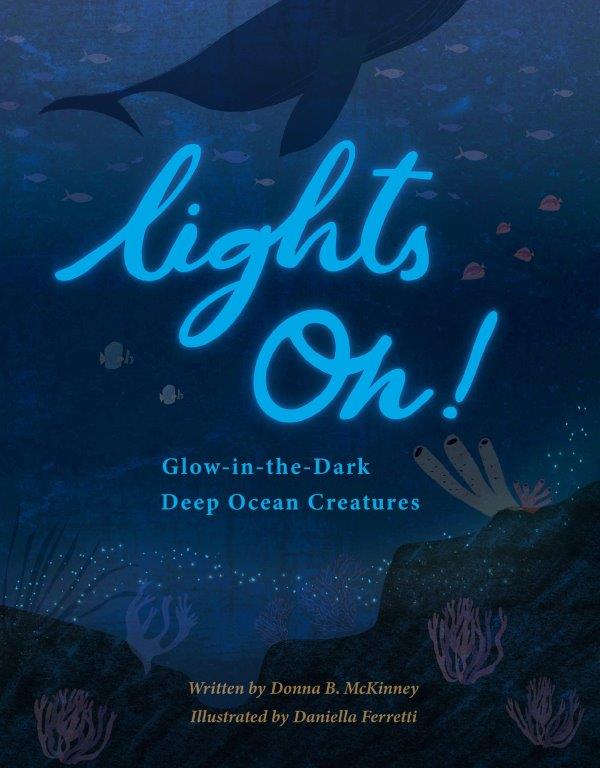
Lights On!: Glow-in-the-Dark Deep Ocean Creatures 
by Donna B. McKinney; illus. by Daniella Ferretti 
32 pages; ages 4-8
Yeehoo Press, 2023

Near the ocean’s surface, the first rays of sunrise bathe the waters. Here fish, seals, and turtles swim, splash, and eat in a world lit by sunlight.

But down below, where the sunlight doesn’t reach … where it’s always dark as night, what do the creatures do? Vampire squid and lantern fish carry their own light. Pocket sharks and jellies glow in the dark. Some animals use their bioluminescence to find a mate, others to trick prey, and others to escape from a predator. There’s a lot of action going on down in the deep, dark sea.

What I like about this book: There are flaps! Beneath each flap is a tidbit of information that adds to what is on the page. For example, the spread introducing pocket sharks: lift the flap to learn how this shark got its name. I like the contrast between what’s happening in the upper, surface layers of the ocean and the action in the darkest deep waters. To do that, the book was designed to be turned by the reader. This creates long, vertical spreads. And there’s back matter, where Donna introduces the term “bioluminescence” and gives some fun facts.

I wanted to know a bit more about Lights On! so I asked Donna a couple questions:

Me: Whose idea was it to create the flaps? 

Donna: My editor, Molly Shen Yao, suggested the flaps. I had submitted the story to Yeehoo with that additional informational text positioned as sidebars (text boxes). In the editing process, Molly suggested putting the sidebar material under flaps. I loved the idea and I hope my readers will enjoy the flaps!

Me: Upon opening the book, readers have to turn it so they can get a tall vertical look. How did this come about?

Donna: Editor Molly gets credit for that, too. Because each art spread in the book reflects what's happening above the ocean surface and at the ocean depths, she thought the vertical orientation would give the illustrator more freedom to reflect that ocean depth. I love how the illustrator, Daniella Ferretti, was able to use that vertical space, showing what was happening from sky to ocean depths in each spread. 

Luminous: Living Things That Light Up the Night 
by Julia Kuo 
44 pages; ages 4-8
‎Greystone Kids, 2022

When it’s dark out, we need light to see.

We might use a flashlight or a lantern to see at night. But some animals make their own light. That light, explains Julia, is called bioluminescence, and creatures make that light using special chemical reactions in their bodies. Throughout the book, she shows fungi, fish, and dinoflagellates that create light. Each spread includes an info-packed sidebar, so there is no need (or room) for back matter.

What I like about this book: The black pages with white print set the perfect stage for a book about dark, though I do wish the sidebar text was bigger. Of course I love that bioluminescent fungi are included! As are fireflies and glow worms (which she points out are neither flies nor worms). And I love the focus on the diversity of creatures that make their own light.

Beyond the Books:


Go on a night walk and look for luminous things. If you’re walking near the ocean, you might see plankton glowing on the water. If you’re walking in a woody area, you might find glow-in-the-dark mushrooms (here are a few), and if you’re in the eastern part of the US you might see fireflies blinking above the tall grass. I once found glow worms in my garden!

Make some glowing water with this simple experiment from PBS

Donna B. McKinney is a member of STEAM Team 2023. You can find out more about her at her website https://www.donnamckinneybooks.com/

Today we’re joining Perfect Picture Book Friday. It’s a wonderful gathering where bloggers share great picture books at Susanna Leonard Hill's website. Review copies provided by the publishers.

Wednesday, May 10, 2023

Explore Outdoors ~ Dandelions (and the bugs that love them!)


We're going on a dandie hunt (sung along to the tune of Going on a Bear Hunt). You do have dandelions growing in your neighborhood, don't you? But we're not just looking for dandelions - we're looking for the insects that hang out on them. Dandelions may not be the best source of nectar and pollen for bees, but they are an early source of food for insects. Which is why I consider them "pretty yellow flowers" and not "weeds."

This week, take a close look at the dandelions growing in your yard, along the sidewalks, in gardens, and at the park. Then look closer. You might see:
  • carpenter bees
  • wasps
  • flies of all kinds
  • miner bees
  • honey bees
  • bumble bees
  • spiders
  • butterflies
  • slugs

... or even something else! Spend some time watching them. Draw a picture and jot down some distinguishing characteristics of the critter you find. For example: that tachinid fly in the bottom left corner. See those short antennae? The white patch on its butt? The way it holds its (single pair of) wings out at an angle? 

If you'd like to grow some flowers for bees and other pollinators, check out the list I have in this post from a few years back.

Friday, May 5, 2023

Spring Books Bring Trees & Frogs

Trees are leafing out and frogs are singing. Spring is bringing new life to woods and wetlands, and I’ve got two fun books to share for the season.

theme: life cycles, trees, frogs

A few years ago I reviewed a book by this author/illustrator team. I am so happy to share this new book about how the world’s tallest trees grow up.

Rise to the Sky 
by Rebecca E. Hirsch; illus. by Mia Posada 
32 pages; ages 5-10
Millbrook Press, 2023 

What is the tallest living thing? It’s not an elephant or a giraffe or even a blue whale.

You can probably guess, but you have to turn the page to confirm that it’s a … tree! But not just any tree. In this book, Rebecca Hirsch highlights eight of the world’s tallest trees – trees that grow at least as tall as the Statue of Liberty. That’s about 305 feet tall or, comparing to whales, about 3.8 Blue whale-lengths.

Rebecca shows how tall trees begin as small seedlings, sprouting from old stumps or growing from seeds. She tells how they breathe, move water and nutrients, and rise up, up, up to the sky.


What I like about this book: The text is fun to read and easy for young children to follow. And the back matter tells more about how trees grow, what phloem and xylem are, and how long tall trees can live. Rebecca also includes a couple hands-on activities at the back. But wait! There’s more! Mia Posada’s cut paper collages add amazing texture to the pages, making me want to stay and explore the illustrations. And, there is a great vertical book-turn to give these giant trees the space they need to Rise!


Where there’s trees, you might find tree frogs. At least in my neck of the woods. 

One Tiny Treefrog: A Countdown to Survival 
by Tony Piedra, illus. by Mackenzie Joy 
‎40 pages; ages 4 - 8 years
Candlewick, 2023

Ten tiny tadpoles grow in their eggs.

This is a fun count-down book that shows the lifecycle of a red-eyed treefrog.

What I like about this book: I love the expressive tadpole faces, the illustrations, the fun language – and the notes that identify the different animals by common name and scientific name. There’s also a fun book-turn so you can see the tadpoles plunge “plink, plink, plink” into their new, watery home. And I love that there is back matter! One section tells what it takes to become a red-eyed treefrog, with some additional “survival” notes about the different stages. A great book for any frog-loving kid.

Beyond the Books:

Create some cut paper art to show some of the nature you see outside. You might use watercolors to paint paper to use for your collages, like Mia Posada does, or snip your colorful bits from old calendars and magazines. 

Sit outside or open a window and listen to frogs. Don’t think you have any? I’ve heard tree frogs when standing in a restaurant parking lot in downtown Ithaca, NY.

How tall are the trees where you live? Here are some ways to figure out tree height.

Today we’re joining Perfect Picture Book Friday. It’s a wonderful gathering where bloggers share great picture books at Susanna Leonard Hill's website. Review copies provided by the publishers.