Showing posts with label poop. Show all posts

Friday, January 23, 2026

What Animals Leave Behind...

Scat, poop, dung … whatever you call it, tells a story: about the animal, about its environment, and possibly about the future. These three books look at the things wild animals leave behind, each in its own way. Their themes: animals, poop, nutrient cycle, observation

Scat: The Incredible Science of Wildlife Poop (Books for a Better Earth) 
by Anita Sanchez 
96 pages; ages 8-12
‎Holiday House, 2025

Poop, writes Anita Sanchez, is full of surprises. “It can be food. It can be shelter. It can be life…” Poop carries seeds, helps fertilize soil and oceans, and even carries messages to friends and family. Eight chapters discuss what poop is, how it connects the lives of plants and animals, the kinds of information scientists can gather from studying scat, and why some animals eat their own. 

There are a whole bunch of things I love about this book. First is the sly humor Anita injects into the topic. Take section headings for example: “Thinking like an avocado” or “Does a Bear poop in the forest?” Inquiring minds want to know! There are some truly great photos of animals taking dumps in the wild. For folks who want more, there are sidebars, titled “Scat Science” that dive into such topics as why wildlife poop doesn’t smell bad, dino doo, and moths that look like bird droppings. What’s really fun is the Field Guide to Scat at the end of the book, with photos of droppings from insects, birds, and mammals.

Ready, Steady, Sloth! 
by Justin Anderson; illustrated by Manu Montoya 
32 pages; ages 5-8
‎Candlewick, 2025

High up in the forest canopy, hidden among the leaves, there is a sloth. 

Mama sloth doesn’t move much, but today she needs to go down the tree for a special mission. And she’s taking her baby with her. Down, down, down they go. Oh dear… mama sloth is going so slowly you’re going to wonder whether she’ll make it. This journey is important because sloth has to “go” and the only place she can do that is down on the ground.

What I like about this book: Layered text allows younger readers (or read-alouds) to focus on the story of mama and baby sloth’s adventure down the tree, while introducing some of the other forest creatures – including jaguar! Will he find them? Smaller text provides sloth facts (did you know sloths can’t fart?) and back matter introduces all five three-fingered sloth species and the two two-fingered sloths.

For another book on the topic, check out Kyle Goes Alone 

The Secret of Poo Mountain: Book 4 (Whose Poo Is This?) 
by Song-eui Park; illus. by Duck-Young Kim 
88 pages; ages 7-11
‎Lerner/ Graphic Universe   ‎ March 3, 2026

There are as many ways to write about poo as there are kinds. This book is fourth in an educational comic series that takes readers on a journey to learn about the ecology of animals and the sorts of information that can be derived from the study of poo. Previous books have taken Dr. Egg’s team to the desert and on a boat. In this book, they climb a steep mountain. The three Korean scientists who make up the team learn such things as what an animal eats and where it lives by studying the scat left behind.

What I like about this book: Like other books in the series, this one is structured like a scavenger hunt, with each chapter revealing a new clue. That mystery, and the graphic format help make it appealing to readers who might not want to spend time with a field guide.

Beyond the Books: 

Check out this video, Whose Scat is That? Created by the folks at the Saint Louis Zoo.

Write a list of as many words you can think of (or find) that refer to “poo.”  Don’t forget about dinosaurs…

Create your own story or comic about animals doing something in the wild: making breakfast, going to sleep, combing their fur...

You can find an online “field guide to scat” here. Remember: if you head out on a scat-hunt, look but don’t touch!
https://a-z-animals.com/articles/a-field-guide-to-identifying-wild-animal-scat-in-north-america/

Today we’re sharing Ready, Steady, Sloth! with Perfect Picture Book Friday. It’s a wonderful gathering where bloggers share great picture books at Susanna Leonard Hill's website

Thanks for dropping by today. On Monday we'll be sharing Scat over at at Marvelous Middle Grade Monday, a hangout for MG book bloggers. It's over at Greg Pattridge's blog, Always in the Middle, so hop over to see what other people are reading. 

This week’s review copies were provided by the publishers.

Friday, November 24, 2023

Food, Glorious Food!

Today I offer a banquet of books to feast your eyes on while contemplating leftovers…  The Themes are: food, animals, cooking

The Sun Shines on the Jungle
by Michael Slack
board book; ages 3-5
‎Candlewick, 2022

The sun shines on the jungle.
Plants grow, reaching for the sun.


And then the munching begins. Beetles eat the leaves. Spiders eat the beetles. And before you know it you’ve got a full-fledged food chain on your hands!

What I like about this book: It is deceptively simple. Simple text with lovely illustrations showing one thing eating another. It’s not until you’re four spreads in that you begin to think: Hey! That animal ate the one I just saw on the previous page! But wait – there’s more. 


 Lifting the flaps, we can see inside the predators’ tummies. What a fun way to begin a discussion about who eats whom – perfect reading before any meal.

 My kids always enjoyed cooking up things in the kitchen, whether it was messing around with pizza dough, tossing chips into cookie dough, or making their very first sandwich. We didn’t have a kid cookbook, so our culinary adventures were more … math and science labs (for want of a better description).

 Now here’s a visual guide to cooking for kids who just might want to make their own snacks!

Look and Cook Snacks: A First Book of Recipes in Pictures
by Valorie Fisher
48 pages; ages 4-7
‎Astra Young Readers, 2023

The idea behind this book: illustrate recipes in a step-by-step fashion so kids who can’t yet read (and visual learners) can take some ownership of their kitchen adventure. And with recipes like these, who wouldn’t want to? Lime Fizz, pickled peanut, avocado smashup (something I made last night with no help, btw), easy-peasy pickles, and yummus – which is like avocado smashup but with chickpeas. And a lemon instead of a lime.

What I like about this book: It’s fun and kid-friendly, contains lots of math stuff and enough mashing and smashing to entertain anyone – but an adult needs to be nearby to help with the sharp stuff, the hot stuff, and the grindy stuff (blender). Also, there is Front Matter. A how-to-use-this-book page introduces symbols that indicate servings, time needed for the recipe (or a step) and a hand in a red circle to indicate “get help from a grown-up.” There’s a visual guide to tools used for measuring, mixing, cooking, and a wonderful guide on how to tell whether your muffins are done using the toothpick test. At the end is a page that shows things you can substitute – heck! I can think of a few adults who could use this book.


Since we’re talking about food and food chains, I could not resist this one!


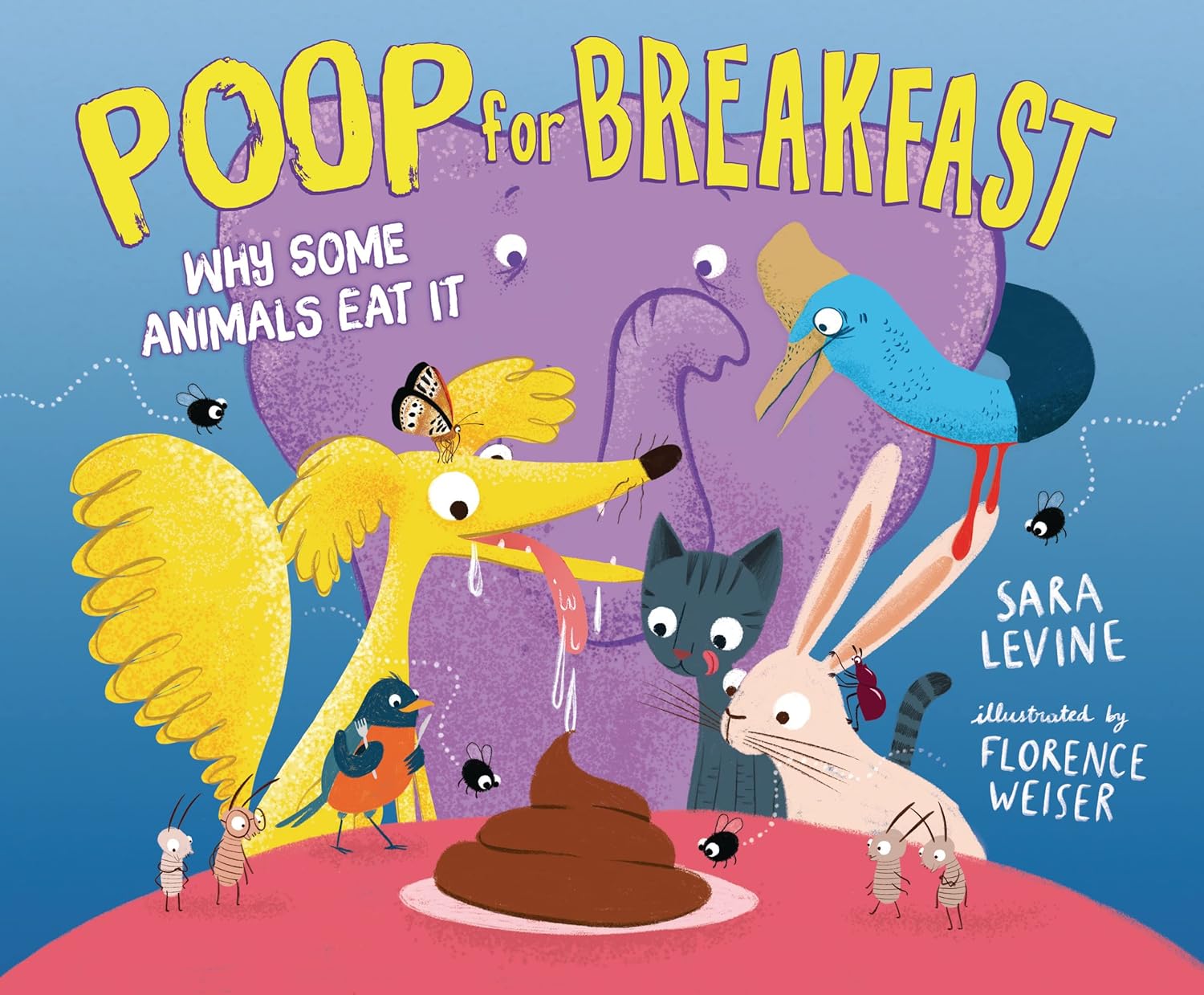
Poop for Breakfast: Why Some Animals Eat It
by Sara Levine; illus. by Florence Weiser
32 pages; ages 5-10
Millbrook Press, 2023

What’s for breakfast? Poop’s for breakfast!
Really? EWWWWWWW!

Sounds disgusting, sure – but some animals eat poop. There’s even a name for this: coprophagy. And they do it for a number of surprisingly good reasons, says Sara Levine. For butterflies, it can help make their eggs stronger. To get grass- (and leaf and bark)-digesting bacteria into their guts, baby elephants eat droppings from their mom and other members of the herd. Some animals need food to travel through their digestive system twice so they … well, you get the picture.

What I like about this book:
Each spread gives an example, and then in a sidebar provides a detailed explanation of how coprophagy is an adaptation for that animal. Final spreads show why it isn’t for humans. The language is easy to read, humorous in places, and never gets boring. Plus there is back matter that includes a visual field guide of scat and invites readers to be “poop detectives.” There's also a tongue-in-cheek textbox listing synonyms for poop. Not on the list: coprolite.

Beyond the Books:

Did you eat turkey on Thanksgiving? If it was a wild turkey it might have eaten acorns and berries, insects and snails – even a frog! And then you ate it. Can you draw a food chain for a wild turkey that ends up in your tummy?

Make something you like to eat. Maybe it’s a sandwich or pancakes, or maybe you love chocolate chip cookies. Whatever it is, help gather ingredients, measure things, mix … and definitely taste-test. Sometimes you have to test more than one (especially with cookies, right?).

You have probably seen signs of animals in your neighborhood: round pellets in the grass, maybe berry-laden scat near your garden. Wouldn’t it be great to know who was there? Here are a couple books that were written for young nature detectives: Tracks, Scats and Signs (Take Along Guides) by Leslie Dendy and Mammal Tracks and Scat: Life-Size Pocket Guide by my friend, Martha Mitchell (illustrator) and Lynn Levine.

Today we’re joining Perfect Picture Book Friday. It’s a wonderful gathering where bloggers share great picture books at Susanna Leonard Hill's website.Thanks for dropping by today. On Monday we'll be hanging out at Marvelous Middle Grade Monday with other  bloggers. It's over at Greg Pattridge's blog, Always in the Middle, so hop over to see what other people are reading. Review copies provided by the publishers.