Showing posts with label beyond-the-book. Show all posts

Friday, September 12, 2025

Crows Come Together

 
I Am We: How Crows Come Together to Survive 
by Leslie Barnard Booth; illus. by Alexandra Finkeldey 
44 pages; ages 5-8
Chronicle Books, 2025 

theme: birds, behavior, community, winter

I spill across the sky like ink—
fill the night with jagged cries.
I have one thousand eyes.

With the opening of the book we are invited into a winter flock of crows – a flock where one crow is part of the many because, as Leslie writes, “one set of eyes isn’t nearly enough.” With lyrical language she shows how the flock works together for survival. 

What I like about this book: The lovely, poetic language pulled me right in to the crow’s reality of winter survival. I love how Leslie explains that “we” is stronger than “I” – even if it is just for a night’s roost. There is a wonderful nod to the witches in Macbeth, and the recurring theme that night casts the spell that binds the birds together. The illustrations are perfect: dark, but not dreary! And there is Back Matter where curious readers can learn more about crow families, bird intelligence, social learning, and winter survival.


Every time I read a book by Leslie, I feel like she’s found a new way to tell a story. So I had to ask her One Question.

Me: How did you come to this way of telling a story about crows? And did you explore other ways of telling the story?

Photo by Kristal Passy Photography
Leslie: This story began with the concept of crows as social creatures that cooperate and collaborate to survive. I was particularly struck by the fact that crows benefit from the vigilance of other crows--by moving and resting as a flock, they can in a sense "see" with a thousand eyes. I had also been thinking, at the time I wrote this piece, about the power of cooperation more generally. We humans are inextricably bound to one another--our happiness, health, and survival depend on the actions of families, communities, and nations. Because the collective is the focus of this story, when I wrote the first draft I chose first-person plural point of view. While other aspects changed from draft to draft (I worked to add tension and create more of a narrative arc), the point of view remained consistent.

Beyond the Books:

Check out the video and activities at Leslie’s page for educators. There’s a lot to do there!

Get to know a crow. The best way is to find a place to watch them in your neighborhood, or at a park. If you want to know how to identify a crow, check out this page from Cornell’s All About Birds

Fold a paper crow. Instructions here.

Leslie is a member of #STEAMTeam2025. You can find out more about her at her website, lesliebarnardbooth.com
https://www.lesliebarnardbooth.com/

Today we’re joining Perfect Picture Book Friday. It’s a wonderful gathering where bloggers share great picture books at Susanna Leonard Hill's website. Review copy provided by the publisher.

Friday, August 22, 2025

How To Plant a Forest


The Blue Jays That Grew a Forest 
by Lynn Street; illus. by Anne Hunter 
48 pages; ages 4-8
‎Peachtree/Margaret Quinlin Books, 2025

theme: ecology, autumn, birds

How does the mighty oak create more oak trees? By making acorns.

But here’s the thing about acorns: they are heavy! (I know this because I’ve had a few fall on my head.) They are too heavy to blow on the breeze, so they plunk right down to the ground. Right under the tree. Here’s another thing about acorns: they need sun and water and room to grow. And how can they get that if they’re laying on the ground in the shade with all the other acorns? Well, if they’re from the white oaks next to my house they get picked up and moved by squirrels and birds, carried away, and buried in the ground. 

And sometimes those acorns get forgotten and they sprout into tiny oak seedlings (I know this because I’ve had more than a few grow in my vegetable patch!). 

In luscious, lyrical language, author Lynn Street pulls readers into the acorn-caching behavior of blue jays who hide their treasure – like pirates! “With their beaks, the jays tap, tap, tap the acorns into soft ground…” she writes. The jays have to move fast, because there’s competition. Squirrels, turkeys, mice, chipmunks, deer … they are gathering up acorns too.


What I like about this book: I mentioned the language. Here’s what I mean: “Back and forth— flashes of sapphire in the sun— blue white, blue white.” Even without an illustration you can picture this blue jay flapping across the sky. I like that Lynn takes us through an entire year: winter when jays dig up the acorns to eat, spring when they feed their nestlings bugs (because acorns are too big for babies…),  and fall, when the young jays join the “blue crew” and help their parents collect acorns for the winter. I like the back matter, too! More information about oak trees and jays, and how human interaction has changed the nature of oak forests. There’s also a great list of books for further reading and some websites to visit.

Lynn’s inspiration for this book came from a photo of a blue jay carrying an acorn. In addition to researching books and articles about blue jays and oaks, she spent lots of time watching jays. So I had to ask her A Couple Questions:

Me: What cool insights have you gained from the jays visiting your backyard? (ours are raucous thieves!)

Lynn: I watched blue jays in my backyard as they interacted with a pin oak just over the fence. From a second story window, I was able to see into the oak’s canopy as jays pried acorns from the tree. Over several fall seasons, I spotted more and more of this acorn gathering in real time.

I noticed, too, where the peanuts from my bird feeder were being hidden. One jay buried a peanut under leaf litter. Another time I spotted a jay leaving a peanut in the rain gutter of my neighbor’s house. I also watched a blue jay pull an acorn out from between flagstones on my patio.

Me: Jays are related to crows, and crows are pretty smart birds. How do jays exhibit their corvid intelligence?

Lynn: Blue jays are part of the corvid family, which includes crows, magpies, nutcrackers, and ravens. Blue jays are very intelligent. They have an amazing spatial memory, which helps them locate thousands of buried acorns. The blue jay that dug up an acorn from my patio knew exactly where it was hidden. It landed, plucked it out, and was flying again a few seconds later. 

Blue jays are also great mimics. Their calls can sound like a hawk, or a squeaky gate. The hawk call may alert other jays to predators nearby or trick other birds into thinking a hawk is present. I hear the hawk call often, and the jays always fool me. I look outside when I hear it, but each time it’s a blue jay perching in a nearby tree. Only one time was it a hawk circling high above my street.

In captivity—but not in the wild—blue jays have been observed using tools to rake food into their cages.

The black markings on their faces and throats (called a bridle or necklace) vary and may help the jays to tell each other apart. Do you think you can tell the blue jays at your feeder apart?
 
Beyond the Books:

Watch some blue jays this fall.  Draw a picture of what your jays look like – and make sure to note the markings on their faces and throats.

This one comes from Lynn: Watch your jay’s behavior. Is the bird eating? Is it hiding food or plucking an already buried acorn out of the ground? Blue jays move quickly, so pay close attention!

Do you have oak trees in your neighborhood? If so, get to know them. Draw a map of where the oak trees are growing. 

In the spring, look for oak sprouts. You might find one in your yard or neighbor’s garden. If it’s “in the way” ask if you can dig it up. Then put it in a pot and watch it grow,

Lynn is a member of #STEAMTeam2025. You can find out more about her at her website, lynnstreetbooks.com 

We’ll join Perfect Picture Book Friday once they resume. It’s a wonderful gathering where bloggers share great picture books at Susanna Leonard Hill's website. Review copy provided by the publisher.

Friday, August 15, 2025

Finding our "Best Buds"

I’ve been spending a lot of time in my garden this summer, and I’ve come to realize that, for me, many of the plants (and insects) in my garden have become … friends. Best Buds, even. So I’m delighted to share this book with you today. It’s not my ordinary STEM book offering, though there are plenty of stems in it. 

Best Buds 
by Becky Scharnhorst; illus. by Jiarui Jiang 
40 pages; ages 4-8
‎Margaret K. McElderry Books, 2025


theme: friendship, plants, moving

On his first day in a new town, Spencer made a friend. It was easy!

Spencer and his mom are moving into a new house, and Mom is worried about making friends. But Spencer has NO trouble finding friends. He met Fred on the first day, just sitting outside in a box under a tree, and Vera was found next to a fire hydrant.

Spencer cares for his plant friends. He takes them to the playground and to reading circle so they can hear the stories. Everywhere he goes, people ask “wouldn’t you like a real friend?” as if plants couldn’t be friends. Some days Spencer would load up his wagon with a few friends and go to the park. That’s where he meets Daisy, whose friend is much smaller and has no leaves at all!


What I like about this book
: I like how Spencer appreciates each plant’s personality: They could be “late bloomers” or shy, or even a bit wild, but it didn’t matter because he loved them anyway. As he comes to accept the differences of his plant friends, readers will accept that friendship doesn’t depend on what you look like. It’s more about accepting people – or plants – as they are.

I also love the illustrations. The detail of each plant, and the diversity pictured is just plain fun – from the front endpapers to the last – and every page in between. 


Beyond the Books:

Do you have any plant friends (trees are included)? Draw a picture of your favorite and if they don’t have a name, give them one!

If you were a plant, what kind would you be? Would you be tall? Spiky? Flowery? Would you have long, thin leaves or leaflets that are bunchy? Draw your plant portrait!

Get to know the plants growing in your neighborhood on a first-name basis! Are there tiny flowers in the grass? Are there bold, yellow dandelions growing between cracks in the sidewalk? Are there trees you’d like to get to know better? Draw a map of where your plant friends live.

Hop over to the GROG and find out more about author Becky Scharnhorst in this lovely interview with former librarian and author, Kathy Halsey.

We’ll join Perfect Picture Book Friday once they resume. It’s a wonderful gathering where bloggers share great picture books at Susanna Leonard Hill's website. A huge thank you to author Becky Scharnhorst for a review copy.

Friday, February 16, 2024

Books that Explore Volcanoes

 There are so many ways to explore volcanoes: you could hike up a dormant volcano (there are plenty hanging around North America), or fly over an active volcano. There are also plenty of ways to share your volcano discoveries: you could paint pictures, take photos, write poetry, film a video. Here are two books that take different paths up a volcano.

theme: volcanoes, geology, nature


Climbing the Volcano: A Journey in Haiku 
by Curtis Manley; illus. by Jennifer K. Mann 
48 pages; ages 4-8
Neal Porter Books, 2024

dormant volcano—
but at sunrise each day
it blazes

This book is an adventure story. Author, Curtis Manley shares a “there and back again” tale in which a family hikes up Oregon’s South Sister volcano. Along the way, we discover tiny toads, a trail of pawprints through the snow, butterflies … and what the world looks like from a raven’s point of view. 

What I like about this book: The entire story is told through a series of haiku – small snapshots of the journey. The journey extends over the course of a day, and also through different ecosystems as the family climbs above treeline. There is also back matter: more information about the South Sister volcano; things to carry with you on a mountain hike; a visual guide to the plants and animals observed along the way; and a bit about what haiku is and how you can try to write your own. They may be short, notes Curtis, but they are powerful. Also, did I mention the illustrations? They are marvelous! Make sure you peek under the dust jacket so you can see the ”undies.”

I can’t believe that I’ve had this book lost in my book basket for two years! (That’s what happens sometimes when they come as F&Gs … they are very “slouchy” and easy to lose track of) 

Volcanoes 
by Gail Gibbons 
32 pages; ages 4-8
‎Holiday House, 2022

The ground begins to rumble. Loud roars, hissing, and violent blasts are coming from deep inside the Earth. Suddenly ….

Ash, lava, rocks, and steam shoot into the air! We’ve got a volcano. Author Gail Gibbons introduces children to the inner earth layers, and what happens when a volcano breaks through the crust. Bold, bright colors will entice children to linger over the illustrations.

What I like about this book: One thing Gail does in her books is show the details. In this one she shows the tools and equipment volcanologists use as they study the volcano, maps of the tectonic plates, and an inside look at how a volcano forms. I like that she includes a list of what to do when there’s a volcano warning and an introduction to famous volcanoes. This book is so fact-filled there is no need for back matter. 

Beyond the Books:

Tour a volcano – above and inside! You can do this safely with this National Geographic video 

Create and map a volcano. Here’s a NASA video that shows how.

Last year, Lestie Barnard Booth shared her field trip to the Fagradalsfjall volcano in Iceland. You can read it here. And here is the CBS 60 Minutes video about it.

Climb a volcano – if you don’t have one nearby, hike up a mountain. What plants and animals do you see on your hike? What do you hear? What does the world look like from the top? Share what you discover by writing your own haiku or drawing a picture.

Today we’re joining Perfect Picture Book Friday. It’s a wonderful gathering where bloggers share great picture books at Susanna Leonard Hill's website. Review copies provided by the publishers.

Friday, August 25, 2023

A Little Night Science

 One day I was walking through town and I noticed a small owl napping in the crook of a branch. The tiny screech owl blended in with the tree and, had I not been looking for leaves and flowers, I probably wouldn't have seen them. I have a fondness for owls, and leave my windows open at night so I can hear their hoots and whooos. So I knew right off I just had to read this book!

Night Owl Night
By Susan Edwards Richmond; illus. by Maribel Lechuga
32 pages; ages 4-8
Charlesbridge, 2023

theme: owls, migration, scientists

In October, Mama becomes a night owl.

Not an owl with wings and huge eyes … but a person who works during the dark hours of night. That’s because Sova’s mom is a scientist who studies owls and other birds, and she needs to be out in the field when the owls are active. Sova wants to be a night owl, too. She draws owls, carries around a stuffed owl, and even creates an owl costume. Not yet, Mama tells her. Scientists must wait. Finally, Sova is old enough to join Mama in her owl research. Together they put on headlamps and walk out to the woods where (eventually) they  capture, measure, and release a saw-whet owl.


What I like about this book: I like the repetition of “scientists must wait” – whether it is for the right time, or for the owls to show up. I love Sova’s enthusiasm for owls, and her creative ways to remind Mama that she wants to be a night owl, too. I can totally see the costume she creates inspiring kids to make their own wings and bird mask. I especially like how the field science is represented: the careful measuring and weighing and banding of the owl – and the gentle release into the night. And of course, there is back matter for curious young night owls-in-training: a page about common northern forest owls, an explanation about how banding is used by scientists, and resources for learning more.

I wanted to know more about Susan Richmond and her writing process so I asked her a Couple Questions:

Me: This is your third picture book I’ve reviewed – and I want to know: when do you know you have a book idea? 

Susan: First, thank you so much for reviewing my previous books, Sue!  I really appreciate it.  
I know I’ve got a book idea - maybe partly at least - when I can’t get it out of my head! Though it often takes a while, sometimes years, before an idea finds its proper form.  For example, Bird Count I originally envisioned as a simple, seek-and-find counting book in verse! Many iterations later, with feedback from both my critique group and my editor at Peachtree, it became a community science adventure packed with birdwatching tips.  Night Owl Night, however, came to me with its complete story arc soon after my own saw-whet owl banding experience.  I had learned and felt so much in a single evening that I believed I could use a similar setting to have my audience do the same. Because I wanted the book to invite inquiry about other species of owls as well, and to teach more about the significance of banding in bird conservation, those refinements came later through additional research.  

Me:  Do you use a dummy and/or storyboard in your writing process? 

Susan: This may sound strange, but my dummy/storyboards are really in my head.  My artistic skills are very untrained, so I rarely try to sketch my ideas on paper.  Then, when I think the book is approaching a satisfying draft, I paginate the manuscript.  I’ve heard that some editors/agents don’t like to receive paginated manuscripts from authors who aren’t illustrators, but for me it’s a necessary step.  It allows me to “see” spreads and page turns, including potential “cliff hangers,” to be sure the story has  enough visual and plot interest.  Paginating also helps me with pacing and ensuring the book will “work” within a picture book format. 

Beyond the Books:

You can watch trailer for Night Owl Night, and download activity kit (a fun migration maze included!) at Susan's website.

Make an owl puppet out of a paper bag – and tell your own owl stories. Here's how.

Learn to talk like an owl. Here are some great resources from Cornell Lab of Ornithology, Audubon, and the American Bird Conservancy.

Bake an Owl pizza (no owls will be harmed in this activity!). You’ll need to make a pizza crust and have pepperoni and olives on hand for toppings. Here’s directions

Susan Edwards Richmond is a member of #STEAMTeam2023. You can find out more about her at her website.  Here’s where you can find my reviews of her other books, Bird Count and Bioblitz!: Counting Critters

We’ll join Perfect Picture Book Friday once they resume. It’s a wonderful gathering where bloggers share great picture books at Susanna Leonard Hill's website. Review copy provided by the publisher.

Friday, October 14, 2022

Meet some Peculiar Primates

Peculiar Primates: Fun Facts About These Curious Creatures 
by Debra Kempf Shumaker; illus. by Claire Powell 
32 pages; ages 4-8
‎Running Press Kids, 2022

theme: nonfiction, animals, adaptations

 All primates climb and breathe in air. 

To be a primate, you have to have certain traits: hands, hair, lungs, and a big brain. But there are so many kinds of primates, and they are all different. In this companion to Freaky, Funky Fish, Debra uses rhyme to show the diversity of primates and their behaviors. Some primates live alone, while some live in groups. Some build nests and some sleep with their family on bare branches, with their tails twined together.

What I like about this book: I love so much about this book that I’ll just start from the outside and move in. First is the jacket: so many different primates swinging, perched on limbs, grooming, hooting, leaping! And then, the actual book cover beneath the jacket. It’s a field notebook – which adds context to the endpages: a map taped to a page, a packing list, and some reminders clipped to the list. The title page is fun, as is the dedication page… and we have yet to reach the meat of the book!

I love the couplets – rhythm is spot on, and the rhymes are fun to read out loud. Primates featured on the spreads are identified, so curious young primatologists can learn their names. And some receive Peculiarity Department Ratings (on a scale of 1-10)

And there is back matter! Three pages of more info about the primates featured on each spread. Plus websites and books and videos. There’s a lot here for parents and teachers – and older kids who want to explore the field of primatology.

But what I loved the most was the last spread featuring young primates playing and building things. You don’t even have to go to a zoo to see one – just look in the mirror!

Beyond the Books:

What traits do you share with other primates?

If you live near a zoo, visit all the primates there. Spend some time watching them (are they watching you?). Write down what you observe.

Some primates use tools. What kind of tools do you use? Here’s a video of chimpanzees using tools.  

Debra is a member of #STEAMTeam2022. You can find out more about her at her website, debrashumaker.com

Today we're joining Perfect Picture Book Friday, an event where bloggers share great picture books at Susanna Leonard Hill's website. Review copy provided by the publisher.

Friday, April 1, 2022

Busy Bugs are All Around You


Hustle Bustle Bugs 
by Catherine Bailey; illus. by Lauren Eldridge 
40 pages; ages 4-8
Little, Brown Books for Young Readers, 2022

theme: insects, nature, 

Secret cities buzz and bustle /with itty-bitty hard-work hustle.

In rhyming couplets, Catherine Bailey shows bugs busy at work. Ants build a colony. Ladybugs on pest patrol. Dung beetles rolling … yeah, dung. Butterflies and bees, fireflies and caterpillars… every bug has a job to do, even if it’s a cricket crooning a tune to the moon.

What I like about this book: There is back matter! Kids – and parents – will want to know more about the insects introduced in the pages. So Catherine provides Buggy Facts, and highlights the best bits that make great sharing at the lunch table: did you know grasshoppers have ears on their bellies?

I also like the illustrations. They look like a mix of toys, like plastic insects, and landscapes.

Lauren: Yeah, but I didn’t use any toys. I made everything by hand.

Turns out that Lauren tells all about how she did the illustrations in her “Note from the Artist” at the back of the book. Because the book is about exploring the environment, she decided to incorporate as many things from the natural environment as she could: dried flowers, sticks, dirt, grass. 


me: But what about the ants and beetles and butterflies?

Lauren explains that, too. She used wire, epoxy putty, tinfoil, polymer clay, mini foam footballs, and vellum to construct the bugs. Except for the butterfly wings, she says. For those, she used yupo paper and alcohol inks. 

I’ve played around with yupo paper and alcohol inks, and it is a lot of fun! You can get some nice stained-glass effects.

To pull it all together, Lauren began by photographing the settings. Then she photographed the bugs and the human characters, and pieced several photos together to create each scene.

Usually at this point I would ask the author a question. But Catherine will be over at the GROG blog on the 20th to talk about bugs and how she came to write this book. Catch her there...

Beyond the Books:

Where do the bugs hang out in your neighborhood? Look for spider webs, ant mounds, caterpillar tents and other evidence of bug homes in your backyard or at a local park. Be careful if you find a wasp nest – wasps have sharp stingers and some of them are not averse to using them.

Spend time watching a bug. If there are ants in a line, where are they going? What are they doing? I once watched a crew of ants drag a large, dead butterfly home. Supper maybe?

Make your own Busy Bug illustration. Use clay and things from the recycling bin ( tinfoil, plastic containers) to construct a bug. Pipe cleaners come in handy – so do toothpicks and beads, grapes, raisins, tissue paper, and heavy paper. Once you’ve built a bug or two, create a scene with grass and pebbles or soil, and take a photo.

Catherine Bailey is a member of #STEAMTeam2022. You can find out more about her at her website.

Today we're joining Perfect Picture Book Friday, an event where bloggers share great picture books at Susanna Leonard Hill's website. Reviewed from a pdf provided by the author.

Monday, March 7, 2022

Celebrating Flies, party-style

 One of those warm, sunny days sandwiched between snowy storms, I noticed flies swarming above the lilac tree. Tiny flies, to be sure, but just enough to remind me that Fly Season is on its way. And by this, I don’t mean the season where you grab your waders and pole and head to the trout creek. Oh, no. I mean the time of year when cluster flies and black flies and – oh so many kinds of flies – emerge or hatch or whatever they do so they can buzz around and … bug us.

Although, to be fair, they do play an important role in the world. They help decompose dead things, pollinate flowers, and provide fast food for critters of land, sea, and air. I bring up their nutritional contributions because I’m celebrating the one-year anniversary of my picture book, 13 Ways to Eat a Fly. 

 Over at Melissa Stewart’s Info-liscious blog, I share thoughts about writing it. (Thanks for inviting me, Melissa!) 

Meanwhile, I thought that over here we'd celebrate with party favors. And since you're wherever you are and I am probably a great distance away, they are going to be Make Your Own party favors.  

So grab some paper (origami paper or recycled gift wrap – even a sheet of graph paper will do) and some scissors, markers, and glue because it's time for arts & crafts!


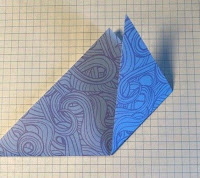
If you don’t have origami paper, cut a 6” x 6” square of paper. Then fold one corner of the square paper to the opposite corner to make a triangle.

Turn the triangle so the longest (folded) side is nearest you. Now fold the left and right corners to meet the central point of the triangle.


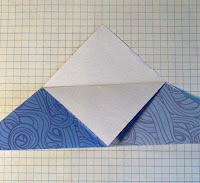
Unfold, so you have your large triangle again. Then, slide your finger between the layers of the top point. Fold the top layer down so that the point meets the center of the long, bottom side.

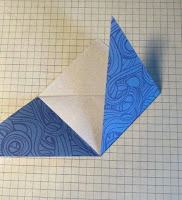
Remember that right corner you folded up and unfolded? Well, you’re going to bring it up to meet the peak of the triangle again. But this time you tuck it into the pocket, right behind the middle triangle. 


Now do the same thing with that left corner: bring it up and tuck it in. At this point it looks like a diamond. But we’ll fix that…

Bring the tip of the diamond down to the bottom corner of the triangle, and crease it. Then tuck the flap of paper inside the pocket. 


Add wings and compound eyes to turn your bookmark into a fly. Or add eyes, wings, beak, legs, and other features to turn your bookmark into a fly-eating creature. Slide your bookmark over the corner of the page and – ta-da! – you’ve got a bookmark to slide over the top corner of whatever page you want to mark.