Showing posts with label animal families. Show all posts

Friday, March 7, 2025

Animal Homes

Home is where you feel safe – and we all need a safe place to sleep, eat, and keep warm (or cool). My home probably doesn’t look like your home, and it definitely doesn’t look like a polar bear’s home. Reading these books is like doing armchair open-houses! Today's themes are: animals, home, family

Finding Home: Amazing Places Animals Live 
by Mike Unwin; illus. by Jenni Desmond 
48 pages; ages 7-9
Bloomsbury Children's Books, 2025 

If you could have any home that you wanted, what would you choose?

Once upon a time I dreamed of living in a castle. And then I had an opportunity to spend a summer in a small dome, with a sleeping loft and just enough room. So I’m always intrigued to see what sorts of housing choices other folks make. Mike Unwin shows the different sorts of homes animals make, from aardvarks to wasps and everything in between.

Readers visit a polar bear snow den, a puffin burrow, and the mobile home of a hermit crab. There are condos for the social beings – termites, wasps, weaver birds – and more solitary accommodations for the loners. There are tree houses, earthen houses, stick houses and houses built of straw.


What I like about this book: the section titles are lots of fun. “Hanging around” for the three-toed sloth who … hangs in the treetops of tropical forests. Or “All sewn up” for the tailorbirds that use plant fibers and spider silk to stitch leaves together for their nest. Main text – and there’s a page full for each species – explains how the animals build their home, raise families, and live in their environment. Supplemental text provides fun facts. 

A Home Like This (Board book )
by Laura Purdie Salas; illus. by Miriam Nerlove 
7 spreads
Creative Editions, 2025

The text and artwork show a diversity of animal homes. Some are open to the sky, some are more sheltered. Some are temporary, some are permanent. 

What I like about this book: read altogether, the pages are a poem. For each spread, illustrations show the animal and its home. The last spread includes some human dwellings amongst the wild, and emphasizes that home is where the heart is. As I was reading this book, I kept feeling as though I’d met this illustrator before. And indeed, I reviewed two of Miriam Nerlove’s board books a few years ago here on this very blog!


Beyond the Books:

Make a drawing or model of your home. If you had to explain to a rabbit or an anteater about where you live, what would you tell them?

Animals use what’s in their habitat to build their homes. Check out this video to see some of the shelters they construct. 

Walk around your yard and take stock of the natural materials you could use to build a home. It could be snow or mud, dried grass or twigs. Then collect a few of those materials and build a model nest or shelter. 

Today we’re joining Perfect Picture Book Friday. It’s a wonderful gathering where bloggers share great picture books at Susanna Leonard Hill's website. Review copies provided by the publishers.

Friday, May 3, 2024

Meet some Super Animal Dads

Superdads! Animal Heroes 
By Heather Lang & Jamie Harper 
32 pages; ages 3-7
‎Candlewick, 2024

theme: animal families, STEM

Bringing up babies in the wild is a mighty big job. Animal moms usually get the credit since they’re the ones who do most of the parenting. But some dads take the lead…

Who are these unsung dad heroes? And what do they do? Some, like the brown kiwi, incubate eggs and keep them safe until they hatch. In fact, there’s lots of dads who care for eggs: water bugs, seahorses, and frogs. Some dads hide their young by building a shelter or hiding them under his wings. Dads feed their young and some play with them and teach them life skills, such as hunting or singing.

What I like about this book:

Last year I reviewed Supermoms! so I was really looking forward to a book about dads. Heather and Jamie did not disappoint.

I like the way this author/illustrator duo presents the caretaking tasks dads do as superpowers, from child care and feeding to defending and teaching. And I like that the featured dads come from a diverse list of animals that include fish, amphibians, insects, birds, and mammals.  The cartoon illustrations are fun – like when the wolf pups play tug-of-war with dad – and the animal dialog gives readers an opportunity to stretch their role-playing skills.

And, there is Back Matter! One spread gives each superdad a chance to share a fun fact about his superpower. There’s also a list of books and online resources for curious kids to explore.

Reproduced by permission of the publisher* (full permission at bottom)

I had so much fun reading this book that I just had to ask Heather and Jamie a couple of questions:

Me: Hi Heather. I want to know how you found so many cool examples of Superdads. Can you talk about how you explored your research?

Heather: We knew from our Supermoms! research that moms do most of the parenting in the wild, so finding superdads would be more challenging. But luckily Jamie and I both love a good treasure hunt!

We began with a small list of remarkable dads that we’d discovered while working on Supermoms! Some of those came from a field trip we took to see the Museum of Science’s Nature’s Superheroes exhibit in Boston. Next, we searched the web, books, science articles, blogs, even social media. We watched webcams, YouTube videos made by nature enthusiasts, and many documentaries, including PBS Nature episodes. 

Along the way we reached out to experts for ideas, to confirm facts, and to clarify details. Sometimes this resulted in us cutting an animal. For example, contrary to what you might read, there is no real evidence that male bats nurse their young! I think reaching out to experts to fact check and ask questions is always one of our favorite research steps. Often our scientists share rich details we can add to the text or use in our back matter, and their enthusiasm is always contagious.

With a small pool of dads to choose from we worked to develop categories of parenting behavior. We landed on five: incubation, making a home, feeding, protection, and play. Then we played around with different combinations of animals in each category. We asked ourselves whether the facts were sufficiently different? Did they show a variety of parenting strategies and ecosystems? Which could lead to the funniest images and speech bubbles? What would look the best? It was a complex puzzle, but perhaps made easier by the fact that there were fewer dads to choose from. 

Me: This one’s for Jamie. What goes into deciding how to present illustrations on the page? In Superdads, pages are divided into panels, like a comic book. 

Jamie: Using a comic-book style was a new experiment for me, and a fun one because it gave me the opportunity to show an action happening over a period of time and not just in a single moment. In a way, moving from one panel to the next provides a pause, in the same way turning the page does. Those pauses allow for so much play like creating a surprise, exaggerating an emotion, extending the story, or simply allowing the reader to take a breath. It’s tricky, that’s for sure, but it gives you lots of extra tools when illustrating a book. I got to practice using multiple panels in Supermoms!, which let me loose to challenge myself further when making Superdads. I do wonder… will it be tough to return to illustrating a book, that doesn’t have this “comic book” format?!?

Me: Enquiring minds want to know - Is there a Superkids book in the works? 

Heather & Jamie: What a terrific idea! Actually, we do have some superkids in our next book in the series . . . Supersquads! (coming in 2025). Making these books together has been one giant collaboration, so writing a book about animals that team up in the wild seemed like the perfect choice!

Beyond the Books:

Observe some animal superdads. Some of the easiest to watch are birds. You might see them collecting nesting material or defending their territory by singing and chasing other birds. Do they help keep eggs warm? And can you catch them bringing home take-out meals for the chicks?

Do you have a parent, grandparent, or close relative with “superpowers?” What are they?

Think about the kinds of superpowers you have. You might have super-friendship abilities, a super-imagination, or you’re super-creative. (I once thought I could fly if I practiced. It didn’t work…)

Heather and Jamie are members of #STEAMTeam2024. You can find out more about Heather at her website, www.heatherlangbooks.com Learn more about Jamie at her website, www.jamieharper.com. They both are active on Instagram, Twitter, and on Facebook.

Today we’re joining Perfect Picture Book Friday. It’s a wonderful gathering where bloggers share great picture books at Susanna Leonard Hill's website. Review copy provided by the publisher.

* SUPERDADS! ANIMAL HEROES. Text copyright © 2024 by Heather Lang and Jamie Harper. Illustrations copyright © 2024 by Jamie Harper. Reproduced by permission of the publisher, Candlewick Press, Somerville, MA.

Friday, April 26, 2024

The Wolves of Yellowstone

 Aha! I’ve found a stash of wolf books in my basket. I’m sharing two of them today, both about wolves reintroduced into Yellowstone National Park. They are great stories to share during Earth Week.

theme: environment, wolves, animal behavior

The Unlikely Hero: The Story of Wolf 8 (A Young Readers' Edition) 
by Rick McIntyre and David A. Poulsen; illus. by John Potter
120 pages; ages 9-12
Greystone Kids, 2024

This is the first book in the Chronicles of the Yellowstone Wolves series and is based on Rick McIntyre’s research and sightings of Wolf 8 when he worked for the national park. Written as close to a wolf’s perspective as possible, this story tells how Wolf 8 struggled as a pup after his family was captured from the wild and introduced to their new home: Yellowstone. It is by turns an adventure tale and a tale of scientific discovery. And while no one can truly know what a wolf thinks, after 44 years of wolf-observation Rick might just come close enough.

Readers follow Wolf 8 as he grows, plays – and fights – with his brothers, and eventually moves away to a new family. We watch him as a father teaching his own pups to hunt, and defending his new pack against other wolves as well as buffalo and grizzlies. The book is filled with a wealth of sound scientific information on wolf behavior and sidebars through which Rick explains how he and other wildlife scientists come to understand the wolves.

If you like stories about underdogs, this one’s for you! 

The Wolves of Yellowstone: A Rewilding Stor
by Catherine Barr; illus. by Jenni Desmond
48 pages; ages 5-8 (and older)
‎Bloomsbury Children’s Books, 2022

Yellowstone National Park is home to nearly 2,000 different kinds of wildlife. Birds, fish, elk, bison. Lynx, mountain lions, bears, coyotes. And wolves – at least now there are wolves. Not too long ago it was a place without wolves. Hunters shot wolves if they chased cattle. The US government didn’t interfere with the wolf hunts, and in 1926 the last wolf was killed.

And then things got out of hand. Without wolves, the elk population grew. And grew. And grew. Their grazing changed the habitat, and other animals left. In 1995 Yellowstone made the decision to reintroduce wolves to the park. First, though, they had to trap the wolves. Then they penned them in enclosures so the wolves wouldn’t try to return to their Canadian homes. Finally, after 10 weeks or so, they released the wolves into the wildest parts of the national park.

With the return of the wolves, something started to happen. The elk population declined, and other animals increased their presence in the park. As the number of elk went down, grass had a chance to grow, and trees reappeared along riverbanks. Trees provided habitat for songbirds. Reintroducing wolves created a chain of positive impacts on the ecosystem.

Here’s what I like about this book: The endpapers. The front one, filled with elk tracks; the back one with wolf tracks and hummocks of grasses. I love the illustrations and the section on “how nature works” and there’s a lot of information about wolf life and behavior in this book. If I could change one thing it would be to make the text larger and, on the dark pages, give it more contrast to make it easier to read.

Beyond the Books:

Read: Learn all about the wolves at this Yellowstone National Park page

Watch: 60-Minutes story on the Yellowstone wolves and a PBS (short) video on wolves

Observe: Visit a zoo (or Yellowstone National Park) where you can watch wolves. The Yellowstone wolves are gray wolves, but some zoos have red wolves. Both are interesting to watch.

Draw a picture of a wolf. Compare it to a dog you know … what similarities do you notice? What differences?

Today we’re joining Perfect Picture Book Friday. It’s a wonderful gathering where bloggers share great picture books at Susanna Leonard Hill's website

On Monday we'll be hanging out at Marvelous Middle Grade Monday with other  bloggers. It's over at Greg Pattridge's blog, Always in the Middle, so hop over to see what other people are reading. Review copies provided by the publishers.


Friday, July 7, 2023

These Books are For the Birds!

Every morning the birds wake me up: robins and mourning doves, jays and crows. Loudest of all is a tiny phoebe, its feathers still ruffled from sleep. So when I discovered these books nesting in my book basket, I knew I had to get them out to sing their “good morning” songs.

themes: birds, animal behavior, family

Finding Family: The Duckling Raised by Loons 
by Laura Purdie Salas; illus. by Alexandria Neonakis
32 pages; ages 5-10
Millbrook Press, 2023 

Perched on the edge of a northern lake, a nest of dried mud and grass cradles two eggs.

If all goes well, those olive-colored, black-splotched eggs will hatch into baby loons. But one stormy day, when the loon parents return to the nest, they find broken shells and only one single chick. The chick grows and changes and soon it’s clear this chick is not a loon chick. It’s a mallard duckling! Now, mallards and loons are not related. They aren’t good friends – more like enemies … and yet these parent loons and duckling create a family. Throughout the book, Laura Purdie Salas contrasts how loons and ducks behave – and how this young duckling learns loon behavior.

What I like about this book: This is an engaging story to begin with, and I love the way Laura shows how the duckling learned loon things – diving for food, eating fish – and still did its own ducky things. I like that she asks questions: what made loons raise a lost duckling? How did the duckling learn loon behaviors? Will the duck ever find a mate? And I like how she emphasizes the importance of family. Plus there is Back Matter! Laura tells about the true story and presents a Venn diagram comparing loons and mallards.

How Birds Sleep
by Sarah Pedry and David Obuchowski
40 pages; ages 4-8
‎minedition (Astra), 2023

It’s dusk. Unless you’re an owl, it’s time to get ready for sleep. 

As the sun sets, birds all over the world are getting ready to snooze. Some settle in bunches, perched in a line on a tree branch. Others hang upside down. Some nest in trees, while others snuggle together at the end of a tunnel in a termite mound. And some never land, sleeping in the air as they glide.

What I like about this book: The illustrations are luscious, done in shades of blue that evoke night. Each bird is identified by common name, scientific name, and a location – which makes it easier for curious naturalists to find out more about a bird that piques their interest. And the language is perfect for a go-to-sleep book, with nests described as cozy and safe, or pillowy-soft, or waves rocking the birds to sleep. Yaawwn! Just don't fall asleep reading!

Swoop and Soar: How Science Rescued Two Osprey Orphans and Found Them A New Family In The Wild 
by Deborah Lee Rose and Jane Veltkamp 
54 pages; ages 5-12
Persnickety Press, 2022

High above the dark blue water, a sharp-beaked osprey hovered in the morning sky.

Father osprey is fishing for his chicks. But when a storm knocks down their tree, the baby birds need help. That help comes in the form of Janie, a raptor biologist who has rescued many ospreys. Her idea: foster the osprey chicks with a pair of osprey that had lost their own. This book follows the story of how Janie Veltkamp helped create a new osprey family, and shows the chicks, Swoop and Soar, growing up in their new nest. 

What I like about this book: In addition to Swoop and Soar’s story, Janie tells what it’s like to rescue ospreys and reintroduce them into habitats. There’s a section all about Ospreys where readers can learn more about osprey adaptations, where they nest, and why they became endangered. There’s even a list of how you can help the ospreys.

Beyond the Books:

What sorts of things would you learn if you were adopted by a different animal (or an alien)? Think about the way you find food, what you eat, the way you might play together. Then check out this video of the loons with their adopted duckling.

How do you sleep? Do you make a nest? Or snuggle in with others? One thing that you can do to help birds sleep is to make sure you turn of outdoor lights at night.

What makes a family? One book shows loons adopting a duckling, and another shows how a wildlife rehabilitator was able to help osprey chicks bond with new parents. Draw a picture or write a poem about what makes the people – and animals you live with – your Family.

We’ll join Perfect Picture Book Friday once they resume. It’s a wonderful gathering where bloggers share great picture books at Susanna Leonard Hill's website. On Monday we'll be hanging out at Marvelous Middle Grade Monday with other  bloggers. It's over at Greg Pattridge's blog, Always in the Middle, so hop over to see what other people are reading. Review copies provided by the publishers.

Friday, March 10, 2023

Animal Moms have Superpowers!

 
Supermoms! Animal Heroes 
by Heather Lang & Jamie Harper; illus. by Jamie Harper 
40 pages; ages 3-7
Candlewick, 2023 

theme: animal families, STEM

Supermoms are everywhere. They come in all shapes, sizes, colors, and species.

Like other superheroes, Supermoms have different sorts of superpowers. Some make safe burrows and other comfy places to live – and hide from predators. Some make sure that siblings are separated so they don’t eat each other. Other supermoms focus on meals – some making lengthy treks to get enough food to feed their young. And some supermoms are fierce fighters, doing what it takes to protect their babies.

What I like about this book: I like the many different superpowers that different animal moms have: super hardworking, super protective, super smart, super strong… The list is long and diverse and includes mammals, reptiles, birds, fish, amphibians, and mollusks. 

I like the fun cartoon illustrations and the dialog balloons that give the youngsters voice. For example, when the bat mom carries her pup on her chest while she flies, the pup begs her to do the “dip of death” – in much the same way a kid might beg to be tossed in the air and caught.

And, there is Back Matter! One spread gives each supermom a chance to share a fun fact about her superpower. There’s also a list of books and online resources for curious kids to explore.

I had so much fun reading this book that I just had to ask Heather and Jamie a couple of questions. Okay, so maybe I asked them Three Questions.

Me: So Heather, you mentioned reading Harriet the Spy to prepare for a life of spywork. But that job didn’t pan out. How did Harriet the Spy prepare you for a life of writing children’s books? 

Heather: It’s true! I wanted to be just like Harriet or Nancy Drew—smart, fearless, and independent. Who knew those childhood fantasies could be fulfilled writing nonfiction for kids! 

Of course, good detective work requires lots of fact-finding missions with clues, dead ends, and many twists and turns. Google searches, even on seemingly reputable websites, are rarely sufficient. I especially love learning from experts. I never know what treasures they’ll share, and I always come away even more excited about my topic, often with new leads to investigate. For Supermoms! our experts were critical. They confirmed facts, resolved conflicting information, and shared rich details we could add to the text or use in our back matter.

To make sure my detective work is up to Nancy Drew standards, I try to find ways to experience what I’m writing about. I’ve gone swimming with sharks, paraglided off the top of a mountain, explored the treetops of the Amazon, gone on a safari in the Serengeti, and most recently, hiked deep into the rainforests of Madagascar in search of endangered lemurs. Whether I’m shadowing a scientist, observing an animal, or soaking up sensory details, those adventures enrich my writing in countless ways.

Me: Now I’ve got a question for Jamie. Can you talk about the research you did? 

Jamie: I knew I would love doing research for Supermoms! because I had a small taste of it when I made the four Miss Mingo books. They were fiction titles, but factoids were included throughout each one. I know you can’t rely on the web alone, but I was amazed by how much conflicting information I found. That led to my reading scientific articles on Google Scholar and to reaching out to experts on particular species. They were generous with their time and in sharing their knowledge. Take Ad Konings, a guru on all things cichlid. He helped me find just the right cichlid with just the right colors, and identified the perfect, ugliest cichlid predator to use in the book. He was a terrific resource and teacher.

To become familiar with the animal's anatomy and how they move, I started watching videos on YouTube, the Nature Series on PBS (there have to be hundreds of episodes and I haven’t seen them all yet), plus the huge collection of animal documentaries streaming on Apple TV, Disney and National Geographic. Another new and exciting research tool was drawing animals live on a platform provided on Instagram. For two hours, I drew orangutans while watching them in their natural habitat—good practice for creating my orangutans in Supermoms!


Me: So what are your Supermom powers?

Heather: Looking back, I think my powers evolved as my kids got older and needed different things from me. Perhaps I’m super flexible like our mama giraffe on the cover. Raising triplets plus another little one, I needed to be super patient, and changing up to thirty-five diapers a day, I will say I was super hardworking! As the kids grew, I was always looking for super creative, hands-on projects to entertain them. The teenage years were the most challenging—finding that balance between guiding them and letting them go off and make their own mistakes. I always strove to be super sensible (although sometimes my super protective nature got the best of me). These days, I’m super grateful to have four kind and wonderful adult kids, whom I adore.

Jamie: I wish I could say that I share the same powers as our supermoms! I have three girls who are all grown up now and living their own lives. I’d like to believe I raised them with lots of love, kindness, and respect. And that I was patient, a good listener and consistent in my parenting. But those really aren’t special powers—so I’m wondering, do I have any special powers? I’m a baker and I always have the freezer stocked with the girls’ favorite baked treats just in case they pop home. I’m a communicator so I let my girls know regularly that I’m available—to talk, to listen, or to get together. Now that I think about it some more, I do have something in common with the supermoms in the book. Like the penguin, I too would travel for weeks and weeks to get food for my baby chicks. . . if the food was homemade ice cream and I could get it back home without melting.

Beyond the Books:

Find out how mother animals (and sometimes father animals) care for their young. One way is to read a book or article. Another way is to watch animal families: ducks at a neighborhood park, or cats, or even animals at a zoo.

Do you have a supermom (or super grandma)? What are her superpowers? My mom had eyes on the back of her head, and she could freeze us motionless with her stare of doom.

Heather and Jamie are members of #STEAMTeam2023. You can find out more about Heather at her website, www.heatherlangbooks.com. Learn more about Jamie at her website, www.jamieharper.com. They both are active on Instagram, Twitter, and on Facebook.

Today we’re joining Perfect Picture Book Friday. It’s a wonderful gathering where bloggers share great picture books at Susanna Leonard Hill’s website. Review copy provided by the publisher.

Friday, February 3, 2023

Tree Hollows Make Cozy Hiding Places

 Ages ago, when I was in fourth grade (I think), I read My Side of the Mountain by Jean Craighead George. The cover was a simple line drawing of a boy with a hawk perched on his shoulder, but inside was a detailed tale of a kid who lived off the land. He made his home inside a hollow tree and used the library to learn all about edible weeds. I wanted to live inside a tree, too – it sounded so cozy. 

I wasn’t the only one. After reading her copy of the book, Melissa Stewart also wanted to make a home inside a hollow tree. And the seeds for Tree Hole Homes were planted. Time passed, and she forgot about the book until … on a visit to Vancouver Island, Canada, she spotted a tree with a hole big enough for her to squeeze inside.

So she did. 

It was then, as she looked up into the hollow tree, that she knew she’d write a book about tree hole homes. The thing about writing books – and growing trees – is that they both take time. That serendipitous visit to Vancouver Island happened in 2011. Melissa’s book came out in October, 2022. In between those years, Melissa filled up notebooks with tree hole observations.

Tree Hole Homes: Daytime Dens and Nighttime Nooks 
by Melissa Stewart; illus. by Amy Hevron 
40 pages; ages 4-8
‎Random House Studio, 2022

theme: nature, animals, trees

Imagine this: One day while walking in the woods, you spot a towering tree with a hole big enough to slip inside. 

So you do.

From birds to squirrels, frogs to bears, many animals use tree hollows as a place to nest, rest, or just escape the world for a bit. A tree home can be calm and quiet – a place for a fisher to sleep during the day. Or it can be filled to the brim with activity, as cubs and kits and hatchlings explore their world. 

There is so much I like about this book, beginning with the endpapers! The first endpaper shows a child with a backpack walking toward a tree. There’s a spread before the title page where we see the child sitting inside that tree. They look so cozy and content! You meet them later in the book and also on the back endpaper.

I like the layout of the pages. Large text presents a big idea: a tree hole home could be large or small. Smaller text provides information about the featured animal (or two) that live in those holes. Here’s am example of the spread explaining just how busy a tree hole home can be, with seven little ones to care for. (I particularly like this spread because the raccoon kits are checking out the fungi growing on the tree!)

  
And of course I love that there is back matter. Three pages provide the vital statistics about the tree hole dwellers featured in the book: their scientific name, where they live, what they eat, and a fun fact. Plus there is a list of books for curious kids (and adults) who want to learn more about animal homes.

Beyond the Books:

Head over to Melissa’s website and check out the videos about Tree Hole Homes. There’s a fun video about how Amy created the art for this book by painting on wood (and leaving some of the wood grain showing). You can find a link to a Reader’s Theater here.

Read more about tree hollow habitats in this article published by the Concord Monitor

Go on a tree hollow scavenger hunt. Look for:
  •  A hole high in a tree
  • A hole low to the ground
  • A hole made by a limb that fell
  • A hole made by an animal
  • An old hollow
  • A new hole or hollow
  • Small holes in a tree
  • A large hole
  • Holes that look like they were made while seeking food
  • A hole used as a nesting or resting place
Adopt a tree hollow. Visit it every month and keep track of the activity in and around it. You’ll need a notebook, pencil, maybe binoculars, and something to sit on – choose a place where you can sit quietly, hidden from view.

Melissa is a member of #STEAMTeam2023. You can find out more about her at her website.

Today we're joining Perfect Picture Book Friday. It’s a wonderful gathering where bloggers share great picture books at Susanna Leonard Hill's website. Review copy from my local library system.

Friday, April 22, 2022

A Lullaby for Endangered Babies


Where the Wee Ones Go: A Bedtime Wish for Endangered Animals  
by Karen Jameson; illus. by Zosienka 
36 pages; ages 3-5
‎Chronicle Books, 2022

theme: animals, sleep, conservation


When the stars are out and the moon’s above, 
where do the wee ones go, my love?
Where do the wee ones go?

The sweet lullaby that is this book takes children around the world to see how baby animals go to bed. An orangutan baby snuggles on its mama’s chest, a koala cozies up in mother’s pouch, and a condor chick is safely wedged on a rocky ledge. From rainforest caves to savannah plains to rocky cliffs high above the ocean, each baby animal has a warm, safe place to fall asleep.

What I like about this book: The text is so lyrical it is like reading a lullaby. These gentle rhymes will rock even the most reluctant youngster to sleep. Whether it’s an otter mom and babe drifting hand-in-hand upon the ocean swells or baby hippos draped across their mothers’ backs, the gentle rhythm and rhyme will sooth the savage beast. 

The illustrations are filled with soft colors and soft edges. Images add details about the habitats, such as strands of leafy seaweeds wrapped around the otters. 

This is a perfect book for Earth Day – or any day – as it spotlights the bedtime rituals of some of the most endangered animals on our planet. While there is a brief author’s note on the copyright page, I was left wishing for back matter. 

Karen was kind enough to answer One Question:

me: Can you talk about how you chose which endangered animals to feature in the book? 

Karen: My research started with a world map of endangered animals from the San Diego Zoo website.  I wanted to represent a variety of animal classifications - mammals, birds, reptiles, etc. - from around the globe.  Geography and habitats were purposefully woven into the stanzas to give a true sense of the animals' homes in the wild. Of course, being a bedtime book for young children, the animals' diverse sleep habits were key, as well. From otters wrapping their babies in kelp, to condors perched high on rocky ledges, and polar bears in dens of snow, each animal has its own unique way of sleeping.

Beyond the Books:

How do the animals living around you go to sleep? Maybe you have pets… or there are squirrels and birds that live in your backyard or neighborhood. What sorts of nests and beds to they make?

What is your going-to-sleep ritual? And what sort of warm and safe nest do you go to sleep in?

Karen is a member of #STEAMTeam2022. You can find out more about her at her website.

Today we're joining Perfect Picture Book Friday, an event where bloggers share great picture books at Susanna Leonard Hill's website. Review copy provided by the publisher.

Friday, January 28, 2022

What's a Wombat?


Wombat 
by Christopher Cheng; illus. by Liz Duthie 
32 pages; ages 5-9
Candlewick, 2021  

theme: animals, nature, nonfiction

Far underground, where dirt and tree roots mesh, tunnels lead to a burrow.

That’s where wombat lives. Wombat is a nocturnal marsupial, so she becomes active as day fades into night. We follow her as she ambles along her well-worn path on a mission to find breakfast. We watch as she excavates a burrow. And we find where she has left her cube-shaped poop on a rock – it’s her way of marking her territory, so stay out if you’re another wombat!

Wombats may look soft and cuddly, but you don’t want to tangle with them. They have sharp teeth, strong limbs that they use to shovel dirt like bulldozers, and bony bottoms they use to defend their burrows.

What I like about this book: It’s fun to tag along with Wombat on her daily rounds – where we see the world through her point of view. Sidebars add additional information, and there’s additional information at the back. There’s a handy index at the back that makes it easy to look up information more quickly. 


Beyond the Books:

Learn more about Wombats. Here’s an article about wombats, and here’s a video, and here’s an article about how they can produce poop cubes. Because, yes – scientists wanted to know.

Make a Wombat mask. Use cereal box or paper plate to make a stiff face – add ears, draw on a nose, and remember to cut out holes for your eyes. Tie it on with yarn and go off on a wombat adventure.

Learn how to talk like a wombat. They are generally quiet, but make a variety of sounds such as the soft grunts and loud raspy calls you can hear on this video.

Today we're joining Perfect Picture Book Friday, an event where bloggers share great picture books at Susanna Leonard Hill's website. Review copy provided by the publisher.

Friday, January 14, 2022

Life in the Very Slooooow Lane


The Secret Life of the Sloth
by Laurence Pringle; illus. by Kate Garchinsky 
32 pages; ages 6-9
‎Boyds Mills Press, 2021

theme: animal families, rainforest, nonfiction

Perezoso swims. She swims across a narrow river to reach a place in the rainforest where she knows there are tree leaves she likes to eat.

Perezoso is a three-fingered sloth who spends her life in the trees. Readers will travel with her as she searches for food, escapes the clutches of a harpy eagle, and gives birth to a baby.

What I like about this book: Perezoso’s secret life high in the rainforest canopy fits in well with Pringle’s other books in the “secret life” series. He provides details that you might not otherwise ponder. For example: sloths have weak back legs. So when she is on the ground, she needs to have strong front arms that can pull her along on her belly. And algae grows on her hair. And moths and beetles and other tiny creatures make their home in her fur – some of them snacking on the algae.

I like that this book ends the same way it begins – with Perezoso swimming in the river. And there is Back Matter! (You know I love back matter) This is where we learn what the sloth’s name means, and about fossils of giant sloths, and how hanging upside down affects the internal anatomy of an animal. We also learn how the slow, secret life of sloths is threatened by humans.

Beyond the Books:

Find out more about the brown-throated three-toed sloth. Here’s an article, and here’s another.

Get to know a sloth. One way is to visit a zoo where sloths live. Observe the sloth for a while. What kind of sloth is it? What is it doing? If it’s moving, figure out how long it takes to travel a certain distance.

Move like a sloth. Need inspiration? Here’s a video to get you moving… very …. slowly.

Today we're joining Perfect Picture Book Friday, an event where bloggers share great picture books at Susanna Leonard Hill's website. Review copy provided by the publisher.

Friday, January 7, 2022

We are all part of the Circle of Life

 I'm doing something new this year: adding a Monday blog post. It will be a place to talk about writing, share inspiration, and even feature some guest authors and illustrators. Drop by Monday and join me. And now, back to our regularly scheduled book review.
 
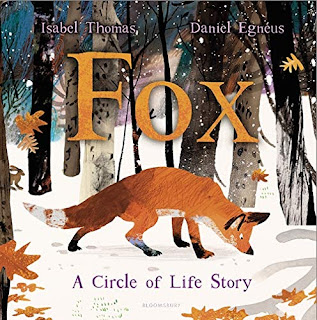
Fox: A Circle of Life Story 
by Isabel Thomas; illus. by Daniel Egnéus
48 pages; ages 5-7
Bloomsbury Children's Books, 2021

theme: life, nature, death

The ground is frozen. The branches are bare. Dead leaves crunch underfoot. But look closely….

… and you will find life stirring in the shadows. A squirrel maybe? A bird? In this book, it’s a fox hunting supper for her cubs. Over time we see the young foxes grow, play, begin to hunt on their own. They are part of the circle of life.

We also watch mama fox, killed in an accident, in her own journey in the circle of life. Leaves cover her. Birds and beetles get to work, laying eggs “where they know brand-new life can grow.” Over time, particles that were once part of fox find a new place in the world.

What I like about this book: I like how Isabel Thomas embraces a huge question: what happens when an animal dies? By focusing on a single animal, fox, she shows the cycle of life: birth, growth, death, and how the decomposition of the fox provides for new life. I like the language. As mama fox hunts a rabbit, we see her ears stiffen, and then she leaps! As the cubs grow, they somersault and tumble, leap at insects, chase each other. And there is Back Matter! That’s where curious kids (and parents seeking ways to help answer tough questions) can find out more about the building blocks of life, decomposition, and how death is a natural part of the cycle of life. “Death,” writes Isabel, “is the end of one life, but it is also the beginning of many more.” 

Beyond the Books:

What sort of rituals do people use to mark our life cycle? How does your family celebrate birth? How do you honor growth and aging? Do you have special observances for remembering people who have died?

Observe the life cycle of a plant. Watch how a plant grows through the season. Trees flower, grow leaves, then lose their leaves in the fall. What happens to those leaves over winter? Eventually they decay, providing nutrients to the soil.  

Pay attention to scavengers in nature. Next time you come across a dead bug – or a worm or frog – take a moment to look around. Are there ants or beetles (or even birds) carrying off parts for a meal? Note the location and time, and check back later. Is the bug or frog still there? How long does it take the “clean-up” crew to remove it? 

Today we're joining Perfect Picture Book Friday, an event where bloggers share great picture books at Susanna Leonard Hill's website. Review copy provided by the publisher.

Friday, August 28, 2020

You Can Be a Primatologist

You Can Be a Primatologist: Exploring Monkeys and Apes with Dr. Jill Pruetz 
by Jill Pruetz
32 pages; ages 4 - 8
National Geographic Children's Books, 2020

theme: animals, scientists, families

Hi! My name is Jill Pruetz, and I’m a primatologist.

Primatologists study primates, including monkeys, lemurs, and chimps. Dr. Pruetz studies chimpanzees on the African savanna, and shares tips for future primatologists. She talks about what a typical day in the field is like, what chimps like to eat, and how she observes their behaviors. All that observation means a lot of note-taking.

Dr. P asks questions, such as: how do her chimps make and use tools for hunting? and do they remember you? There’s a spread showing the stuff she carries with her into the field, and a great section on how studying primates helps protect them. And she ends with tips for how you can become a primatologist.

What I like about this book: I love the photos and how close Dr. P gets us to the chimps. And I really liked her response to the question, “does your job ever get boring?”


Beyond the Books:

Find out more about Dr. P’s research. You can read her blog posts here, and meet the members of her chimp group here.

Learn more about primates by reading a book or articles about them. Here is one place to start.

If you want to be a primatologist, you have to be good at observing and recording what animals do. So grab a notebook and binoculars (if you need them) and find an animal to observe: neighborhood squirrels, your cat or dog, birds in the trees – even ants. Write down what they do and how they do it.

Today we're joining Perfect Picture Book Friday, an event where bloggers share great picture books at Susanna Leonard Hill's website. Review copy provided by the publisher.

Friday, March 13, 2020

Get Ready for Nesting Time!

Spring is on its way, and that means songbirds will be winging their way back to their favorite nest-building sites. To celebrate that, I'm sharing Randi's newly-hatched book:

The Nest That Wren Built  
by Randi Sonenshine; illus. by Anne Hunter
32 pages; ages 4 - 8
Candlewick, 2020

theme: birds, animal families, homes

These are the twigs, dried in the sun, that Papa collected one by one to cradle the nest that Wren built.

Page-by-page, verse-by-verse we watch Wren and her mate make their nest from things found in the forest. Twigs, moss, feathers, thread – all used to make the nest. And then… there are eggs and, soon, a family safely together in the homey nest.

What I like love about this book: The text is rhythmic, patterned on “The House that Jack Built” and fun to read. It’s clear that author, Randi Sonenshine has closely studied what goes into a wren nest, and reveals each treasure in such a delightful way.  Anne Hunter’s ink-and-colored pencil illustrations bring softness and warmth to each page.


And there is Back Matter! Wren facts for curious readers and a brief glossary that clarifies words used in the text – perfect for kids who want to know the difference between a hatchling, a nestling, and a fledgling.

Does Randi love wrens? I caught up with her the other week to ask her that Exact Question!

Randi: As you can probably guess, I love birds! They are such fascinating, entertaining creatures. I love photographing them, listening to them, and watching all their avian drama unfold at my feeder and in my yard. I hate to say I have favorites, but, alas, I do! Carolina wrens have captured my heart. They are tiny, but sassy, smart, and steady; they are always nearby. Even if I don't see them, I hear them... singing, scolding, and sometimes warning each other.

One spring, a pair of them built a nest inside a bike helmet in my garage. Later that season, they built one inside a cloth grocery bag on a shelf in the garage. This astounded me. Later, when I looked at the abandoned nests, I was intrigued and impressed by the ingenious design and the assortment of nesting materials they used, so I started to research (a little obsessively, actually!). I discovered the most amazing details in my research, particularly the scientific facts and theories regarding their choice of nesting materials. I knew this had to be a subject of a picture book, but I wasn't sure how to frame it. Then one morning I woke up with the title in my head, and that was it!

Beyond the Books:

Get to know the wrens who live in your neighborhood. What they lack in size and flashiness, they make up for with their big personalities. Check out this article by Audubon, and this page from Cornell.

Listen for wren calls. Here’s a house wren, and here’s a Carolina wren.

If you were a bird, what kind of nest would you build? Collect some materials and build a nest.

Want to help nesting birds? Here’s how.

Randi Sonenshine is a member of #STEAMTeam2020. You can find out more about her at her website.

Today we're joining Perfect Picture Book Friday, an event where bloggers share great picture books at Susanna Leonard Hill's website. Review copy provided by the publisher.


Friday, December 6, 2019

Growing Up Gorilla ~ Blog Tour Stop

Growing Up Gorilla
by Clare Hodgson Meeker
48 pages; ages 8-12
Millbrook Press, 2019

The subtitle says it all; this is a book about “how a zoo baby brought her family together.”  As the book opens, we meet Nadiri, a 19-year old gorilla preparing to give birth. She’s gathered a thick nest of hay around her, but when her baby is born she has no idea of how to respond and care for a tiny baby.

The keepers and staff at the Woodland Park Zoo were committed to having Nadiri raise her baby. But they were also ready for the possibility that she might not embrace motherhood immediately, because Nadiri had been rejected by her own mother and was hand-raised. So while they began caring for the new baby gorilla, they were determined to help Nadiri bond with baby Yola in a safe, non-threatening environment.

What I like about this book: Reading this book gives you a front row seat into what goes on behind the scenes in a zoo. Author, Clare Meeker takes us into the gorilla dens, introduces us to the other gorillas that become family, and shows us the love and dedication of the zoo staff. There’s also plenty of back matter so kids can see how humans compare with gorillas (we share 97.7% of the same genes), and some of the ways people are working to protect gorillas and their habitat.

Clare graciously shared her thoughts during a phone conversation a couple weeks ago. She admits to having a deep love for animal stories. Clare has written a passel of books, including one about an otter and another about rhino rescues. She’s also written a number of animal stories for magazines. Some stories, she said, take longer than others, and this one has been simmering on the back burner of her mind for the past twenty years.

Archimedes: That seems like a long germination time for a story.

Clare: I was working on another book, Hansa, about a baby elephant, and met Harmony Frazier, who has been caring for baby Nadiri at the time. When I saw a photo of the two of them, I thought it would make a great story. But it would have focused on hand-raising a baby gorilla. Fast-forward twenty years and times have changed. Now the Harmony and the team of keepers had a plan. Nadiri had practiced mothering skills with a burlap doll. Still, she was so nervous when faced with caring for her actual baby. Even though the keepers stepped in to begin baby care, they knew that they wanted to raise this baby, Yola, in a gorilla-centered environment. And the beauty of this book is that I could talk about how things had changed for the good, as the keepers focused on helping Nadiri and Yola bond.

Archimedes: It feels like you were right in the cage with Yola. What sort of research did you do?

Clare: Yola was born in November of 2015, and I began doing research not even knowing if she would stay at the Woodland Park Zoo. I’d read a book about the Columbus zoo’s surrogacy program, and asked if I could talk with Barbara Jones and Maureen Casale, the coordinators of that program. They graciously answered all my questions about baby gorilla care without the certainty of knowing whether I would have a book. I spent time at the zoo, watching the gorillas, watching them make nests and engage in outdoor activities. And numerous interviews [note: nearly two-years-worth!] One thing I’ve noticed about the gorilla keepers is that they truly love their animals and are totally dedicated to their care.

Before disconnecting, she talked a bit about where she gets her ideas. Often they come from a chance meeting. One day, driving through Seattle, Clare saw a billboard that inspired her first book, A Tale of Two Rice Birds. Her advice: be open to ideas no matter where they come from.

Thank you for joining us today, Clare. You can find out more about Clare Meeker and her books at her website. If you missed any of the stops on her blog tour, here’s the schedule.


Today we're joining other book bloggers over at STEM Friday, where you can discover other cool STEM books. Review copy provided by the publisher. 


Wednesday, November 20, 2019

We LOVE Animal Books!

Who doesn't love a new book about animals? Here's a bunch just out that will inspire you to look closer at footprints, animal babies, and the news.

theme: animals, adaptations, animal families

Whose Footprint Is That?
By Darrin Lunde; illus. by Kelsey Oseid
32 pages; ages 3-7
Charlesbridge, 2019

Whose footprint is that?

We see a print made by two pointy toes – pointy toes belonging to a mountain goat. Later, prints left by flamingos, dinosaurs, a snake. Wait! Snakes don’t have feet!

What I like about this book: It’s a simple, straightforward introduction to the kinds of footprints animals leave behind – along with more information about why the footprint looks the way it does. I like the “who left this footprint” mystery before the animal reveal. And I really like the kinds of footprints people can leave, depending on their footwear.

We Love Babies!
by  Jill Esbaum
40 pages; ages 2-5
National Geographic Children’s Books, 2019

Big or tiny, fast or s-l-o-w…..

It doesn’t matter whether the animal baby is striped, spotted, hard-shelled, or featherless – this photo-packed book captures the cuteness of baby animals.

What I like about this book: If you read the text without stopping to – wait! isn’t that just the cutest little jerboa? Ok, back to the words: if you read the text all the way through you realize it’s a fun poem about fur, feathers, beaks and bills. There are plenty of action words, and plenty of photos showing babies climbing and hanging and bouncing around. Every now and then the cheerleading squad shows up to lead a chant (we love babies! yes, we do!). I also like that the back spread identifies each animal baby and provides a special name that the baby is called. Did you know that a baby alpaca is called a cria?

So Cute! Koalas
by Crispin Boyer
32 pages; ages 3-7
National Geographic Children’s Books, 2019

Koalas may look like teddy bears, but they aren’t bears. They are marsupials that live in Australia and spend their days in the treetops, grazing on eucalyptus leaves.

What I like about this book: This book is brimming with cuteness, from the engaging photos to the breezy text that describes koala lives. There are text-boxes with lots of extra info, such as the one that tells what koalas do when a forest fire burns their habitat.


Beyond the Books:

Go on a Footprint Hike. The best places to find footprints are on fresh snow or in mud. You might find some familiar animal tracks (cats, dogs, squirrels, birds) and some interesting human tracks. Check out this guide for help, or pick up a copy of a field guide to animal tracks.

What makes baby animals so cute? Look at these photos of baby animals and see if you can find some common features that make baby animal faces so appealing.

Koalas are in danger from the wildfires in Australia, and rescuers are using specially trained “sniffer dogs” to help rescue koalas trapped by the fires. Read more here and here.

Today we're joining other book bloggers over at Perfect Picture Book Friday, an event where bloggers share great picture books at Susanna Leonard Hill's website. Review copies provided by the publishers.

Friday, September 6, 2019

Books about Skunks and Noses!

Skunks are cute, when seen from a distance. But - whew! - up close they pack a sensory wallop. So I figured it's only fair to combine these books in a review.

themes: animal families, animal adaptations, nonfiction

The Secret Life of the Skunk (Secret Life series)
by Laurence Pringle; illus by Kate Garchinsky
32 pages; ages 6-9
Boyds Mills Press, 2019

Warm. So warm! Five baby skunks snuggle in the fur of their mother’s belly.

This book takes us inside the underground burrow of a striped skunk and her kits. The burrow is a cozy place, lined with soft leaves and grasses. It’s filled with warmth, earthy smells, and mama skunk’s musky scent. As the kits grow, they begin exploring outside the den. Eventually mama takes them on a foraging expedition, digging up beetle grubs to show them how to find food.

What I like about this book: Kate Garchinsky’s illustrations are so soft that you almost feel the furry little kits. And Laurence Pringle finds the best words to describe skunk sounds: squeak, squeal, churr, twitter. I love the narrative arc of the story told over one season of the skunks’ lives: from birth in the spring, through summer growth, and into the fall when they are preparing for winter dormancy. I also like the back matter where you can learn a lot more about skunks, check out words in the glossary, and find a short list of books about skunks.

Check out my reviews of Pringle’s other Secret Life books: little brown bat, woolly bear caterpillar, and red fox.

Given the musky fragrance of skunks, it’s only fair to consider the noses of those living nearby!

Animal Noses (Animal Adaptation series)
by Mary Holland
32 pages; ages 5-9
Arbordale, 2019

Noses come in all kinds of shapes and sizes. Some are pointed, some are flat. Some are tiny and some are huge.

In this book we meet a variety of animal noses: shrew noses, bird nostrils, bear and possum sniffers, and insect … antennae! Because everyone needs to be able to smell their friends, their enemies, their food, and potential mates. Some of these noses are very strange – like the star-nosed mole’s nose. The question is: what kind of nose do you have?

What I like about this book: The photos are fantastic. Holland took most of them – she posts her nature photos on her blog, Naturally Curious. One of the things I like about Arbordale books is the back matter – four pages of book-related activities. Holland includes more information about the sense of smell, fun facts about animal noses, a matching game and a thoughtful challenge.

I like how Holland focuses on one animal adaptation and shows the diversity of ways of using that adaptation. You can check out my short reviews of her books about tails, legs, eyes, and ears.

Beyond the Books:

Skunks are omnivores. That means they eat both plants and animals. Are you an omnivore? What do you eat for your meals?

Your nose provides information you need to use. What is the best smell you’ve discovered? What is the worst?

Today we're joining other book bloggers over at STEM Friday, where you can discover other cool STEM books. And we're joining  Perfect Picture Book Friday, an event where bloggers share great picture books at Susanna Leonard Hill's website . Review copies provided by the publishers.