Whale Fall: Exploring an Ocean-Floor Ecosystem
by Melissa Stewart; illus. by Rob Dunlavey
40 pages; ages 4-8
Random House Studio, 2023
theme: whales, ecology, food chain
When a whale dies,
its massive body
silently sinks
down,
down,
through the inky darkness,
finally coming to rest
on the soft, silty seafloor.
When I’ve come upon the remains of creatures on my walks, perhaps a cat on the side of a road, I notice the activity surrounding the body. Flies, beetles, wasps – so many other creatures involved in recycling the once-alive animal. But I never once thought about what happens when a whale dies! Turns out it’s a lot like what happens with animals in the forests and fields – only it’s deep, deep in the sea. Hagfish and other sea animals smell the whale and gather for a feast. Crabs scavenge for left-overs and smaller critters scrape the bones clean.
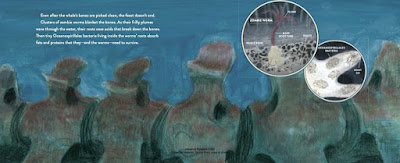
What I like love about this book: I love how Melissa shows that everything is connected. While zombie worms eat the bones, tiny lobsters dine on the zombie worms. I love how she carefully curates strings of alliterative words. Crabs “scarf up scraps,” others “sift through sediment,” and everyone is “hunting for tasty tidbits.” Rob Dunlavey’s artwork is detailed and brings even the most land-locked reader deep into the ocean. And there is Back Matter where readers can find out more about whale falls and the animals that feed on those whales.
To make sure she gets the facts, Melissa goes straight to the source. I wanted to know more
Me: Why is it so important to reach out to scientists when writing STEM books for kids?
Melissa: Interviewing experts can enrich any nonfiction book, and when a book is about cutting-edge science, like ocean exploration or dinosaur discoveries, it's the only way to be sure the information you're sharing is accurate and up to date.
For Whale Fall, reaching out to experts was critical because so little has been written about these amazing deep-sea ecosystems. And even the scientists who are devoting their careers to studying whale falls and the creatures that depend on them still have many questions. Interviewing researchers wasn't just the best way to get information--it was the only way.
In some cases, illustrator Rob Dunlavey's art shows creatures and behaviors that have never before been represented visually, so he also depended on feedback from our science consultants to get the details right. We really couldn't have created this book without their assistance.
Beyond the Books:
Find out something about one of the animals that helps turn a dead whale into recycled nutrients: sharks, rattails, hagfish, crabs, amphipods, lobsters, zombie worms.
Next time you come across bones or remains of an animal, think about how they fit into the food cycle. Do you see any insects eating the animal? Or signs of scavenging?
Melissa Stewart is a member of #STEAMTeam2023. You can find out more about her at her website,
Today we’re joining Perfect Picture Book Friday. It’s a wonderful gathering where bloggers share great picture books at
Susanna Leonard Hill's website.
Review copy provided by the publisher.


